Get Full Government Meeting Transcripts, Videos, & Alerts Forever!
Get email alerts on the Water Infrastructure topic
No spam. Unsubscribe anytime.
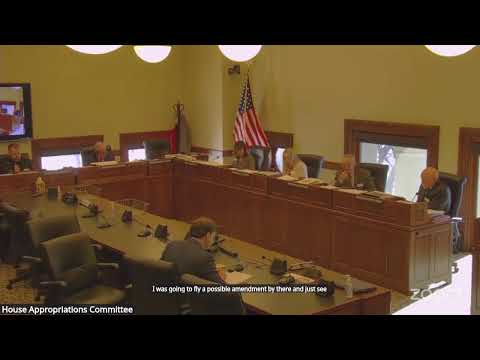
House panel approves $60 million LISRA appropriation for LaPral dam after amendments
Summary
The House Appropriations Committee on a voice and subsequent roll-call vote voted to advance House Bill 143, LaPral Dam Rebuilding, after adding amendments to specify how available water development reversions and language conflicts with an omnibus construction bill should be handled.
The House Appropriations Committee on a voice and subsequent roll-call vote voted to advance House Bill 143, LaPral Dam Rebuilding, after adding amendments to specify how available water development reversions and language conflicts with an omnibus construction bill should be handled.
Representative (bringer) presented the bill as an urgent funding measure to address a dam considered to be at risk of catastrophic failure and said the bill would appropriate $60,000,000 from the LISRA (the state’s Legislative Stabilization Reserve Account) into the Water Development account to cover the state share of the project. The bill sponsor said $30,000,000 had been previously appropriated and that total state need is roughly $90,000,000.
The committee heard technical clarifications from Jason Meade, director of the Water Development Office, who explained the state maintains multiple water development accounts. He said Water Development Account 3 is for large new reservoirs (2,000 acre-feet or larger or enlargements of 1,000 acre-feet or more) while Account 2 is typically used for rehabilitation work like LaPral. Meade said the construction bill under consideration would move money and revert $50,000,000 from the Alkali Creek reservoir project into Account 2 to cover part of LaPral funding; that language would, in practice, draw available account balances before using LISRA funds. Meade estimated demolition of the existing dam would begin near the end of the month, that NEPA permitting could be completed by summer, early site work might begin sooner, and full construction likely would not start until mid‑2026 with completion anticipated in 2029.
Committee members asked about timeline, downstream flood and debris risk, the number of irrigators affected, and mitigation for bridges and infrastructure. Meade said the existing outlet capacity is limited and that cracking near abutments makes relying on the existing structure as a temporary pass‑through unsafe; using it as a coffer dam was the original plan, but inspections showed active failure. Meade estimated the service area includes roughly 12,000 acres and “about 100 irrigators,” but he said that precise counts and plans for affected users should be addressed by the local irrigation district.
Holly Kennedy of the Wyoming Association of Conservation Districts testified in favor, saying local water rights holders have been deprived of full water use since 2019 and that restoring the dam is important for the local economy and public safety. Public comment closed and the committee considered two floor amendments: one to state that the omnibus construction bill should control (a Harrelson amendment) and a Pendergraft amendment directing that any reversions from Water Development Account 2 be spent on this project first and that any funds in excess of the $60,000,000 appropriation revert to LISRA by a specified date (July 1). Both amendments passed on voice votes.
The committee then took a roll-call on the final motion that House Bill 143 do pass with amendments. The clerk read a list of aye votes; the tally reported in committee was 7 ayes, 0 noes. Representative Smith’s vote was recorded as aye via proxy. The bill will be managed on the floor by the sponsor.
Votes at a glance: House Bill 143 — do pass with amendments; tally reported 7–0.
Background: Committee members and the Water Development Office framed the work as emergency rehabilitation of an existing dam identified in statute; the construction plan calls for roller‑compacted concrete and substantial aggregate stockpiles. Meade said Alkali Creek funding was being reprogrammed in the construction bill to prioritize LaPral and that Alkali Creek would need reauthorization later if land acquisitions and easements are secured.
Next steps: The bill will move to the full House. The committee’s amendments instruct staff to prioritize available Water Development Account 2 reversions for LaPral and to revert excess LISRA funds by a stated date if not used.