Get Full Government Meeting Transcripts, Videos, & Alerts Forever!
Get email alerts on the Land Use Rezoning topic
No spam. Unsubscribe anytime.
Edgecombe County commissioners fail to rezone 179-acre Macclesfield parcel after extensive public comment
Summary
On Jan. 6 the Board of Commissioners voted 3-3 and did not approve a request to rezone a 179-acre parcel on NC 111 South from AR30 rural residential to R20 mixed residential. The hearing drew dozens of residents who raised concerns about traffic, stormwater, sewer capacity and emergency services; the planning board had recommended denial.
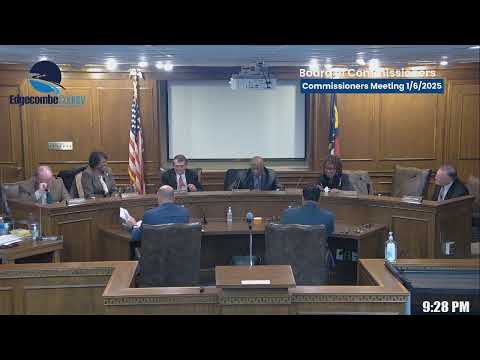
TARBORO, N.C. — The Edgecombe County Board of Commissioners on Monday declined to approve a request to rezone a roughly 179-acre parcel on NC 111 South in the Macclesfield area, after a lengthy public hearing and a split 3–3 vote.
The application, submitted by CT Williams Corporation for property identified in county records as parcel 3783-67-3068-00 and described in the public notice as owned by Sandra Hamm, sought to change the site from AR30 (rural residential) to R20 (mixed residential). The hearing was held Jan. 6 in the Jonathan Feudt Commissioners Room at the County Administrative Building in Tarboro.
The rezoning would have allowed smaller lots and a denser single-family subdivision than the existing AR30 rules permit. Planning Director Durbin Spehl told commissioners the planning board had “voted unanimously to forward the rezoning request to the board of county commissioners with an unfavorable recommendation,” saying the change was inconsistent with the county’s 2014–2034 comprehensive plan and the county’s growth-management policy for rural areas.
Developer Cecil Williams Jr., identifying himself as an owner with CT Williams Corporation, described the type of neighborhood he said he would build. “My name is Cecil Williams, junior owner, with Long Time Life, CT Williams Corporation,” he said during his presentation. He showed photos of previous subdivisions and said the proposal would include interior, stick-built single-family homes on lots he described as about 20,000 square feet with landscaping, silt fences and other erosion-control measures.
Dozens of residents spoke during the public comment portion, raising similar concerns. Richard Woodlark, whose property is near the site, asked commissioners to reject the rezoning: “I would appreciate your vote of no for the proposal to r 20,” he said. Several speakers said they had bought property specifically for rural character and cited volunteer fire capacity, school impacts, traffic on narrow rural roads and insufficient law enforcement staffing.
Other speakers focused on environmental and stormwater risks. Farmer and property owner Brad Hill presented engineering-style estimates for runoff increases and said the southeastern border of the site lies in a FEMA high-risk flood zone; he urged commissioners to reject the request and to learn from neighboring counties’ recent policy changes. “In conclusion, I would just urge you to listen to the voices of these Edgecumbe County residents, and reject this rezoning of request,” he said.
Officials and staff answered technical and process questions. County Manager Evans and planning staff said that: water service is available in the area but sewer service is not; the developer would need state permits (including Division of Water Quality and Army Corps approvals where required) and county signoffs before any construction or earth-moving could occur; septic systems would be required where sewer is unavailable and each lot must obtain health department permits; roads would be designed to NCDOT standards and could be offered to the county or state for adoption once they meet applicable standards; and a construction plan and agency signoffs are required before grading.
Speakers stressed limits of county authority and the post-hearing process. Planning staff clarified that an unfavorable vote on the rezoning does not prevent the current owner from developing under AR30 rules; under AR30 the owner could still pursue a conservation subdivision that typically requires larger minimum lot sizes and at least 40% open space. Staff also noted the alternative of a conditional rezoning application, which would include a site-specific plan and conditions for the board to consider.
After members debated, a motion to deny the rezoning was made and seconded; the vote was a 3–3 split. County Attorney Peters said for the record, “It’s my opinion, mister chairman. Without a majority to approve the rezoning, then the rezoning is not approved and therefore it is denied.” With that clarification the board recorded that the rezoning request was not approved.
The hearing record shows strong local opposition and significant technical questions that residents asked the developer to answer. Commissioners and staff said applicants may reapply under the county’s ordinance procedures; planning staff said they would check the ordinance for any required waiting period and can advise the applicant on whether a conditional rezoning submission would be a faster path to address many site‑specific concerns.
The board did not take any other immediate action on the parcel; no conditions were adopted and the zoning remains AR30.
Ending — Next steps: Planning staff will advise the applicant on reapplication options and the county’s timeline and permitting requirements. Commissioners and staff also reiterated that more detailed site plans and state and county permits would be required for any future development under either zoning scenario.