Get Full Government Meeting Transcripts, Videos, & Alerts Forever!
Get email alerts on the Utility Rate Reform topic
No spam. Unsubscribe anytime.
Witnesses tell Ohio House panel HB 142 would give gas utilities broader powers, reduce consumer protections
Summary
Opponents told the House Energy Committee that House Bill 142 would expand forecasted test years, riders and utility leverage over settlements, shorten PUCO review windows and limit refunds — shifting financial risk to consumers.
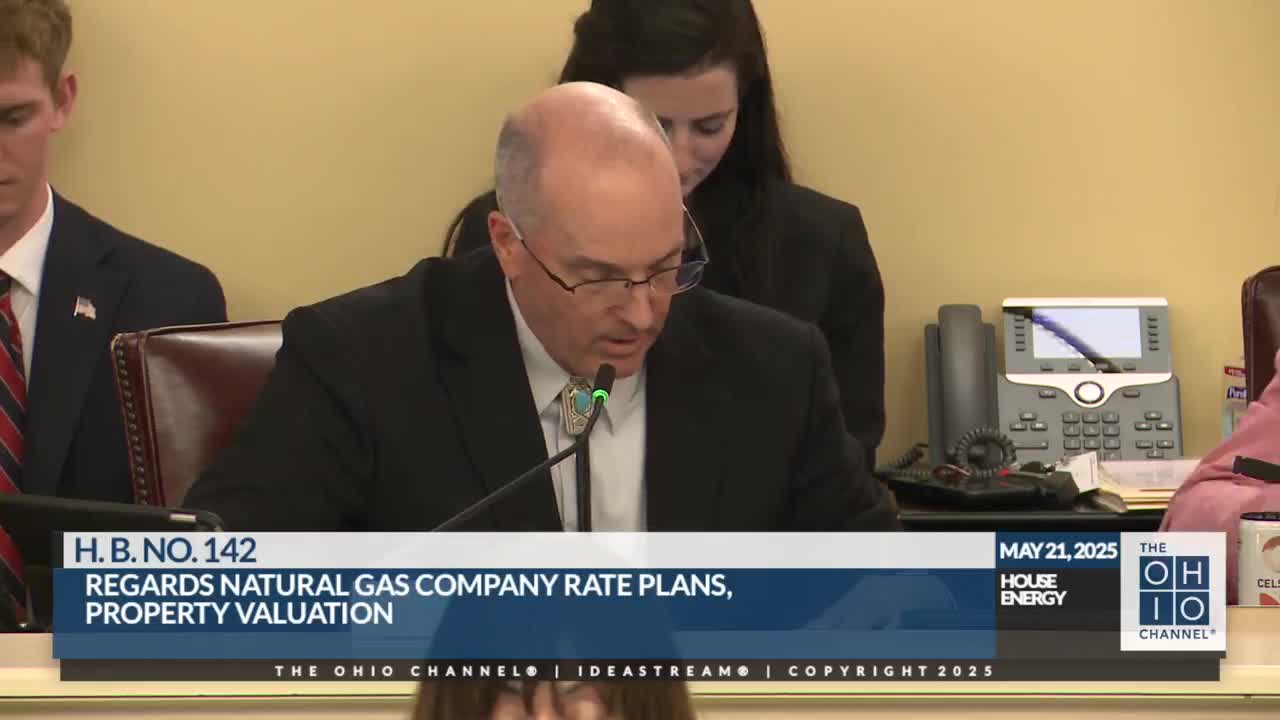
Opponents of House Bill 142 told the Ohio House Energy Committee on Wednesday that the bill would expand utilities' ability to collect projected costs from customers, weaken oversight at the Public Utilities Commission of Ohio and leave residential consumers exposed to higher bills.
Karen Nordstrom, clean energy attorney for the Ohio Environmental Council Action Fund, told the committee she opposes the bill’s Section 4 (903.3) “which codifies a 3 pronged test for stipulations or settlements at the Public Utilities Commission of Ohio.” She said that codifying the test would “functionally operate[] to rubber stamp settlements between utilities, intervening parties and commission staff.”
The Ohio Manufacturers Association and the Ohio Consumers’ Counsel also opposed the measure. Kim Boyko, partner at Carpenter Lipps representing the Ohio Manufacturers Association’s Energy Council, said the bill would allow gas utilities to use projected test periods, “lock in a potentially outdated or overly generous rate of return,” put projected rates into effect immediately on a PUCO order and require the Commission to approve many commercial agreements while ignoring revenues from those agreements when setting rates.
Maureen Willis, director of the Ohio Consumers’ Counsel, testified that HB 142 “hands gas utilities everything but the kitchen sink” and warned that it goes “far beyond what was provided for electric utilities in HB 15.” She said the bill would revive and enlarge riders and alternative rate-plan tools that electric-sector reforms in HB 15 removed, and that the bill’s true-up process is “fundamentally flawed.”
Why it matters: witnesses said the bill would transfer financial risk from utilities to customers by allowing collection of projected capital and other costs before they are incurred, shortening the Commission’s review windows (creating automatic approvals if PUCO misses deadlines), and removing or narrowing refunds and appeals. That combination, they said, would incentivize higher initial utility rate requests and make it harder for interveners and the Commission to protect ratepayers.
Details witnesses highlighted included: - Forecasted test periods: Boyko and Willis said HB 142 would expand forecasted test periods for gas utilities, allowing multi‑year projected test periods and multiple “date certain” windows for charging customers for future investments. Willis said gas utilities already can propose test periods beyond an application filing date and that HB 142 would extend them further. - Riders and alternative rate plans: Willis and Boyko warned the bill restores or expands riders and single-issue rate making for gas utilities. Willis said Columbia Gas had collected roughly $1,800,000,000 from customers through riders and that such collections have been used extensively instead of standard rate cases. - No refunds/no rehearing: Both witnesses said HB 142 limits refunds if rates are later found unjust, shortens or eliminates rehearing and appeal rights for many alternative rate plans, and creates “shot clocks” that can result in deemed approvals if PUCO does not act within specified days. - Settlement and veto power: Nordstrom and Boyko warned that the bill’s language would condition the Commission’s consideration of a settlement on utility support, effectively giving utilities veto power over settlements supported by customer or intervening parties. - True-up concerns: Willis said the bill’s true-up would be truncated and incomplete — for example, limited to plant and capital structure with no expense or profit true-up, and subject to a 60‑day window she described as insufficient to examine prudence. - Cost shifting and large‑load arrangements: Willis said provisions for “large load” commercial arrangements (customers above a certain annual volume) risk shifting ongoing or stranded costs to residential and small commercial customers because the bill excludes revenues from large customers in rate proceedings.
What witnesses recommended: OEC urged removal of the codified three‑prong stipulation standard and recommended treating settlements under the same standard applied to fully litigated cases. OMA asked that any changes mirror the balanced provisions of HB 15 (electric utility reform) rather than creating different rules for gas. OCC urged the committee to adopt stronger consumer protections, restore refund and rehearing rights, and implement a complete true-up and periodic rate-case requirement similar to HB 15.
Committee response and next steps: committee members asked witnesses for specifics and whether parts of HB 142 could be salvaged by making it more parallel to HB 15. Witnesses said they were open to working with members on amendments but continued to oppose the bill as written. The third hearing on HB 142 concluded with no formal action recorded in the transcript.
Ending: The committee heard only opponent and interested-party testimony at this session; the panel did not vote on the bill during the hearing.