Get Full Government Meeting Transcripts, Videos, & Alerts Forever!
Get email alerts on the College Admissions Assessment Clt topic
No spam. Unsubscribe anytime.
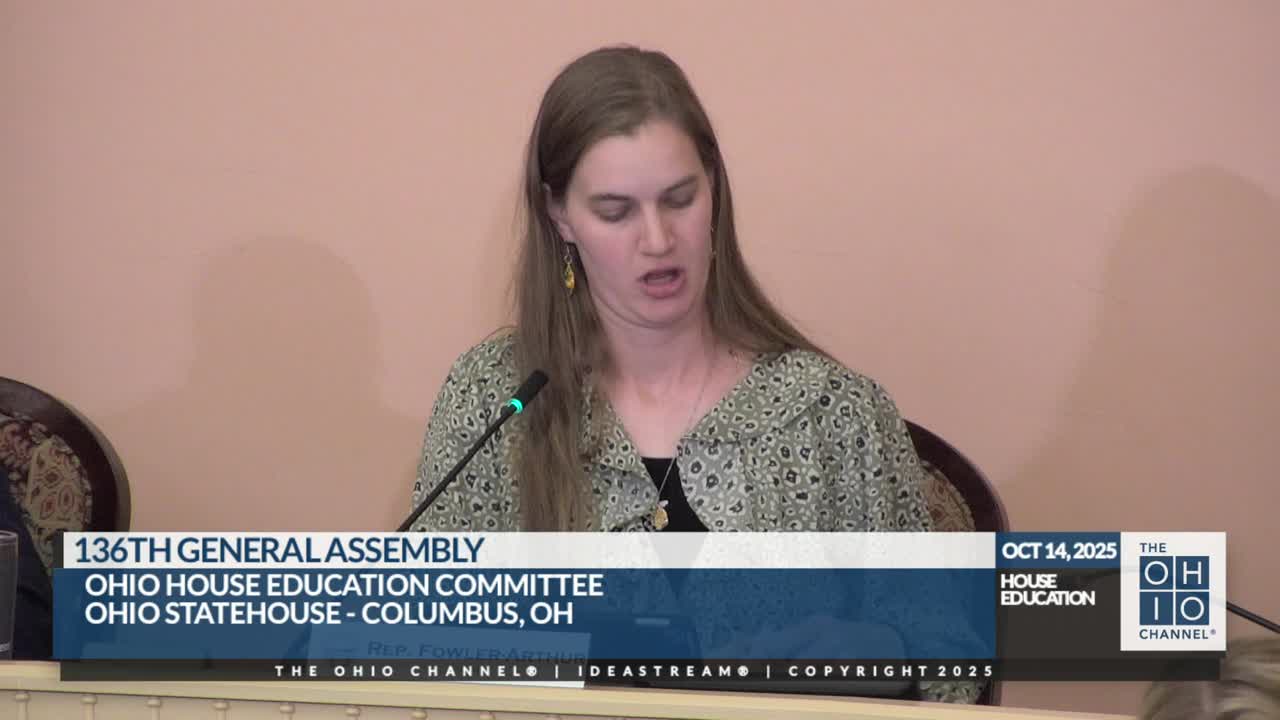
Committee hears testimony on allowing Classic Learning Test as option for Ohio students
Summary
The House Education Committee held a second hearing on House Bill 326, which would expand assessment choice by explicitly allowing the Classic Learning Test (CLT) as an alternative college-entrance exam and enabling districts to offer it as an in‑school assessment option.
The House Education Committee held a second hearing on House Bill 326, which would expand assessment choice by explicitly allowing the Classic Learning Test (CLT) as an alternative college-entrance exam and enabling districts to offer it as an in‑school assessment option.
Michael Torres, policy director at Classic Learning Initiatives, said CLT products include college-entrance exams and grade‑span assessments and described rapid growth in the company’s acceptance among colleges and in testing volume. Torres outlined the company’s remote-proctoring and security measures—recording screen, audio and video, requiring room scans, an honor code, and a lockdown browser used by many universities—and said machine-learning analysis reviews response patterns to flag irregularities. He described regular test-form rotation and said the company produces new test forms monthly with items not reused for at least a year.
Nut graf: Proponents asked the committee to allow assessment choice by accommodating the CLT for admissions and local district testing options; they provided technical materials, discussed test security, and requested that the Department of Education set cut scores and concordance methods if the CLT is used in state contexts.
Committee members asked how CLT acceptance would affect students who want to apply out-of-state to colleges that traditionally accept only the SAT or ACT and whether fee waivers would present barriers. Torres said districts are not required to adopt CLT; families could continue to use other tests, and fee-waiver programs already exist for the SAT and ACT; he said CLT offers reduced direct-to-consumer pricing and typically lower contracted per-student prices when districts contract with CLT.
Members asked about alignment with Ohio standards and whether Ohio students would be prepared to take CLT. Torres said the CLT is a standardized exam of reading, writing and math—not a direct test of any single curriculum—and explained concordance studies the company has produced to align CLT scores with SAT/ACT benchmarks. He said states that used CLT for graduation or remediation purposes relied on concordance and local validation studies to set cut scores.
Legislators requested technical reports and predictive- and concordance-study materials from CLT. Torres said the company posts technical reports and the concordance study on its website and noted an academic predictive-validity study from Grove City College would be published shortly.
No formal committee vote occurred at the hearing. The committee asked for additional documentation on test security, cost, concordance methodology, and predictive validity to evaluate how CLT would be implemented for state or district purposes.
Ending: The committee concluded the second hearing; sponsors and witnesses agreed to provide technical materials and requested additional follow-up on implementation details, cut-score setting and data-sharing arrangements with the Ohio Department of Education.