Get Full Government Meeting Transcripts, Videos, & Alerts Forever!
Get email alerts on the Parking topic
No spam. Unsubscribe anytime.
Poulsbo council approves downtown paid-parking plan after months of debate
Summary
After hours of public comment and council debate, the Poulsbo City Council on Feb. 19 approved Resolution 2025-03 to move forward with a paid-parking program on city-owned downtown spaces, a step city staff says is needed to create funding for future parking capacity.
The Poulsbo City Council voted Feb. 19 to approve Resolution 2025-03, directing staff to pursue implementation of paid parking at selected city-owned downtown spaces with the stated goal of launching the program in summer 2025.
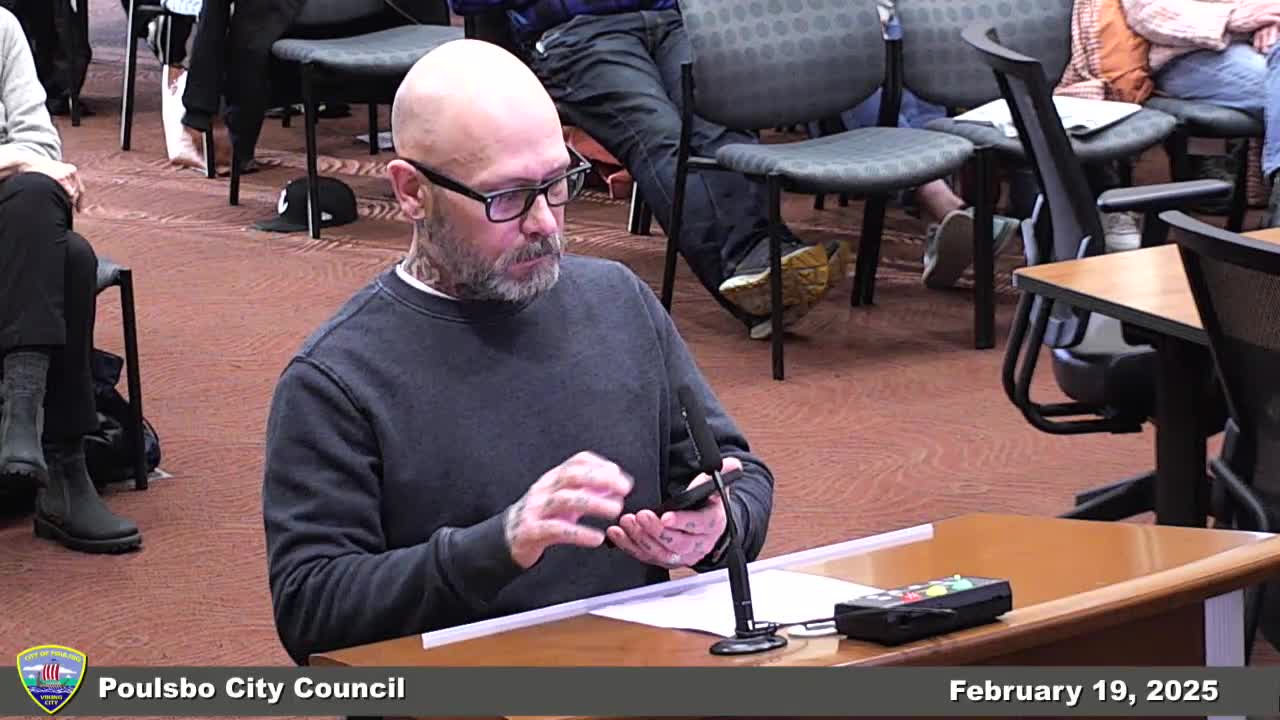
The action follows more than two hours of public comment from downtown business owners, employees and residents and extended council discussion about enforcement, employee parking and how revenue would be used. City planning staff and a hired consultant recommended a hybrid approach that keeps a majority of spaces free while placing meters on a portion of on-street and public-lot spaces.
Supporters of the resolution, including several council members, said paid parking is the most reliable local funding source to expand parking capacity and encourage turnover in core front-row spaces. City planner Heather Wright summarized consultant estimates that the proposed program could generate about $1,000,000 a year in gross revenue from paid spaces, with roughly $500,000 annually available to invest in additional parking capacity after operating costs. Wright said the consultant analysis applied to city-owned spaces only and that the proposed paid-parking footprint would cover about 40 percent of city-owned downtown spaces.
Opponents from the business community urged the council to delay or abandon the plan. Mike Perry, a downtown business owner and member of the Historic Downtown Poulsbo Association, told the council: "Residents and business owners have voiced overwhelming concern that this change would negatively impact accessibility, local businesses, and the overall appeal of our downtown area." Other speakers said paid parking would disproportionately hurt nonprofits, hourly employees and seniors on fixed incomes.
Council members debated three timing options presented by staff: (1) implement signage, designated employee parking, enforcement and paid parking in 2025 (the option reflected in the adopted resolution); (2) delay paid parking until 2026 while doing other preparatory work in 2025; or (3) a phased approach with enforcement and employee parking in 2025 and paid parking in 2026. Supporters argued a 2025 start preserves momentum and creates revenue to fund future projects; opponents said the city should try enforcement and signage first and give merchants more outreach time.
Councilmember Doug Newell argued for moving forward, saying opponents had two years to participate and warning that a delay could mean the work never advances: "If we do not vote tonight on option 1, I am convinced that this will never happen," he said.
The adopted plan includes allotting a parcel of city-owned spaces to employee parking (staff noted an initial proposal of roughly 42 employee spaces at the Lower King Olaf lot) and maintaining free parking in parts of downtown (including portions of Third Avenue and some side streets). Staff said specifics such as hourly rates, enforcement technology and a final map will be developed as part of implementation; those details will return to council before full launch.
How the city will enforce new time limits and paid parking was a central concern. Several speakers said enforcement of existing time limits has been inconsistent; city staff said enforcement will be part of the implementation package and that the city would aim to avoid dedicating sworn officers solely to parking enforcement. Council members and staff also discussed potential mitigations such as a local “locals day,” a grace period, expanded handicap stalls, parking signage and employee-permit programs.
The council approved Resolution 2025-03 after roll-call voting recorded a majority in favor. The vote followed more than two hours of public comment and additional council discussion; staff said the next formal implementation steps will include public-facing outreach materials, a final schedule for signage and enforcement, and work on an employee-parking plan. The council scheduled continued review and public discussion on March 5, 2025.
Why it matters: Poulsbo’s downtown merchants and residents have long said parking constraints limit visits and sales. City staff and consultants say paid parking can create a dedicated funding stream to add capacity or lease spaces offshore and to encourage turnover in high-demand spaces; business owners worry about lost customers and added costs for employees. The council majority voted to proceed with the plan in order to begin generating revenue quickly and to retain the option of reversing course if the program proves problematic.