Get Full Government Meeting Transcripts, Videos, & Alerts Forever!
Get email alerts on the River Revitalization topic
No spam. Unsubscribe anytime.
Truckee forms River Revitalization Steering Committee to guide East and West River Street work
Summary
Town of Truckee staff and volunteers are moving a multi-year "River Revitalization Steering Committee" (R2SC) from planning toward draft actions, combining river health, access and economic-catalyst work for East and West River Street.
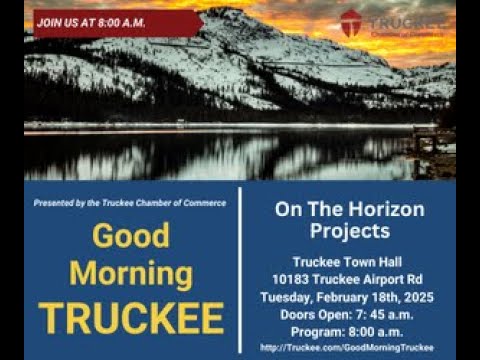
Carissa Binkley, economic development program analyst for the Town of Truckee, outlined the River Revitalization Steering Committee (R2SC) and its work at the Good Morning Truckee meeting on Feb. 18. The committee, formed after the Truckee 2040 General Plan adoption, is meeting monthly and has produced outreach, technical review and a set of catalyst project proposals aimed at revitalizing East and West River Street while protecting river health.
R2SC was created to move goals from prior planning documents — including a Downtown River Revitalization Strategy (2005) and recent general-plan work — into actionable projects. Binkley said the committee’s outreach included “coffee chats, taco talks, Truckee Day, Truckee Thursdays, online surveys” and regular public meetings filmed and posted online. The committee has established two action teams (river health and access; community economic vitality), two subcommittees (communications, receiver sites), and hired consultant design teams to translate ideas into concepts and potential projects.
Why it matters: East and West River Street run through Truckee’s downtown core. Committee work aims to improve public access, stabilize riverbanks, restore riparian habitat, and pursue targeted economic projects without mandating change on private property.
Key findings and next steps - River health and access: Volunteers and technical presenters (Balance Hydrologix, Town stormwater staff and Whitewater Park representatives) produced a memo and map identifying enhancement opportunities (floodplain reconnection, bioengineered bank stabilization, vegetation management, stormwater improvements and managed access to reduce habitat damage). Binkley said the group recommends prioritizing both river health and managed access rather than unlimited access. - Community economic vitality: BAE Urban Economics conducted a survey of East and West River Street property owners and businesses. The study found a mix of interest: some property owners want revitalization; others prefer to remain as-is. The action team therefore recommended a set of targeted “catalyst projects” to demonstrate possibilities rather than large, indiscriminate incentives. - Catalyst projects: The team solicited simple one-page applications and interviewed respondents. Binkley said nine applications were received. Examples cited: a two-building adaptive-reuse effort represented by investor Jan Holen at the west end of the corridor; a distillery/restaurant project near the new park (identified on meeting slides as adjacent to Dabayumuway Park) that is close to starting CEQA; and a Mark Tanner site where the owner expressed willingness to relocate operations away from the river. - Receiver sites: A subcommittee is identifying alternative in-town sites (e.g., land near Pioneer Center and properties along Yerger Drive) where businesses might relocate so riverfront parcels can be adaptively reused.
Binkley emphasized that the town is focusing assistance on owners who are interested in change. “We are not here to tell anyone what to do with their private property or their business,” she said. The committee will synthesize findings into a draft plan to return to R2SC and, potentially, to Town Council for actions or approvals.
Public process and participation R2SC meetings are public (Brown Act) and filmed for public viewing; the committee includes property owners, merchants, chamber representatives, public agencies, the contractors association, town council members and residents. Binkley said the committee added a resident seat and reserved a seat for the Washoe Tribe (the tribe is participating as capacity allows).
What remains unresolved No formal Town Council decisions on policy changes were recorded during the presentation; work remains at the plan and project-drafting stage. Binkley said the next steps are drafting a plan, continuing the catalyst projects with partnership agreements and returning with recommended actions for R2SC and, where appropriate, council consideration.
For more information, Binkley directed listeners to the project webpage (as shown in the presentation slides) and to R2SC public meetings.