Get Full Government Meeting Transcripts, Videos, & Alerts Forever!
Get email alerts on the Floodplain Electrical Meters topic
No spam. Unsubscribe anytime.
Taylor County delays decision on RV-park electrical meters; schedules FEMA/NFIP workshop in January
Summary
After months of post-storm debate, Taylor County commissioners agreed Dec. 17 to postpone a final ruling on whether electric meter boxes and panels at coastal RV parks can remain at ground level below base flood elevation and will host a workshop with FEMA and state mitigation in the second week of January to seek guidance.
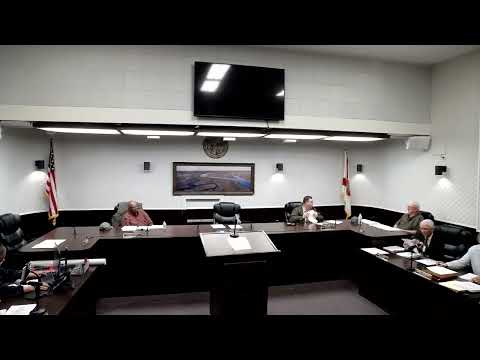
Taylor County commissioners on Dec. 17 heard hours of public comment and staff testimony about whether electric meter boxes and breakers serving RV parks should be elevated above the base flood elevation after storm damage, then voted to wait for guidance and hold a workshop with FEMA and state mitigation officials in the second week of January.
The discussion centered on a request from Jenny L. Contreras, who said she represents Old Pavilion / Ulta Billion RV Park and other Perry-area RV parks and asked the board to allow meter panels “to stay where they are at ground level.” Building official Bobby Johnson and county staff countered that the county must follow the Florida Building Code and related floodplain requirements, and that not following those codes could affect Taylor County’s standing in the National Flood Insurance Program (NFIP) and its community-rating discounts.
The issue matters because electrical equipment and meters are specifically addressed in the Florida Building Code and in floodplain guidance (including ASCE 24-14), and changes or variances can be reviewed during NFIP audits. County attorney Conrad read the county’s variance-and-appeals rules and related ordinance language and noted that variances are allowed only under narrow conditions (unique site characteristics or exceptional hardship) and must not increase flood hazards or public expense. County staff described prior decisions: in June the board had allowed two RV hookups on a 100-amp service in a limited case, and that decision influenced many speakers’ expectations for broader relief.
Speakers at the meeting described business and personal hardship from recent storms. Jared Hunt, an RV-park owner, said his meter boxes “are still standing” and that parts of his campground have power; other park owners said replacing elevated infrastructure would be costly and would slow reopening. Jenny Contreras emphasized that many RV spaces are temporary and cleared in storms and said “anytime there’s any type of event, all these RVs are empty anyway.” County staff and commissioners repeatedly noted two competing concerns: how to help small coastal businesses recover and how to avoid actions that could jeopardize countywide NFIP status or future insurance discounts.
Office of Insurance Regulation staff member Luca Francescaio called in and offered to share a Florida State University–commissioned study on FEMA/CRS (Community Rating System) issues, which county staff said they would distribute to participants ahead of the workshop.
After extended discussion, Commissioner Moody moved — and a second was offered — to delay making a policy decision until after a workshop with FEMA and state mitigation; the motion carried by voice vote. County staff said the workshop is planned for the second week of January and that officials will notify affected business owners and the public when the date is confirmed.
The board and staff urged owners who want exceptions to consider applying for formal variances under the county code (which requires written application, findings of exceptional hardship when appropriate, and recording any granted variance), and several speakers promised to return with cost estimates for alternatives (centralized elevated service, 100-amp ground hookups, or other designs).
The commissioners did not adopt a blanket variance at the Dec. 17 meeting. Instead, they directed staff to convene the January workshop with FEMA and state mitigation representatives to clarify how the Florida Building Code, ASCE 24 guidance and NFIP/CRS rules apply to standalone electrical meters and utility poles serving RV parks.
Ending: County staff said they will text meeting details and materials to park owners and circulation lists once the workshop is scheduled. The board encouraged owners to gather cost estimates and technical plans before the next meeting so site-specific variance applications or staff recommendations can be considered promptly.