Get Full Government Meeting Transcripts, Videos, & Alerts Forever!
Get email alerts on the Transmission Lines topic
No spam. Unsubscribe anytime.
Xcel Energy pitches modified-blue route for Minnesota Energy Connection; PUC decision expected in April
Summary
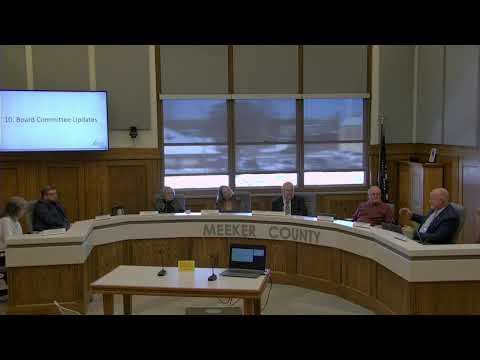
Randy Fordyce, Xcel Energy project manager, and Matt Langan, Xcel Energy project lead, told the Meeker County Board of Commissioners on Feb. 18 that Xcel supports a “modified blue” route for its proposed Minnesota Energy Connection transmission line and that the Administrative Law Judge and Department of Commerce analyses favor the blue-route approach; the Minnesota Public Utilities Commission is expected to decide on the route and the certificate of need in April.
Randy Fordyce, Xcel Energy project manager, and Matt Langan, Xcel Energy project lead, told the Meeker County Board of Commissioners on Feb. 18 that Xcel supports a “modified blue” route for its proposed Minnesota Energy Connection transmission line and that state reviewers have reached similar conclusions. The Administrative Law Judge issued a report on Feb. 5 recommending the modified blue route, and the Minnesota Public Utilities Commission (PUC) is expected to decide on the certificate of need and the route at its meeting in April.
The project would run between the Garvin Substation in southwest Minnesota and the Sherco interconnection near Becker in Sherburne County, a distance Xcel describes as roughly 175–180 miles. Fordyce said the line is intended to replace retiring coal-fired Sherco generation with renewable energy delivered through an upgraded transmission connection serving the Upper Midwest.
Xcel said it proposed two full-route options in its permit application (the blue and purple routes), and public comments produced additional segment alternatives (shown on Xcel maps as pink segments). After analyzing public input and environmental reviews prepared by the Minnesota Department of Commerce, Xcel supported a “modified blue” route that incorporates several public-proposed segments. Langan said the Department of Commerce’s environmental impact statement generally prefers the blue route and the ALJ recommended the modified blue as least impactful.
Fordyce said the PUC decision is expected in April, after which Xcel would begin landowner outreach for easement acquisition. He emphasized that Xcel is not yet seeking easements; current contact with landowners is to request voluntary access for environmental surveys needed for downstream federal permits (including U.S. Army Corps of Engineers reviews). He said easement negotiations and engineering work would continue in 2025, with construction planned for 2026–2028 if permits and approvals are obtained.
On technical and siting details, company staff provided the following specifics during the meeting and Q&A: the project’s typical right-of-way would be 150 feet (75 feet each side of the centerline); typical structure height is about 140 feet above grade, subject to local topography and other constraints; typical tower foundations could range from about 20 feet to as much as 60 feet deep depending on soil and structure type; the visible above‑ground pole footprint (steel structure) would normally be 7–12 feet in diameter above grade; and the company builds 345-kV transmission structures to a minimum 60-year design life and expects many assets to remain in service far longer with maintenance and repowering.
Commissioners asked about farmland impacts, decommissioning and stray voltage concerns near dairies. Fordyce and Langan said easement agreements typically allow continued agricultural use within the right-of-way except at structure and foundation locations, and Xcel’s land-rights agents address repairs to drain tile and site restoration after construction. On decommissioning, Xcel said removal would follow PUC and state permitting and pollution-control requirements; the company noted much tower steel and other materials are recyclable. On dairy concerns, Xcel said stray-voltage effects are more often distribution‑system issues and that Xcel and local distributors offer pre- and post-testing and mitigation guidance.
Board members pressed for more local outreach and asked about a planned midpoint voltage-support substation identified on project materials as the “Sunflower Substation.” Langan said the Sunflower site would be a 40-acre parcel, with impervious surfaces and facility footprint up to about 30 acres in its largest build-out, and that the company has identified a substation setting area in its permit materials.
Fordyce said Xcel has received hundreds to thousands of individual comments and that the project docket on the PUC website also contains substantial public comment. He gave the county links to a project website, an interactive map of route options, and a toll-free number and email for more information and for landowner contact. He closed by reminding the board that the ultimate route selection is the PUC’s responsibility.
The presentation was informational; there was no formal county vote on the project at the Feb. 18 meeting.