Get Full Government Meeting Transcripts, Videos, & Alerts Forever!
Get email alerts on the Mosquito Control topic
No spam. Unsubscribe anytime.
Council asks for clearer standards, tables mosquito control plan until February
Summary
After months of higher West Nile-positive samples countywide, the city’s environmental specialist proposed flexible revisions to Bedford’s mosquito management plan. Council members said the draft lacked minimum standards for traps, surveillance frequency and public notice; they unanimously tabled the item for revisions to return by Feb. 1.
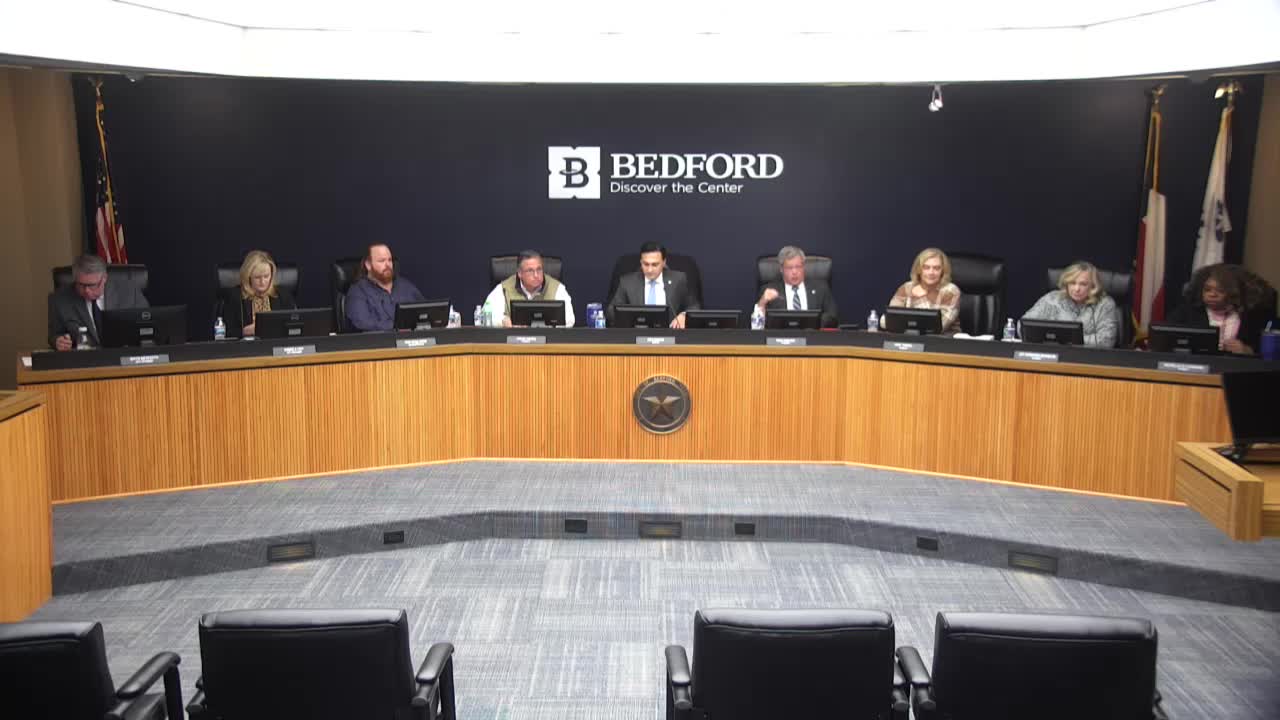
The Bedford City Council on Jan. 14 reviewed proposed revisions to the city’s integrated mosquito management program and voted to table the plan so staff can add clearer thresholds, minimum trap standards and specified public‑notice procedures.
Environmental Specialist Tyler Spence told council the 2024 mosquito season produced Bedford’s highest number of positive trap samples in seven years, and the city needs more flexible language to adjust to year‑to‑year changes in Tarrant County sampling budgets and trap capacity. “These tend to change year to year…being able to stay flexible is an important aspect,” Spence said.
Spence proposed changing the plan’s fixed trap locations to monitoring zones sized by a roughly 1‑mile radius and using a risk‑level system (low, medium, high) tied to surveillance, larvicide and adulticide measures. He also recommended delegating authority to escalate or de‑escalate risk levels to the city manager or the manager’s designee so the city could respond faster than waiting for a council meeting.
Council members raised multiple concerns about vagueness in the draft. “We’re not holding ourselves to any kind of standards,” Councilmember Sabol said, arguing the plan should specify a minimum trap count and define routine surveillance frequency. Several members asked that the plan explicitly state the city will larvicide publicly owned drainage channels and parks and that positive trap detections be communicated via the city website and social media.
Mayor Pro Tem Gagliardi and others proposed a minimum of one trap per monitoring zone and suggested five monitoring zones as a floor; Spence said the map presented anticipated five trap locations if the county allowed five samples. Councilmember Farco and others called for evidence‑based thresholds that clearly define when the city moves from low to medium or high risk.
After discussion, councilmember Gagliardi moved to table the item so staff can revise the plan with the clarifications requested; the motion passed unanimously. Council asked staff to return the revised plan for consideration at the city’s first February meeting (Feb. 11 was scheduled as a strategic planning session, and council asked for the mosquito item no later than the first February regular meeting). Spence said routine larvicide will begin in March to get ahead of the season.
Ending: Council delayed final action to allow staff to add minimum trap requirements, surveillance schedules and explicit public notice procedures, and to insert a clause tying minimum traps to what the county will accept. The revised plan is expected back for council consideration by February 1.