Get Full Government Meeting Transcripts, Videos, & Alerts Forever!
Get email alerts on the Family Law Reform topic
No spam. Unsubscribe anytime.
Extensive opposition at committee hearing warns Ohio family-law rewrite would expand judicial discretion and undermine parental rights
Summary
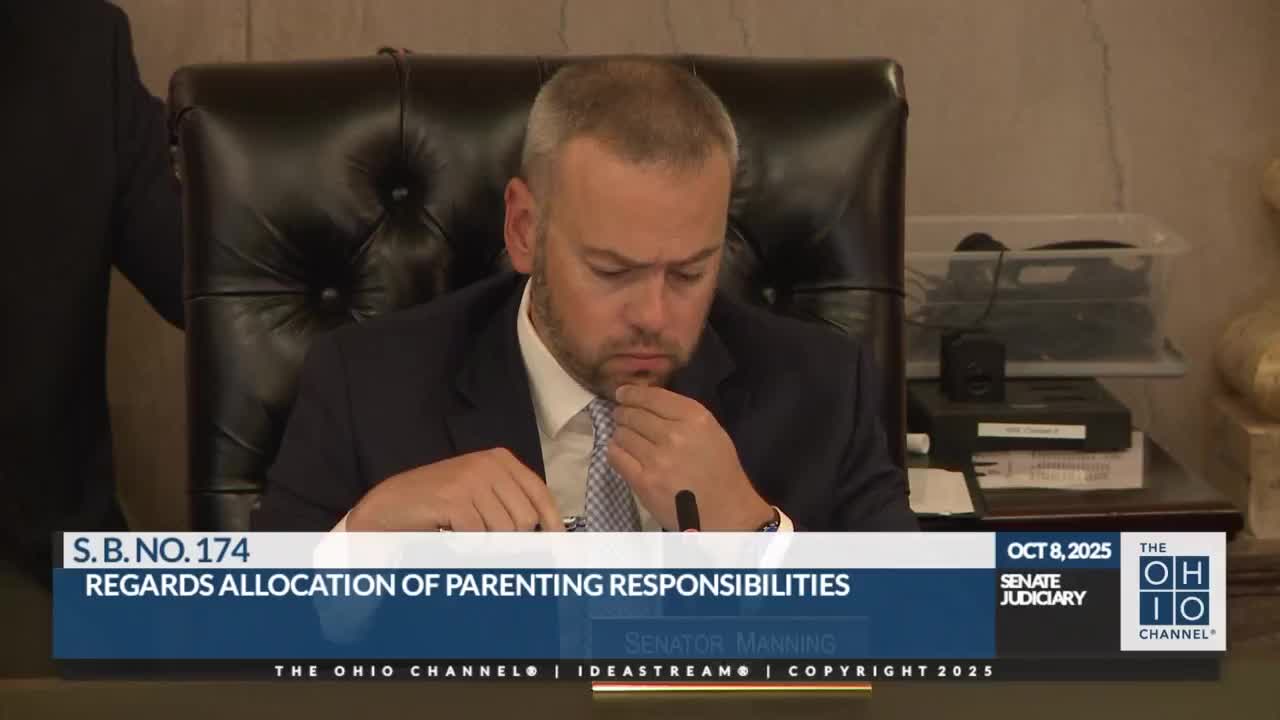
Senate Bill 174, a proposed revamp of Ohio family law, drew broad opposition at a third hearing from parents, advocates and experts who said the bill substitutes rhetoric for reform, expands judicial discretion, and could harm protective parents and children without accountability measures.
Senate Bill 174, a comprehensive rewrite of domestic-relations provisions, drew sustained opposition at its third Senate Judiciary Committee hearing from parents, advocates, legal scholars and community members who said the bill would expand judicial authority, remove references to parental rights and risk inconsistent outcomes across counties.
Opponents from multiple organizations and private citizens described the bill as a countermeasure to citizen-led equal-parenting reforms and said it lacks meaningful safeguards. Don Hubin, chair of the National Parents Organization board, told the committee that removing the phrase "parental rights" from more than 150 places in statute is not merely rhetorical and that parental rights have a long line of constitutional protection. "Parental rights are not about treating children as property," he said, and he urged the committee not to adopt language that would let courts substitute their own judgments for fit parents' jointly submitted plans without a finding of harm.
Other opponents echoed concerns about increased judicial discretion and inconsistent application across counties. Frank Glandorf, an analyst for the National Parents Organization's Ohio Parenting Time Report, pointed to improvements in local parenting-time rules since 2018 but said the bill does not guarantee shared parenting; he warned that outcomes still depend heavily on local magistrates’ views. Elizabeth McNees, Ohio chair for the National Parents Organization, said the bill "sidesteps important findings and recommendations from past task forces and prioritizes judicial discretion over parental rights."
Several witnesses focused on the risk to survivors of domestic violence and lack of accountability: Nicole Amill, a survivor and CASA-trained volunteer, testified that SB 174 would expand judicial discretion without mandatory trauma-informed training, independent oversight, or recusal standards for conflicts of interest, and warned that protective parents can be labeled uncooperative or accused of parental alienation when reporting abuse.
Other opponents included a court observer and parental-rights advocates who described a pattern of local court scheduling that limits overnights and practical parenting time for one parent (often the nonresidential parent). Some witnesses urged an explicit presumption of equal shared parenting, citing other states’ experiences and arguing it reduces litigation and conflict.
Proponents' statements were presented in committee materials and by sponsors in prior remarks (sponsors and some supporters argue the bill encourages parental cooperation and updates terminology); however, the hearing record for this session contained wide-ranging opponent testimony and written submissions opposing the bill. Committee members repeatedly asked witnesses about local practice, juvenile and guardian-ad-litem processes, and the bill’s interplay with constitutional parental-rights jurisprudence.
Why it matters: SB 174 would rewrite how courts label and allocate parenting responsibilities and would change statutory language and standards that govern parenting plans, custody decisions and court review. Opponents told the committee the bill risks entrenching judicial preferences and the current county-by-county variability rather than producing uniform reform.
The hearing was recorded as the third hearing on SB 174 and numerous written opponent submissions were noted by the clerk.