Get Full Government Meeting Transcripts, Videos, & Alerts Forever!
Get email alerts on the Code Compliance topic
No spam. Unsubscribe anytime.
Miami code compliance board hears dozens of property cases; fines, mitigations set
Summary
The City of Miami Code Compliance Board heard more than two dozen cases involving unsafe structures, unpermitted work, vacant lots and illegal dumping. The board issued findings of guilt in multiple cases, set deadlines to cure violations and approved mitigated fines in several large-liability matters.
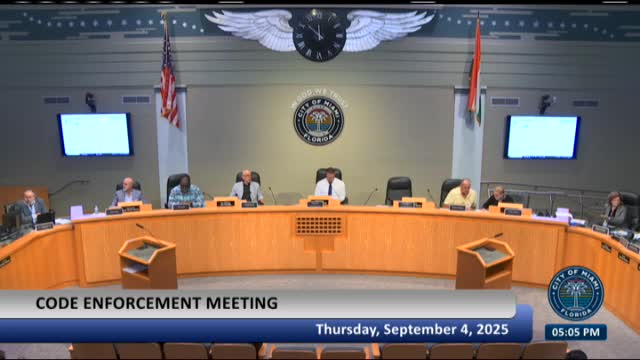
The City of Miami Code Compliance Board met in a public hearing to hear more than two dozen cases ranging from vacant-lot violations and illegal dumping to unpermitted construction and missing business registrations. The board issued numerous findings of guilt, set cure deadlines and approved mitigations in several high-liability cases.
The board opened by telling people with “to be heard” or mitigation cases how the process works and noted that orders of the board may be appealed to the Eleventh Judicial Circuit Court of Florida within 30 days. The hearing included testimony from city inspectors and Miami Police Department personnel and presentations by property owners and their attorneys.
Why it matters: code enforcement decisions can create daily fines that run until property owners obtain permits or correct conditions, and mitigations can reduce liens that otherwise could reach into the tens or hundreds of thousands of dollars. Several cases involved properties close to schools or public rights-of-way, which city witnesses said created additional urgency.
The city’s case presentations emphasized safety and public-health risks. Sergeant Hiram Cabeza, City of Miami Police Department, testified about one vacant, unsecured duplex where “we have several squatters, homeless people coming in and out with shopping carts, leaving them on top of the sidewalk” and said the property’s condition was visible to nearby kindergarten children. City inspectors described broken windows, open doors, illegal electrical hookups and ongoing illegal dumping in multiple cases.
Board decisions followed the city’s evidence in many matters. The board found guilt and set short cure periods with per-diem fines in a string of cases where the city presented photographic evidence and certified mail/posting proofs. For other matters with larger statutory lien amounts, the board heard mitigation requests and approved reduced, fixed fines in several cases where owners or their counsel presented compliance documentation or proffers of active permit filings.
Votes at a glance (case number, address — outcome):
- Case 00133840, 2341 Southwest Ninth Street — Finding: guilty; immediate compliance; $1,000 per day; irreparable-harm fine set at $15,000 (motion seconded and approved).
- Case 00009586, 1498 Northwest 30 Sixth Street — Mitigated lien to $15,000 (motion approved).
- Case 00007735, 777 Northwest 20 First Terrace — Mitigated lien to $15,000 (motion approved).
- Case 00057262, 725 Northeast 60 Seventh Street — Vacant lot; mitigated to $7,500 (motion approved).
- Case 00026656, 190 Northwest 50 Ninth Street — Vacant lot; mitigated to $7,500 (motion approved).
- Case 00076893, 860 Southwest Fifth Street — Four-unit building; fine reduced to $2,200 (20% of lien amount) (motion approved).
- Case 00015198, 6510 Northwest Second Street — Single-family property; mitigation reduced lien to $1,000 (motion approved).
- Case 00060349, 1850 Northwest 20 Fourth Court — Single-family property; mitigation reduced to $800 (motion approved).
- Case 00109272, 1805 Northwest 47th Terrace — Pleaded guilty; 90 days to cure; per-diem fine applicable for non-homestead/property-used-for-business set by the board (motion passed 4–2).
- Case 00074499, 1159 Northwest 40 Eighth Street — Permit/plan issues; 120 days to cure; $150 per day after (owner resides on property) (motion approved).
- Case 00104403, 1418 Northwest 40 Fifth Street — Work without permit; 120 days to cure; $250 per day after (motion approved).
- Case 00126794, 1636 Southwest Ninth Street — Work without permits; 120 days; $250 per day after (motion approved).
- Case 00122615, 3496 Northwest Seventh Street — Sign/awning permits; 90 days to obtain permits; $250 per day after (motion approved).
- Case 00009503, 329 Northeast 58th Terrace — Vacant lot with large lien; mitigated to $7,500 (motion approved).
- Several cases were found guilty with short cure windows and standard per-diem fines after the city presented certified-mail/posting evidence and photographs (examples below): guilty findings with 3 days to comply and per-diem fines of $250 were entered for multiple addresses where unpermitted structural work, illegal unit conversions, or failure to register vacant/blighted structures were documented. Those properties include (but are not limited to) Avocado Avenue (page 6), 1724 Northwest 40 Second Street, 291742 Northwest 40 Second Street (garage conversion), 1253 Northwest 50 First Terrace (subfloor work), 2669 Northwest Second Avenue (CU/BTR deficiency), 6701 Northwest Second Avenue (CU/BTR deficiency), 7638 North Miami Avenue (CU/BTR deficiency), and 3311 Southwest 17th Street (work without permit). In one solid-waste case involving a commercial container near a school, the city requested a $500-per-day fine if the screening was not installed; the board admitted the evidence and entered a finding of guilt.
What owners were told about timing and extensions: board members repeatedly told owners that extension-of-time requests are available and can be filed online at MiamiGov.com before a cure period expires; that filing an extension stops the accrual of per-diem fines while the extension is pending; and that failure to request extensions was a factor in some large liens escalating. The board clerk explained appeal rights to the Eleventh Judicial Circuit Court of Florida.
Procedural notes: the city routinely admitted composite exhibits (photographs, affidavits of posting and mailing, property-appraiser records, and permit applications) into evidence; the board relied on those brochures of record when voting. Presenters included City of Miami inspectors and, in several cases, Miami Police Department sergeants who described safety or public-order concerns.
Several mitigation decisions hinged on evidence the owners submitted showing active permit applications, recertification steps, or immediate compliance following notice. Where owners documented prompt corrective steps or proffered active permit filings, the board often approved reduced fines to the matrix minimums (for example, vacant-lot minimums of $7,500 in multiple cases).
A few cases drew explicit safety concerns: Sergeant Hiram Cabeza described one vacant, unsecured duplex as attracting “squatters, homeless people coming in and out with shopping carts” and said neighbors and a nearby kindergarten were directly affected.
Next steps: owners who received orders were told to await written orders from the board and to file appeals within 30 days to the Eleventh Judicial Circuit Court of Florida if they wished to challenge the board’s decision. Several owners were reminded to file extension-of-time requests online well before cure deadlines if they need additional time to secure permits or inspections.
Ending: The board completed its docket after several hours of testimony and deliberation and adjourned following final rulings and administrative matters.