Get Full Government Meeting Transcripts, Videos, & Alerts Forever!
Get email alerts on the Juvenile Justice topic
No spam. Unsubscribe anytime.
Sponsors pitch juvenile justice bill to raise minimum commitment age, narrow facility placements
Summary
Senate Bill 270 would implement recommendations from the governor’s juvenile justice working group, including raising the minimum age for commitment to the Department of Youth Services from 10 to 14, permitting judicial discretion on youth sentences involving gun specifications, and blocking first-time nonviolent fourth- and fifth-degree felons to
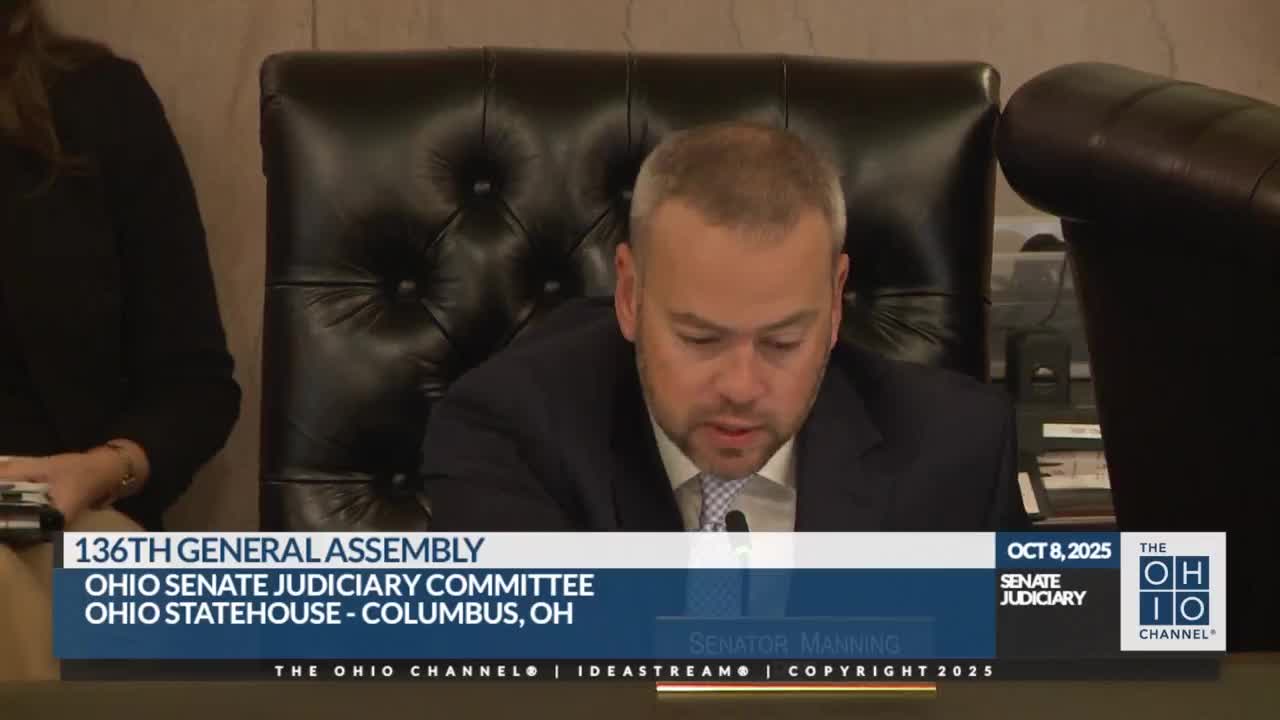
Senate Bill 270, presented to the committee as a first hearing, seeks to implement several recommendations from the governor’s juvenile justice working group and drew sponsor testimony from Chair Manning and a joint sponsor.
Senators described the working group that produced the recommendations as bipartisan and composed of judges, law-enforcement leaders, policy experts and service providers. The bill’s sponsors said those recommendations followed an extensive review of county juvenile detention facilities, the Ohio Department of Youth Services (DYS), and community correction facilities, and culminated in 26 recommendations. The sponsors framed SB 270 as adopting three priority changes that require legislative action: raising the minimum age for youth commitment to DYS from 10 to 14; giving judges discretion when sentencing youth convicted on gun-specifications charges; and prohibiting placement in DYS for first-time nonviolent fourth- and fifth-degree felony convictions (mirroring adult targeted community alternatives to prison programs).
"We thought it was important to at least bring these recommendations to the judiciary committee to have it well vetted," Chair Manning said, noting that the working group was chaired by Tom Stickcraft and that the report was published in September 2024.
Committee response: Sponsors acknowledged the proposals could be controversial to prosecutors and law enforcement but said the bill follows recommendations from subject-matter experts and leaves room for judicial discretion in serious cases. The hearing was recorded as the bill’s first hearing.
Why it matters: The bill would change juvenile commitment age and the range of offenses that may lead to DYS placement, potentially reducing the number of children placed in state juvenile facilities and expanding community-based alternatives.