Get Full Government Meeting Transcripts, Videos, & Alerts Forever!
Get email alerts on the Driving Under Influence Drugs topic
No spam. Unsubscribe anytime.
Witness warns Ohio bill on drugged driving relies on flawed toxicology and could hinder convictions
Summary
At the Senate Judiciary Committee hearing on Senate Bill 55, Ed Wood of DUID Victim Voices testified that proposed per se and inference levels for THC and other drug tests are scientifically unsound and risk convicting the innocent while exonerating the impaired.
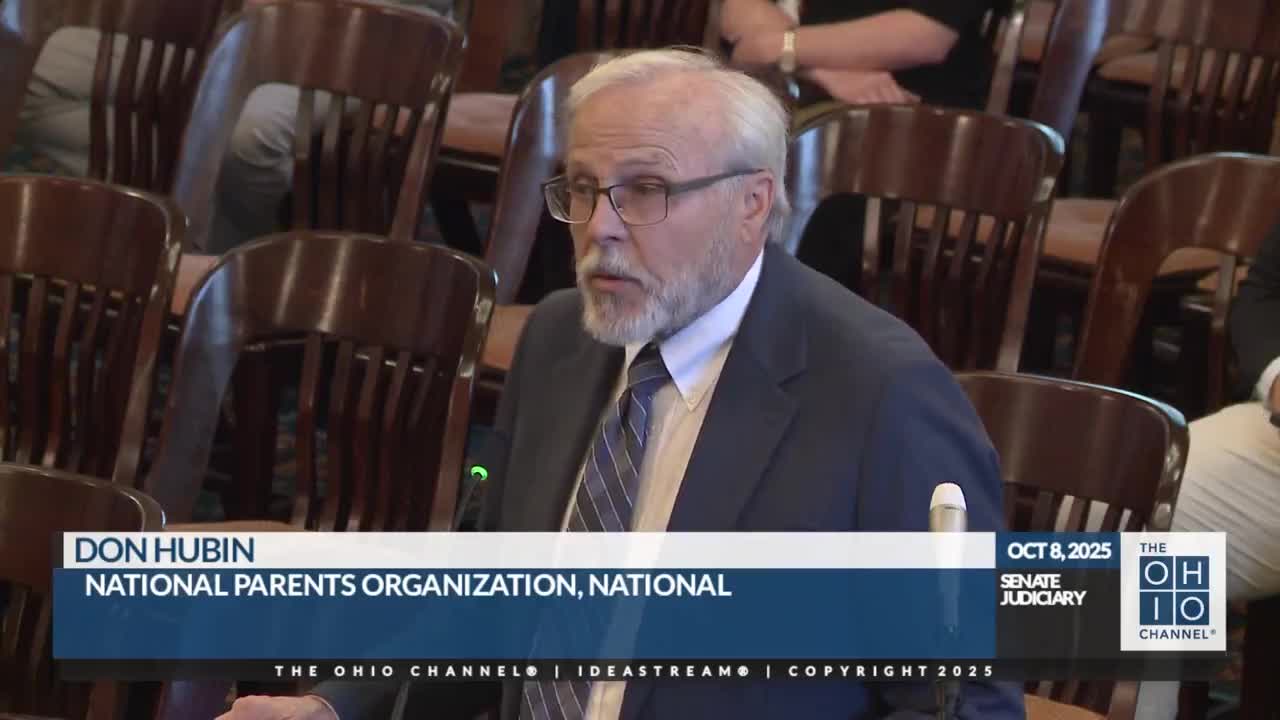
Senate Bill 55 was the first item at the Senate Judiciary Committee meeting and drew opposition testimony from Ed Wood of DUID Victim Voices, who said the bill’s proposed toxicology thresholds for drugged driving are not supported by the science.
Wood told the committee that "urine testing is useless to prove drug impairment" and that neither urine nor simple blood thresholds for THC reliably indicate impairment. He said several provisions in the bill — including a 5 nanogram per whole blood per se level and proposed inference bands — would be ineffective and could produce both wrongful convictions and wrongful acquittals.
Wood summarized his principal concerns: whole-blood and serum/plasma concentrations are not interchangeable; THC redistributes rapidly between blood and brain, so blood levels do not correlate reliably with impairment; polydrug cases can leave drivers impaired below any single-drug threshold; and urine tests detect inactive metabolites that do not show recent impairment. "If you look at figure 3," he told senators, "there is no scientific basis for the adoption of THC per se laws for driving," a point he said is echoed in reports from the National Safety Council and other professional organizations.
Wood recommended several alternatives to the bill’s current drafting: repeal the law that treats marijuana metabolites as a per se basis for OVI; put jury instructions for OVI into statute; gather Ohio-specific data on drug-impaired driving; convene a competent, multidisciplinary body to propose changes; eliminate urine testing for impairment and rely instead on blood or oral fluid; remove nonzero per se limits for drugs other than alcohol; and, if necessary, adopt a permissible-inference approach based on any measurable amount of an impairing drug in blood or oral fluid.
Chair Manning allowed brief questioning; committee members asked whether current Ohio statute is working and Wood replied that the statute’s reliance on an inactive metabolite means it does not show impairment and that Ohio lacks the data to judge the statute’s performance. No committee vote on the bill occurred at the hearing; later in the session the committee moved other business forward.
Why it matters: The bill would change evidence standards for OVI prosecutions. Wood’s testimony focused on the limits of toxicology to prove impairment and urged data-driven policymaking and careful statutory design to avoid both wrongful convictions and failures to hold impaired drivers accountable.