Get Full Government Meeting Transcripts, Videos, & Alerts Forever!
Get email alerts on the Agency Leadership topic
No spam. Unsubscribe anytime.
New commissioner Wynn Rosser outlines priorities: credentials of value, data modernization and legislative engagement
Summary
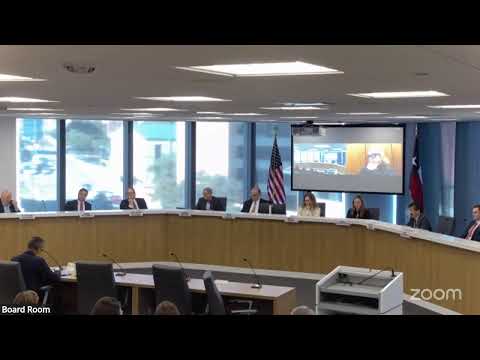
Wynn Rosser, sworn in as the 7th commissioner of higher education effective Jan. 1, 2025, used brief introductory remarks at the board's Jan. 23 meeting to emphasize data modernization, credentials of value, student financial aid and partnership with institutions during the 89th Legislature.
The Texas Higher Education Coordinating Board formally introduced Wynn Rosser as the agency’s seventh commissioner of higher education at its Jan. 23 quarterly meeting. Rosser, who took office Jan. 1, 2025, summarized his 30‑year career in higher education and set priorities that mirror the agency’s agenda for the 89th legislative session.
“I'm honored to step into this role as commissioner of higher education,” Rosser said, thanking the board and Gov. Abbott for the appointment and praising interim commissioner Sarah Keaton for her stewardship during the transition. Rosser noted previous roles as president and CEO of the T.L.L. Temple Foundation and chief executive of the Greater Texas Foundation, and he described his academic path from Kilgore College through bachelor’s, master’s and doctoral degrees at Texas A&M University.
Rosser told the board his immediate priorities include supporting institutions as “resource partners and advocates,” strengthening data infrastructure and advancing efforts to define and amplify credentials of value to promote economic mobility for Texans. “Looking ahead, I'm energized by opportunities the new year brings to collaborate and continue advancing the essential work of building a talent‑strong Texas,” he said.
Rosser also introduced several senior staff who had recently joined or been elevated in the agency, including Glynna Bruun as associate commissioner for public affairs and Andy McLaren as assistant commissioner for funding. He acknowledged the board’s work on rulemaking and said he wanted to ensure rules were “consistent and understandable” while also advancing new programs for approval.
Rosser noted his personal connection to higher education, referencing his family’s trajectory and his role as a father, and said he was “committed to learn more about the strategic postsecondary work going on across our state.” He closed by thanking the board for its “commitment to higher education and to creating opportunity for all Texans.”
The board did not take any formal action on the introduction beyond receiving his remarks. Rosser’s comments preceded an extended staff briefing on credentials of value and the agency’s legislative and budgetary work for the session.