Get Full Government Meeting Transcripts, Videos, & Alerts Forever!
Get email alerts on the Retail Market topic
No spam. Unsubscribe anytime.
Montgomery County committee reviews retail market briefing; staff to refine small-business guide and explore incentives
Summary
Council Economic Development Committee held a work session Oct. 9 to review a county retail market briefing, hear landlord and business-owner concerns about vacancies, permitting and costs, and preview a draft small-business retail guide. No votes were taken; staff will collect feedback and continue the study.
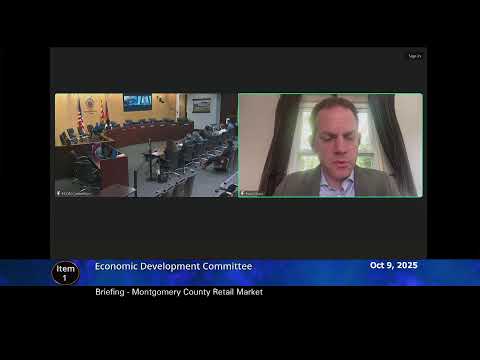
Montgomery County Council’s Economic Development Committee held a work session Oct. 9 to review a retail market briefing from Montgomery Planning, hear comments from landlords and local chambers, and preview a county small-business retail guide; committee members said the session was informational and no votes were taken.
The session brought planning staff, representatives of the county executive’s economic team, chambers of commerce, landlords and retail brokers together to discuss market data, redevelopment and possible county support for retail. Carrie McCarthy, Division Chief of Research and Strategic Projects at Montgomery Planning, said retail in the county totals roughly 36,000,000 square feet, supports about 3,400 retail establishments and employs more than 68,000 people. “Retail is a really important sector of the economy,” McCarthy said, summarizing the presentation’s key findings.
Why it matters: Committee members and stakeholders said retail generates jobs and tax revenue but faces uneven vacancy across submarkets, rising costs to retrofit or redevelop older centers, permitting delays and changing tenant demand driven by e-commerce and new uses such as medical “medtail” and quick-service concepts. Several presenters urged the county to consider targeted incentives and faster regulatory processes to encourage redevelopment and retain small, immigrant- and family-owned businesses.
Planning data and study Carrie McCarthy told the committee the county’s updated retail study (an update to the 2017 report) and a consultant engagement will examine submarket vacancy and trade-area patterns, including a household spending estimate of roughly $13 billion across retail categories. McCarthy said vacancy and rents vary widely by corridor and that mixed-use locations with both residents and workers tend to perform better. She and the consultant noted e-commerce now accounts for roughly 16–17% of sales nationally and continues to change how retailers use physical space.
County support and the small-business guide Nadia Klute, Business Center Manager, described county programs that already support retailers. Klute said the county’s small-business support services budget included $1.7 million in the current program and that about $1.4 million had been distributed to partner organizations for technical assistance. She previewed a draft retail guide — described in the session as Launch Your Dream in MoCo — and said the guide is intended to help entrepreneurs understand leasing basics, marketing and other common gaps. Klute told the committee the guide draft would be circulated for feedback and staff planned to provide an online form and collect comments by the end of the month.
“These businesses . . . need a little more of that hand-holding experience,” Klute said, describing one-on-one marketing and legal clinic supports the county funds. She added the legal clinic offers lease-review guidance but does not provide full representation.
Landlord, broker and developer perspectives Speakers representing landlords and developers emphasized two recurring barriers: regulatory timing and high redevelopment costs. Jeff Sharp, vice president of development for Federal Realty, said routine tenant changes or modest improvements sometimes trigger protracted site-plan or permitting processes that can add months and tens of thousands of dollars to a project. Sharp cited two recent examples at Wildwood Shopping Center where a veterinary tenant and an 800-square-foot cooler required extended approvals.
Sharp and other presenters recommended the county examine tools to reduce permitting time and consider incentives tied to redevelopment. Possible incentives discussed included targeted public subsidies for infrastructure work (utility relocation, undergrounding), sales tax increment or other financing vehicles, tenant-facing grants, and tailored public-private partnership programs to help make infill redevelopment economically feasible while advancing sector-plan objectives.
Market impacts on small-business owners Local business leaders described steep revenue declines in some neighborhoods and raised federal workforce slowdowns and immigration enforcement as immediate, local headwinds. Omar Lasso, representing the Wheaton and Kensington Chamber of Commerce, said many restaurants and retailers there have seen sales declines of about "30% down, 25% down," attributing losses both to fewer workers coming into offices and to immigrant customers who are reluctant to go out. Lasso described rapidly rising costs — for example, a roughly $3-per-pound increase in beef in one month that he said raised his food costs by about $2,000 — and warned tight margins mean many small operators have limited capacity to absorb long permit delays or lengthy fit-out times.
Operational changes and trends Broker and retail principals discussed evolving tenant needs — more demand for smaller footprints, buy-online-pickup-in-store (BOPIS) accommodations, curbside and short-term parking, and medical/wellness uses that function in retail space. Panelists said redevelopment of large “big box” formats and repurposing underused offices could be part of the solution in some submarkets, but those efforts are capital- and time-intensive.
Committee direction and next steps Committee members asked staff to compile the session input and return with follow-up materials. During the meeting the county executive team and Business Center agreed to circulate the draft retail guide and a feedback form; staff asked stakeholders to return comments within roughly three weeks. Planning staff said the retail study update will continue with consultant input and additional outreach. No formal motions or votes were taken at the work session.
Closing note Council members said the briefing will inform future work sessions on retail, grant-program reviews and potential budget requests tied to incentives or program enhancements. The committee will receive a staff report and the revised guide for further consideration.