Get Full Government Meeting Transcripts, Videos, & Alerts Forever!
Get email alerts on the Budget Public Health Ddphe topic
No spam. Unsubscribe anytime.
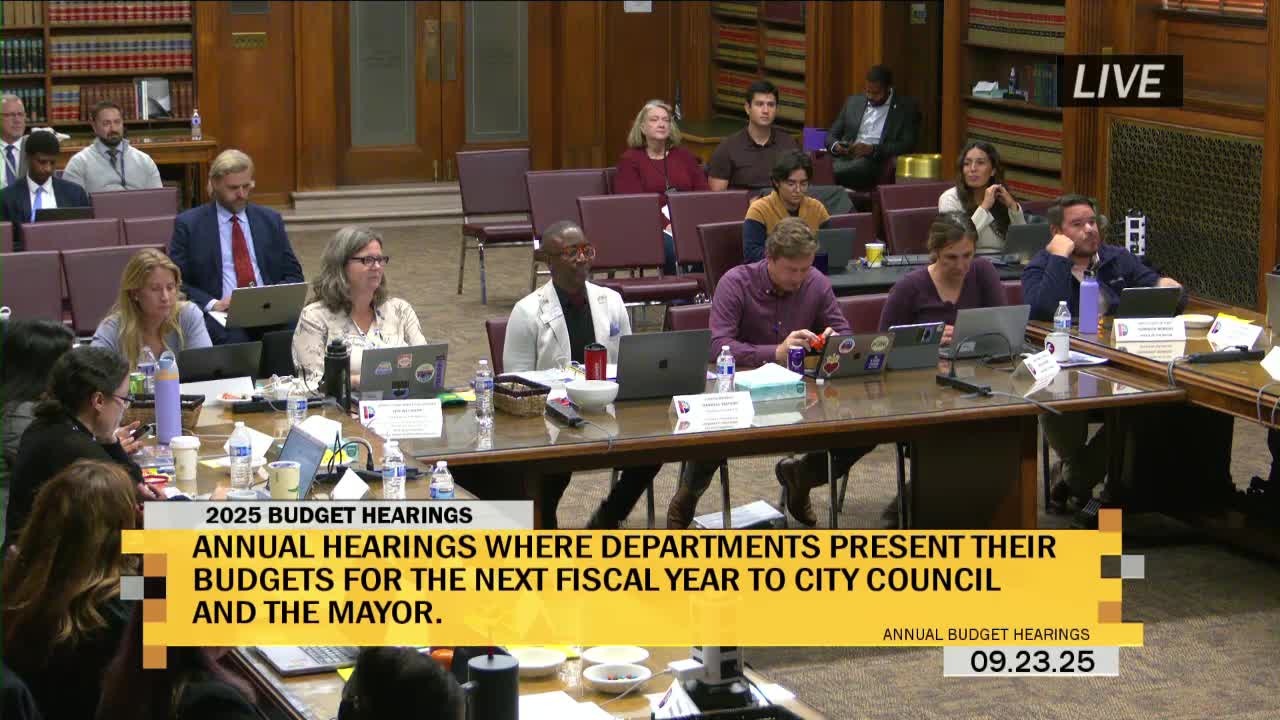
Denver council hears DDPHE budget cuts; officials say core services will be preserved amid reductions
Summary
City department leaders and council members debated proposed cuts to the Denver Department of Public Health and Environment budget, including reductions to contracts and vacant investigator positions, and impacts on the Solution Center, residential health inspections, animal protection and public-health nursing.
Denver City Council members and department leaders spent a budget hearing session reviewing proposed reductions to the Denver Department of Public Health and Environment (DDPHE) budget and the possible impacts on frontline services.
DDPHE presenter Karen (no last name provided), director of the Denver Department of Public Health and Environment, said the department’s total combined budget across general fund, grants and enterprise funds is about $72,000,000 and that personnel and contracts are the largest line items. Karen told the council the department aimed to “protect our mandated core public health services” while taking “surgical and strategic” cuts elsewhere. “We are gonna do less and we are gonna do it well,” she said.
The nut of the discussion was how to balance those cuts while maintaining responses to residential health complaints, animal protection, the Solution Center crisis stabilization and the city’s “roads to recovery” outreach. Council members pressed for details on how reductions would change response times or service levels.
Why it matters: Council members described many of the functions DDPHE performs — residential habitability investigations, animal welfare responses, and crisis stabilization and behavioral-health outreach — as core quality-of-life services that residents routinely report to council offices. Several members warned that lower staffing or contract funding could delay responses to complaints about mold, broken elevators, chronic nuisance properties and animals in distress.
Most important details
- Budget composition and priorities: Karen said personnel is the largest portion of DDPHE’s general fund budget and contracts/services make up nearly 25 percent of department spending. The department emphasized continuing community health assessment work, roads to recovery and wraparound services for people experiencing homelessness and substance use.
- Grants and revenue risk: DDPHE officials said the department is good at winning grants but that federal and state grant funding has become less reliable. They noted work underway to finalize a contract with waste-management operators to capture methane at the city landfill, which could yield future revenue and climate benefits.
- Solution Center and STAR program: Tristan Sanders, director for community behavioral health, said the STAR program and the Solution Center are subject to reductions driven largely by adjustments to indirect cost rates and historic underspending on some contract lines. Tristan explained that one major change is an indirect-rate adjustment that reduced budgeted city support for the Solution Center; part of the funding gap is expected to be covered by increased third-party reimbursements (Medicaid) and by maximizing crisis-stabilization billing. Officials described a roughly $500,000 reduction tied to the indirect-rate change and a total contract reduction in the low hundreds of thousands (council members referenced ~ $950,000 in aggregate reductions).
- Roads to Recovery funding: Karen and Tristan said most of the roads-to-recovery funding level is unchanged from 2025; the 2026 proposal adds about $167,000 to support two public-health nurses who will accompany street engagement teams. Officials said the nurses are intended to improve field triage and increase clinic/vaccine outreach to underserved communities.
- Residential health investigations and inspection model: Danica Lee, director of the Public Health Investigations Division, said the department has prioritized keeping residential health investigation staff levels “consistent” with recent years, but that some vacant investigator positions were abolished. Finance staff later clarified the proposed change included abolishing about eight vacant investigator positions and two filled positions that were selected for layoff or otherwise affected, producing a variance of roughly $1.1 million on the public-health-investigations line in the budget book. Danica said the department will move further toward a complaint-driven inspection model that focuses on repeat violators and serious incidents rather than routine, preemptive inspections.
- Animal shelter and animal protection: Councilmember Kevin Flynn asked about a $405,000 administrative line that appeared zeroed out in the budget book for the animal shelter. Melanie Silbo, introduced in the hearing as director of Denver Bridal Protection, explained that some administrative spending was reclassified into client services (the line increased accordingly) rather than eliminated. Karen and Danica said animal protection officer positions and a community outreach position were among cuts being proposed, and acknowledged response times could be affected as intake and sheltering demand increases.
- Performance metrics and service targets: Karen highlighted that the department is meeting a goal to close environmental and animal-protection complaints within three business days about 90 percent of the time. She cited large increases in vaccinations administered by public-health nursing teams supported by prior council investments.
Council concerns and follow-ups
Council members asked for additional materials and follow-up data: a three- to four-year historical underspend spreadsheet for STAR/solution-center contract lines; clarification on which grants or contracts are rolling forward unspent (the Healthy Food for Denver Kids program was noted as having multiyear rollovers across many grantees); details on hazmat/encampment cleanup contract spending; and a breakdown of the investigator-staffing reductions that together account for about $1.1 million in proposed savings.
Separately, council members raised neighborhood-specific concerns — notably from Southeast Denver (the Kennedy neighborhood) — about cumulative impacts across departments and whether reduced DDPHE capacity would disproportionately affect isolated or underserved areas.
What the hearing did not decide
No formal vote or ordinance was recorded in the transcript. Several members asked for written follow-ups; staff and the department committed to provide historic spend and underspend detail, confirm whether certain positions were vacant or filled, and report back on how the complaint-driven inspection model will be implemented and monitored.
Ending
DDPHE officials and the mayor’s office said they would provide the requested follow-ups and that the council and department will continue iterative conversations and periodic reports to monitor service levels. The council recessed the hearing and scheduled further budget work to continue the next day.