Get Full Government Meeting Transcripts, Videos, & Alerts Forever!
Get email alerts on the Fire Department Budget topic
No spam. Unsubscribe anytime.
Denver Fire outlines 2026 budget with staff realignments, cancelled recruit class and new conveyance testing
Summary
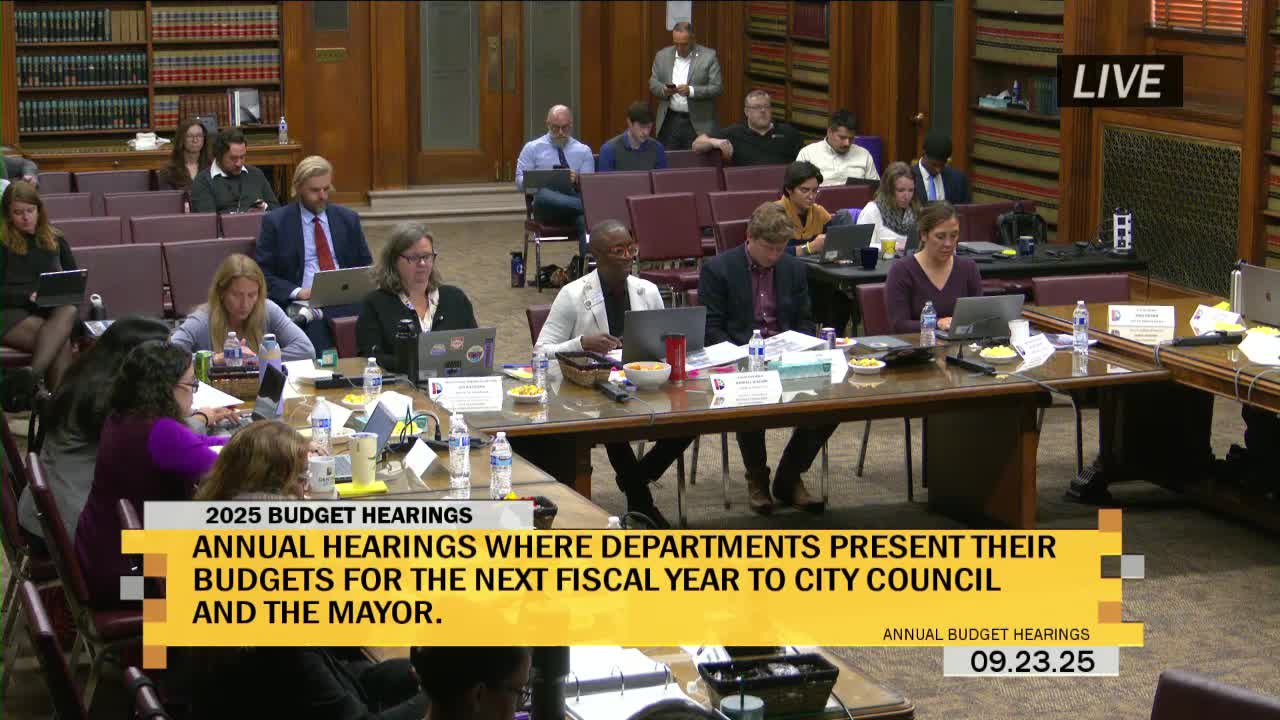
Chief Fulton, the head of the Denver Fire Department, presented the department’s proposed 2026 budget to the Denver City Council and said the plan preserves core emergency response while making personnel and service changes to reduce costs.
Chief Fulton, the head of the Denver Fire Department, presented the department’s proposed 2026 budget to the Denver City Council and said the plan preserves core emergency response while making personnel and service changes to reduce costs.
"The goal and priority is to ensure that the Denver Fire Department is capable of conducting its essential missions and functions under all threats and conditions," Chief Fulton told council members. He said the department is recommending a general-fund expenditure of $158,100,000 for the fire department in 2026 and that "97 percent of our budget is people."
The department proposed several personnel and program changes aimed at keeping firehouses open and maintaining four firefighters per engine or truck while reducing overall budgeted headcount. Those changes include cutting 9 uniform positions and 9 civilian support (CSA) positions in 2026 through attrition, reallocating some staff to the Wildland Special Revenue Fund, and not hosting a recruit academy in 2026. Chief Fulton said the reductions are from attrition and that there will be no layoffs.
To reduce overtime pressure and preserve frontline staffing, the department plans to move some support staff back to operational roles. Chief Fulton described one example: moving the public information officer (PIO) role back into a captain’s capacity on a fire engine and assigning weekly PIO responsibilities to the duty officer phone rotation. Training staff will also be reallocated to support operational staffing needs, and the department said it will reduce the number of training academies in 2026.
The budget presentation included both cost savings and revenue strategies. Chief Fulton said personnel reductions are expected to produce about $4.5 million in savings and that revenue and other offsets—principally from conveyance work and fee adjustments—are "just a hair over $2,000,000," producing part of the department’s budgetary balance.
A major operational initiative described in the presentation is local capacity to perform acceptance testing for conveyances (elevators, escalators and horizontal people movers). Chief Fulton said Denver manages roughly 7,200 conveyances and has begun training Denver Fire staff to do acceptance testing so repaired devices can be certified and returned to service more quickly. "This isn't about just revenue generation. This is about the expedition of getting something open in a timely fashion," he said.
Chief Fulton also described a planned shift from adherence solely to NFPA 1710 turnout standards toward use of a Denver Dynamic Response Model (DDRM) to better prioritize response levels based on medical and other event acuity. He said the model’s goal is to match response resources to incident priority so crews are not routinely dispatched with lights-and-sirens for low-acuity calls.
Council members raised concerns and asked for follow-up detail. Councilmember Flynn pressed the department on whether the 42 percent reduction in the training budget stems solely from canceling the recruit academy; Chief Fulton responded that the academy cancellation is the largest component but that reductions also affect ongoing training and supplies used to send personnel to outside classes. Flynn expressed concern that reductions could affect required training hours and certification reviews.
Councilmember Hines emphasized the public impact of failed or out-of-service elevators and the length and risk of elevator rescues. Chief Fulton said the department is working to expand in-house capacity to get repaired conveyances back in service more quickly and acknowledged the problem of understaffed private conveyance companies. Councilmember Paradis asked for statistics on the mobile medical units; Chief Fulton said the city operates four medical units at specified stations and offered to provide response statistics on those units.
The presentation covered other items that support operational readiness: Denver Fire’s ISO 1 rating and accreditation; plans to complete a class-A burn building at the training academy (address listed as 5440 Rosslyn Street on the presentation); and an expanded wildland program as the season lengthens. The chief also highlighted member wellness and resiliency work and an RSJ equity training academy that is listed at 95% completion.
Mayor Johnson added context at the end of the meeting, explaining a trade-off between the 2026 recruit class timing and costs absorbed by safety collective bargaining agreements. The mayor said city leadership favored supporting the collective bargaining outcome to aid retention and recruitment even though it required schedule adjustments to the academy.
Next steps identified during the hearing included: the department providing more detailed statistics on medical-unit responses and conveyance staffing and violations; follow-up on how overtime estimates are budgeted; and additional scenarios on academy timing and recruiting trade-offs. Councilmembers asked the department and the mayor’s office to provide alternative scenarios for shifting the recruit class earlier in 2026, with the mayor’s office and department agreeing to provide more detailed fiscal scenarios and recruitment timelines.