Get Full Government Meeting Transcripts, Videos, & Alerts Forever!
Get email alerts on the Budget topic
No spam. Unsubscribe anytime.
Denver officials outline proposed 2026 budget with $200 million shortfall, targeted cuts and one-time reserve boost
Summary
City budget staff briefed the Denver City Council on a proposed 2026 general fund budget that closes a roughly $200 million gap through personnel and services cuts, small targeted revenue increases, and a one-time transfer from the Border Crisis Response Fund to lift reserves to about 11% of expenditures.
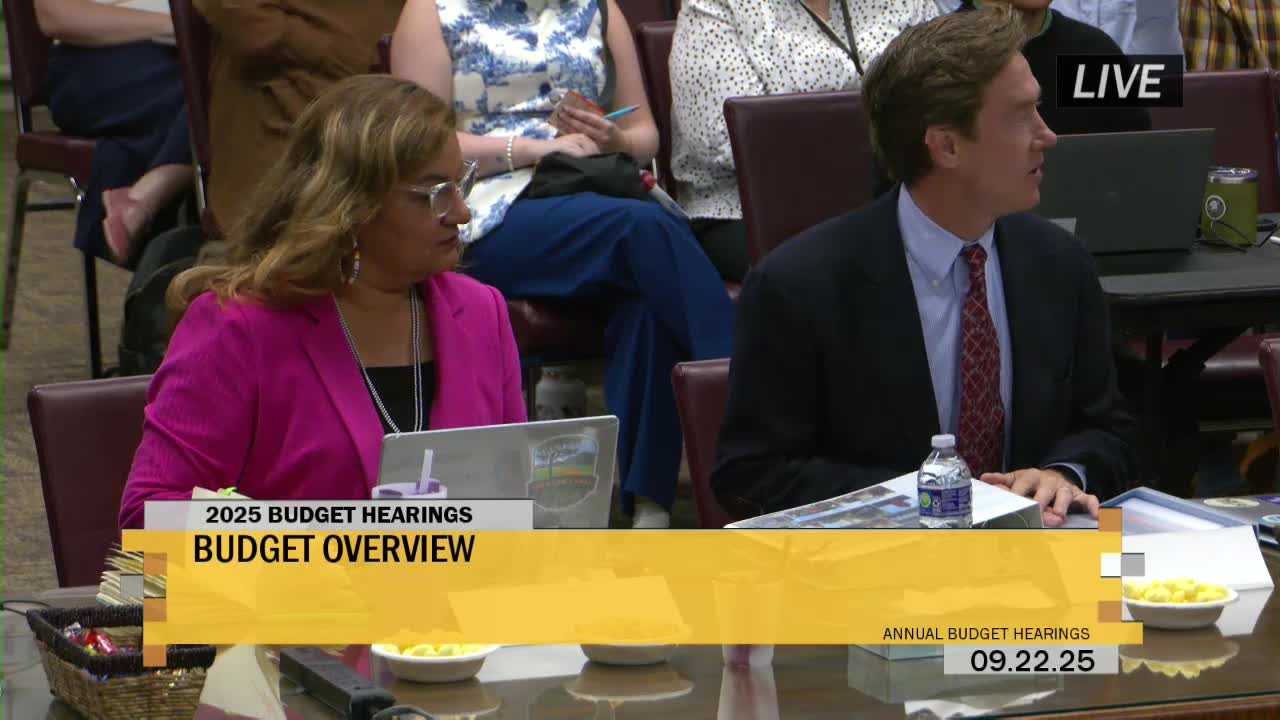
Denver budget officials presented the proposed 2026 budget to City Council during a budget week hearing, saying the proposal addresses a roughly $200 million shortfall through personnel reductions, services and supplies cuts, modest fee increases and a one-time use of contingency funds.
“This is really critical context to the city's proposed 2026 budget,” Budget and Management Office Director Justin Sykes said as he opened the department-level overview. Chief economist Lisa Martinez Stapleton told council members the broader economy is weakening, a factor the administration cited as central to the revenue outlook. “The economy is struggling,” Stapleton said during her economic briefing.
The administration's proposed 2026 general fund budget is about $1,660,000,000 — roughly $100 million less than the approved 2025 general fund budget — and is balanced by a combination of $200 million in reductions, about $6 million in new revenues and limited one-time transfers back to the general fund. Staff described the $200 million in reductions as composed of roughly $118 million from personnel changes and about $77 million from services, supplies and transfers, plus the new revenue items.
Why this matters
City leaders said the recommendation attempts to preserve core services while responding to weaker revenue projections driven by slowing consumer spending, tourism declines and national economic uncertainty. Officials said the budget preserves rec center hours and pool operations, does not cut trash service or curb authorized sworn police strength, and avoids changes to employee health care or benefits in the proposed plan.
Details of the proposal
- Revenue and gap: The administration said the city faces a roughly $200 million gap between projected 2026 spending if no changes are made and the revenue expected in 2026. Sales and use taxes and property taxes make up about two-thirds of general fund revenue; sales and use tax is projected to produce about 56% of general fund revenue in 2026. The administration projects flat general fund revenue in 2025–26 compared with recent years.
- Reductions and staffing: The proposed package includes a net reduction of 957 full-time equivalents (FTE) in the general fund, according to the presentation. Personnel reductions account for about 59% of the $200 million in cuts. The remaining reductions come from services and supplies, transfers and other savings. Agencies were directed to identify contract reductions, renegotiations and program cutbacks.
- New and changed revenues: The budget includes limited, targeted revenue changes expected to raise a little under $6 million: reduced parks and recreation membership discounts and new greenhouse rentals (about $1.4 million), updated fire inspection and permit fees (about $2 million), and expanded traffic enforcement/photo radar revenues (a little over $2 million).
- Grants and federal funding: Staff estimated the city will spend roughly $230 million in grants in 2026, about $133 million of which is federal. Officials said American Rescue Plan Act (ARPA) funds are winding down: roughly $20 million remains to be spent and staff expect to spend that in the remainder of 2025 and into 2026. The administration said it has submitted about $192 million in FEMA COVID-19 reimbursement requests; about $164 million has been received, roughly $17 million denied and about $11 million remains pending. The city is still awaiting about $24 million the administration says it believes is owed for a 2023–24 shelter and services program reimbursement.
- Reserves and one-time transfers: The plan would keep a 2% general fund contingency and, using a combination of one-time steps, grow projected reserves to roughly $183 million (about 11% of projected 2026 general fund expenditures). Staff said they plan to pull roughly $5 million one time back into the general fund from the Border Crisis Response Fund in 2026 because only about $7 million of the $12 million budgeted out of that fund is expected to be spent.
Capital and other items
Capital Planning and Programming staff described the proposed 2026 capital improvement program (CIP) of about $277 million focused on reinvestment and delivery of shovel-ready projects. Jackson Brockway said the capital improvement fund (CIF) — supported principally by property tax revenue and a dedicated 2.5 mills for capital maintenance — represents about 60% of CIP resources, and noted priorities including transportation and mobility maintenance, pavement and multimodal projects, and deferred maintenance for parks and buildings.
What council asked and what staff said
Council members pressed staff on assumptions behind the revenue forecast, the stickiness of the reserve projections, and whether one-time funds had been used to shore up ongoing needs. Justin Sykes and Lisa Martinez Stapleton said the forecast reflects recent economic data — including responses to tariffs and slowing labor-market indicators — and stressed the administration’s intent to be conservative in the face of uncertainty. Sykes noted the administration froze hiring and imposed furloughs earlier in 2025 and stated the budget management office is restricting agencies' 2025 savings so dollars are not spent without central approval.
Council members also asked about the Stapleton TIF retained tax payment that had supported prior budgets, and staff said the TIF expired and the one-time set-aside funds available in 2025 have been largely used; they described the remaining balance and how that interacts with the 2026 outlook. Staff said some items — including proposed funding for a women's soccer stadium referenced in the discussion — will come forward as separate legislative actions.
Ending
City staff said they will provide more detailed agency briefings during budget week hearings and will circulate an October update to the budget book. Council members were reminded of opportunities to meet with capital planners on district priorities and to submit feedback to the mayor before formal appropriation later in the fall.