Get Full Government Meeting Transcripts, Videos, & Alerts Forever!
Get email alerts on the Community Safety topic
No spam. Unsubscribe anytime.
Office of Community Wellness and Safety warns key violence-interruption programs face funding cliff in 2026
Summary
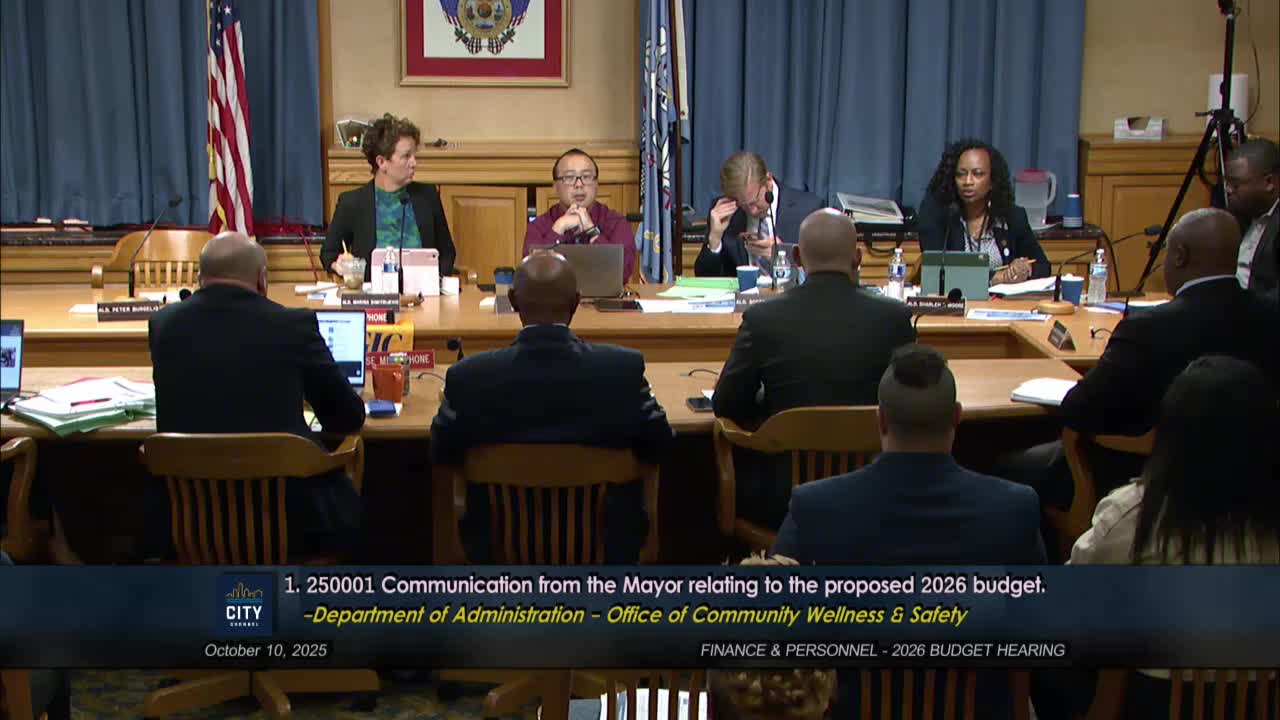
The city—s Office of Community Wellness and Safety told the Finance & Personnel Committee that community violence interruption (CVI) teams and several contracted violence‑prevention workers will be unfunded next year unless the council or administration identifies new revenue.
The Office of Community Wellness and Safety warned the Finance & Personnel Committee on Oct. 10 that several contracted community violence‑interruption teams and city‑supported outreach workers will lose funding in 2026 unless the city identifies new resources.
Director Adam Purcell said the office—s current resources are far smaller than the scale of the problem. He told the committee he is mapping 33 initiatives and the staff, subcontractors, funding sources and performance metrics for each so the council and administration can prioritize. Purcell said the office currently supports 24 part‑time "promise keepers," seven CVI teams, and an eight‑member critical response team; he said those roles are central to de‑escalation and community outreach but that the contract terms and grant timelines mean the city risks losing most or all of those positions in 2026.
Purcell described the human side of the data and said the office lacks the financial scale of other cities that have launched large public safety prevention efforts. "When we talk about homicide rates and metrics, these are people," he said, describing conversations with victims— families during recent incidents. He urged the council and administration to work together to find new, stable funding to retain interrupters and outreach workers and to consider longer, full‑time positions with benefits rather than short part‑time contracts.
Committee members pressed for details on the scale of the funding gap and for lists of contracts that are overdue or at risk. Purcell and budget staff agreed to follow up with an itemized list showing which CVI and outreach contracts expire or are grant‑funded through 2025 and 2026, and how much city levy or special‑purpose money would be required to continue current staffing. Several aldermen said they want a 90‑day strategy from the office showing immediate, midrange and longer‑term options for stabilizing the work.
Purcell proposed several approaches the office is exploring: shifting or consolidating existing short‑term grants to preserve critical staff, negotiating with existing grantees to maintain services if the tax levy or special funds can be identified, and exploring creative revenue or asset strategies such as repurposing underused city lots to support affordable housing projects that would also fund community safety staff. He also asked the council to consider whether some currently contracted programs could be absorbed into city employment structures to provide benefits and career paths for the workers.
Council members acknowledged the difficulty of reallocating limited revenue in the 2026 budget but signaled urgency to prevent the loss of trusted frontline workers. Several members asked budget office staff for an immediate accounting of what grant or ARPA funding currently supports OCWS positions, which contracts are set to lapse Dec. 31, 2025, and the amounts and timing needed to avoid layoffs or contract terminations.
Purcell said he will deliver a 90‑day assessment that inventories staff, contracts, funding sources and service areas, plus options and estimated costs for preserving critical community violence interruption capacity in 2026. He emphasized that while other cities have funded prevention initiatives at much larger scales, the office must first win stability for its existing frontline teams to avoid leaving the city with significantly less on‑the‑ground capacity next year.