Get Full Government Meeting Transcripts, Videos, & Alerts Forever!
Get email alerts on the Economic Development Strategy topic
No spam. Unsubscribe anytime.
Advisory board pushes for clearer economic-development goals, a incentives workshop
Summary
Board members pressed for a concise set of economic-development goals and recommended the committee prepare targeted incentives and a short workshop to craft recommendations for city council, including using county programs, targeted tax credits and non-tax revenue approaches.
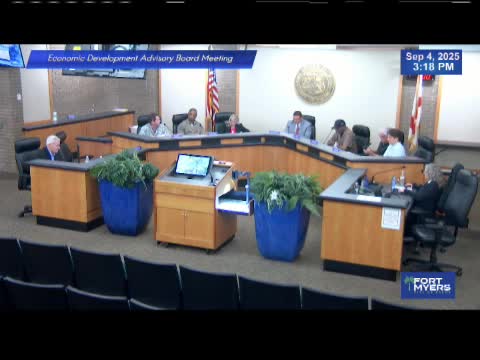
The City of Fort Myers Economic Development Advisory Board used its Sept. 4 meeting to press for clearer, prioritized goals for economic development and a short, focused workshop to craft actionable incentive recommendations for city council.
Steve Weathers, the city’s economic development director, told the board the department has been compiling proposals and that staff can work with the board to crystallize a short list of priorities. "Once you know the goals, you can then reverse engineer into the incentive," he said, urging members to state whether they want job creation, higher-wage jobs, capital investment or sector-specific growth.
Why it matters: Board members framed incentives as a tool to raise local wages and broaden the tax base, not merely as giveaways. They argued that the city should prioritize a few achievable objectives — for example, attracting technology or life-sciences firms, growing class-A office space, or expanding sports/boating-related services tied to basin and marina projects — and then design time- and performance-limited incentives tied to measurable outcomes.
Discussion and proposals: Members and staff discussed an array of potential incentive tools: targeted tax abatements, capital-investment tax credits for high-impact sectors, small-business loan funds, expedited permitting, facade or interior rehabilitation grants, enterprise/trade-mission support, and public–private approaches that contribute city land or non-tax revenues in exchange for a developer share of future receipts. Weathers and board members cited specific programs to consider: the state’s capital investment tax credit for targeted sectors, federal/state export assistance programs such as Gold Key, Lee County grant and bond programs, and locally administered facade and rehabilitation grants operated through the CRA.
Accountability: Several members urged including clawback provisions and measurable commitments in any incentive package. "We need to see these wages, on these jobs," said one board member, calling for wage and job-count reporting tied to incentives. Weathers and others discussed structuring agreements with performance milestones and audit/clawback mechanisms to protect public investments.
Next steps: The board unanimously agreed (by consensus) to prepare a short recommendation packet for staff review and to hold a focused meeting/workshop before year-end. Board member Dwayne (first name used in the record) volunteered to compile transcripts and materials from the past 12 months and to present a first draft summary at the next meeting; staff agreed to invite Lee County and CRA representatives and to provide a list of existing city and county programs board members can piggyback or stack with city incentives.
Ending: Members emphasized a short list of priorities and measurable outcomes — for example a small set of target sectors and concrete deliverables (jobs, wages, capital invested) — before the committee recommends incentives to council.