Get Full Government Meeting Transcripts, Videos, & Alerts Forever!
Get email alerts on the Procurement And Contracting topic
No spam. Unsubscribe anytime.
Fort Myers outlines procurement process, contract limits for public works and police station design
Summary
City engineer Nicole Setzer described how the public works division procures consultants and construction managers, explained continuing-contract limits tied to a state statute and detailed scoping, deliverables and use of project tools on the $130 million police headquarters project.
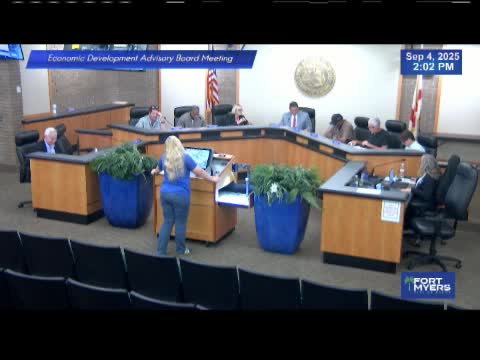
Nicole Setzer, the City of Fort Myers city engineer, told the Economic Development Advisory Board on Sept. 4 that the public works division uses a mix of continuing contracts and project-specific solicitations to secure consultants and construction managers for road, drainage, parks and building projects. "For consultants for design work, we have continuing contracts that are by discipline," Setzer said, and she described the team-based selection and scope-negotiation process used on large projects.
Setzer said continuing professional services contracts carry dollar limits set by state law: studies procured under those contracts are capped at $500,000 and design/construction work under continuing-contract selections is limited to $7,500,000. For larger projects the city issues project-specific solicitations. "The police station is a good example. That's a $130,000,000 build," she said, describing a 30-day advertisement, scoring matrix, shortlists, and finalist presentations used to select the design team.
Why it matters: Setzer’s presentation outlined how the city balances speed and oversight across routine and large-scale projects, how scope and man-hour breakdowns are used to check that senior staff are not charging for routine work, and how construction managers are integrated early to improve buildability and cost control. For the police station — a major capital project — the city used a competitive, multi-member evaluation panel and a construction manager to refine early cost estimates and designs.
The process: Setzer said continuing-contract arrangements are organized by discipline — civil engineering, landscape architecture, surveying, materials testing and others — and that the contracts include hourly rates, caps on construction management fees and stated deliverables. For project-specific selections she described a team-based scoring and ranking system, presentations by shortlisted firms, and iterative negotiation of a written scope of services that breaks costs down by task and includes man-hour allocations. "What we're looking for there is making sure that the CEO of the company who makes $300 an hour ... is not designing the plans," she said, explaining the city’s emphasis on matching tasks to appropriately priced staff.
Tools and oversight: Setzer said solicitations are posted through the city procurement platform OpenGov and the department uses Procore to manage projects from design through construction. She described a recent rewrite of a single-project construction management agreement to clarify who controls contingencies and what personnel and costs may be charged to a project. "It is an owner contingency. We have total control over it," Setzer said.
Cost estimating and third-party review: Board members asked whether the city uses independent third-party cost estimators. Setzer said the department has not routinely hired standalone third-party cost estimators but that construction managers and the city’s design team provide early cost estimates. She noted that early estimates — for example at 30% design — are still preliminary and may change as decisions are refined.
AI, project data and procurement: Several board members recommended exploring AI tools. Setzer confirmed the city has an OpenAI/ChatGPT account and uses digital project-management tools; she and members discussed potential AI uses for transcript summarization, proposal evaluation, and routine compliance checks. One board member described using transcripts with an LLM to extract use cases and constraints; Setzer said the city is piloting technology and industry-standard tools but did not announce any formal AI procurement.
What wasn’t decided: No new procurement policies or purchases were approved at the meeting. Setzer said many of the changes to contract language were already implemented and that converting the revised single-project construction-manager language into a continuing-contract template is the department’s next step.
Ending: Setzer offered to return for follow-up questions and the board asked staff for copies of solicitation templates, scoring sheets and contract-review schedules so members can review how local preference, minority-business evaluation and contractor scoring are applied across project types.