Get Full Government Meeting Transcripts, Videos, & Alerts Forever!
Get email alerts on the School Budget topic
No spam. Unsubscribe anytime.
Scotia-Glenville board adopts $67.0 million budget that exceeds tax cap, restores school safety officers and some staff
Summary
Scotia-Glenville Central School District trustees voted to send a $67,000,128.28 budget to voters Tuesday, choosing a spending plan that exceeds New York State's tax levy limit and would require a 60 percent yes vote to be adopted.
Scotia-Glenville Central School District trustees voted Tuesday to send a $67,000,128.28 budget to district voters, a plan that exceeds New York State's tax levy limit and therefore must win a 60% yes vote to be adopted.
Superintendent Susan Schwartz and district business staff presented two scenarios at the board's final budget work session: the superintendent's recommended budget, described as staying at the tax levy limit of 3.25 percent, and an override scenario that would raise the levy by 5.09 percent. The board voted to advance the higher, override plan as Proposition 2.
The override plan adds funding to fully restore two school resource officers (SROs), add two elementary reading positions and an elementary librarian, and recognizes about $130,000 in additional aid the district expects. District staff said the override scenario would produce a 3.44 percent tax-rate increase (presented as a 5.09 percent levy increase) and a 2.75 percent spending increase for 2025-26; the superintendent's recommended scenario showed a 2.19 percent spending increase and a lower tax-rate change when presented earlier.
Board members and staff framed the vote as a choice between minimizing near-term taxpayer growth and preserving staff and student services that they said would be difficult to restore later. Superintendent Schwartz summarized the meeting goals as, "debunk[ing] the latest myths," answering board questions and asking the board to "adopt the spending limit this evening either at or above the tax levy limit of 3.25%."
Why this matters: district presenters said the override closes gaps that would otherwise reduce library services, reading interventions and school safety coverage. Staff warned that using reserves and one-time revenues to reduce the levy now would leave the district with a thin fund balance going into 2026-27 and that next year's budget risks would be larger.
Details and staff analysis - Staffing changes: district leaders described 24 reductions discussed during the budget process, and said those changes break down as 11 reductions due to attrition, 2 positions tied to employees who will not return, 4 vacant positions and 7 eliminations. Some affected staff have been offered internal reassignment where certification permits. - Reading and library impacts: district staff presented draft schedules showing that eliminating one elementary librarian would mean a library could be closed one to two days in every six-day rotation but that "all students would receive their library class." On reading staff, presenters said the proposal would change allocations so that two elementary buildings (Lincoln and a school the presentation labeled with a similar name) would each be adjusted to two reading teachers; staff said the district believes required RTI/AIS services could still be provided but that supports such as guided reading and some in-class coaching would be reduced. - High-school reading and graduation: staff reviewed five years of high-school reading-class enrollment alongside graduation rates and told trustees that graduation is influenced by many factors, with attendance and student mental health the two most common contributors identified for non-completers. - Fund balance and reserves: the district reported a projected ending fund balance of about $4.7 million for 2024-25, and said it would use roughly $4.143 million of that in the adopted budget scenarios, leaving roughly $600,000 (about 0.89 percent of the budget) — historically low for the district. The presentation said the district plans to use $165,000 from its tax-certiorari reserve and $50,000 from the retirement reserve (about $215,000 total) to support the 2025-26 plan. - Tax impact examples: staff provided illustrative household impacts: under the override scenario, a home with an assessed value of $160,000 would see the school tax bill rise to about $4,070 (an increase presented as roughly $64 to $80 under the cap vs. $136 to $170 under the override for a $200,000 home, depending on scenario comparisons). Presenters and board members emphasized translating percentage changes into monthly dollar amounts when communicating with voters.
Contingent-budget consequences and voter thresholds District officials repeatedly warned trustees about the consequences of a budget defeat. Under New York's rules, if voters reject a budget twice the district must adopt a contingent budget that holds the tax levy at the previous year's level and requires deeper cuts. Staff presented two contingent-budget examples: one if the district stays under the cap and one if the district had sought to override the cap and failed; the latter scenario would require larger cuts to reach the prior year levy. Presenters noted examples of possible cuts under a contingent budget: reductions to athletics, field trips, late buses and outside-user facility access, but said the board must determine exact cuts.
SRO contracts and negotiations Board members asked whether changes in the SRO contract with the Town of Glenville could alter the budget line for SROs. Staff and trustees said the village of Scotia currently charges roughly $42,000 a year for its SRO while the Glenville contract is higher (the presentation cited figures near $113,000 to $120,000 for Glenville). Superintendent Schwartz said district negotiators would meet with Glenville officials and the police chief to try to reach savings next year; any agreement reached soon would affect the 2026-27 budget rather than the immediate spending proposition going to voters.
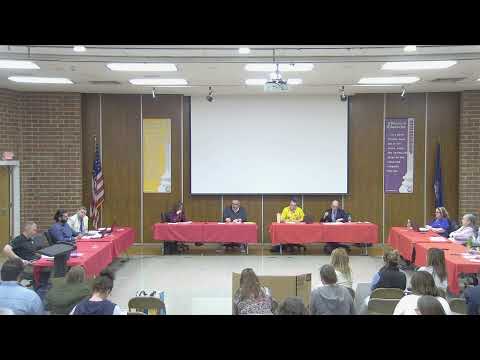
Board action and next steps Trustees first took up Proposition 1 (the superintendent's recommended budget at $66,513,694). After discussion and a roll call, trustees proceeded to introduce Proposition 2, the $67,000,128.28 override budget. A board member moved Proposition 2 and another seconded. After additional discussion about priorities and community feedback, trustees who spoke on the record announced their affirmative votes. The board's president closed the meeting by saying the district must now "get out there" and "make a plan as a board in the community to figure out how we can get this passed for benefit of our kids."
Direct quotes from meeting participants - Superintendent Susan Schwartz: "We want to debunk the latest myths... and we want to have the board adopt the spending limit this evening either at or above the tax levy limit of 3.25%." - Business official Drew: on reserves and one-time revenues, staff said they "increased the use of our tax certiorari reserve, and we added some billings that we get for health and welfare and IEPs," which together produced additional revenue in the draft. - Curriculum/operations presenter Rick on library scheduling: "Each library would be closed from 1 to 2 days out of every 6... however, all students would receive their library class." - Board member Pam (speaking during debate): "I don't think it's enough to go with your budget. I think we need to go out over the cap. I think we have to give the kids the reading and the libraries... and give the community the opportunity to say yes to a slightly higher percentage."
What the vote means next Because the board chose an override budget, the district will put the higher-spending Proposition 2 before voters. That proposition requires a 60 percent yes vote to pass; if voters reject a budget proposition twice the district must adopt a contingent budget that holds the tax levy at last year's level. District officials said they will continue negotiations with outside partners, complete additional public outreach explaining per-household impacts and follow up with any contract changes that could reduce future budgets.
Ending District staff and trustees repeatedly stressed two points as they closed the work session: first, that narrower margins in the fund balance make the district more vulnerable to special-education and high-cost drug-cost increases; and second, that the community-level campaign and clear messaging about monthly household cost will be central to the proposition's success at the polls.