Get Full Government Meeting Transcripts, Videos, & Alerts Forever!
Get email alerts on the Elections Absentee Ballots topic
No spam. Unsubscribe anytime.
Ohio senators debate ending 4-day absentee ballot receipt extension in SB 293
Summary
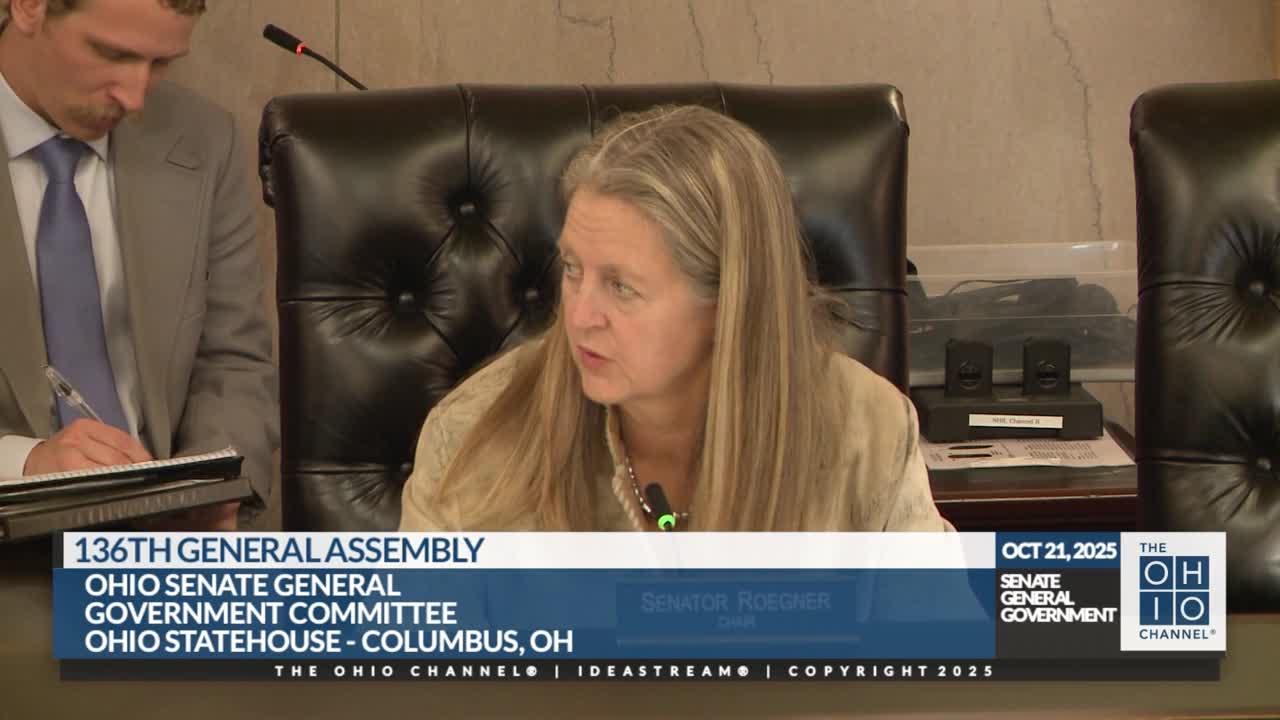
Senator Theresa Brenner introduced Senate Bill 293 in the Senate General Government Committee to require absentee ballots to be received on or before Election Day by eliminating a currently allowed four-day receipt extension.
Senator Theresa Brenner introduced Senate Bill 293 in the Senate General Government Committee to require absentee ballots to be received on or before Election Day by eliminating a currently allowed four-day receipt extension.
The bill’s sponsor said the change would “protect and improve the election process in Ohio” and help ensure a “timely and accurate elections process by eliminating the 4 day extension for absentee ballots.” She cited a U.S. Court of Appeals (Fifth Circuit) decision and said several states have moved to require ballots be received by Election Day to comply with federal interpretations of a uniform election day.
Supporters told the committee SB 293 would remove ambiguity that can delay results and, in their view, create opportunities for fraud. “1 case of voter fraud is too much and I believe Senate Bill 2 93 tightens the loopholes that some people can exploit to undermine our election system and by definition, our republic,” Brenner said.
Opponents and some committee members questioned the practical effects on voters who rely on mail delivery and on military and overseas voters protected by the Uniformed and Overseas Citizens Absentee Voting Act (UOCAVA). Senator DeMora said 10,000 ballots in last year’s election arrived after the current deadline, adding, “10,000—that’s 10,000 people that this bill would disenfranchise.” He also noted that a Fifth Circuit ruling does not bind Ohio, which is in the Sixth Circuit.
Committee members pressed sponsors on how the change would affect service members and other voters who mail ballots and how the state would educate voters. Brenner and other supporters said they would confirm compliance with federal law, including UOCAVA, and work with the secretary of state’s office on outreach. Committee members also noted existing options such as 28 days of in-person early voting and ballot drop boxes.
The committee heard statistics and comparisons from the sponsor: she said 34 states require absentee ballots to be received on or before Election Day and cited Minnesota, North Dakota, Utah and Kansas as examples where states have enacted similar changes. Opponents emphasized postal-service delays and urged data on how many ballots arrived late in prior elections.
The hearing concluded with no vote. Committee members said they expect further review, outreach coordination with the secretary of state’s office, and confirmation that the bill’s deadlines would comply with federal requirements for military and overseas ballots.