Get Full Government Meeting Transcripts, Videos, & Alerts Forever!
Get email alerts on the Artificial Intelligence topic
No spam. Unsubscribe anytime.
University of Hawaii seeks AI agent to answer routine employee benefits and leave questions
Summary
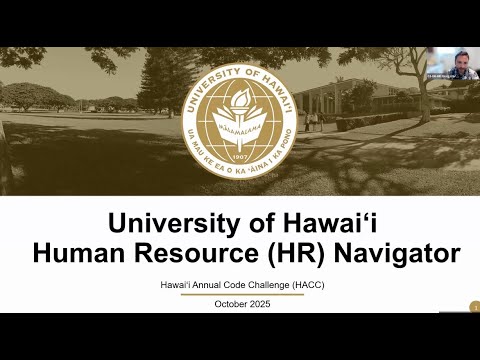
A senior analyst for the University of Hawaii Office of the Vice President for Administration outlined requirements for an AI agent to handle routine benefits and leave inquiries for the university’s roughly 15,000 employees, emphasizing accuracy, source citation, and limits on storing protected data.
A senior analyst for the University of Hawaii Office of the Vice President for Administration outlined a proposal for an AI agent to handle routine employee questions about benefits and leave, saying the tool should improve consistency of responses and free human resources staff for higher-value work.
The analyst said the university’s roughly 10 campuses employ more than 15,000 full- and part-time workers across administrative, professional and technical staff, civil service staff, executive and managerial staff, faculty and temporary hires, many of whom are covered by collective bargaining agreements. Because eligibility for benefits and leave varies by appointment and bargaining unit, the analyst said employees often have trouble finding the precise information they need on the university website or in the agreements.
“We're really looking to streamline access to this information,” the analyst said, adding that the desired agent should provide “accurate, reliable, and tailored response[s] to employees” for basic inquiries while directing complex cases to a human HR representative.
Key requirements the analyst listed include: objective, matter-of-fact responses tailored to the employee using criteria derived from a personnel record; explicit citation of source documents used for answers; a clear explanation of the agent’s scope and limits; and an explicit handoff to HR when answers are uncertain or require interpretation under collective bargaining agreements. The analyst said the agent should not “overstate its capabilities” or “produce any false or misleading information or hallucinate.”
The university will provide a set of publicly available documents that will form the agent’s knowledge base, plus supplemental hypothetical employee datasets for testing. The analyst said real employee data will not be used for the challenge; the hypothetical dataset is intended to mirror real personnel records so teams can validate whether responses match eligibility rules for different appointments.
Security and data-handling rules were emphasized. The analyst said the agent must comply with the institution’s data-governance policy and “should not request, collect, or store any protected data” provided by employees. Microsoft 365 integration and ticketing-system connectivity were listed as optional, “nice to have,” features.
The analyst described expected use levels as variable: the agent could be used concurrently by dozens of users, serve hundreds of users in a day, and reach into the thousands or tens of thousands of engagements in a month. The intended operational benefits are fewer routine HR calls and emails, more consistent answers statewide, and the ability to quantify and analyze common inquiry types to guide further improvements.
The presentation concluded with logistical next steps: the deck and datasets will be circulated to challenge participants, a Slack channel was provided for collaboration, and the analyst said they would address questions in breakout sessions later in the day.