Get Full Government Meeting Transcripts, Videos, & Alerts Forever!
Get email alerts on the Public Library topic
No spam. Unsubscribe anytime.
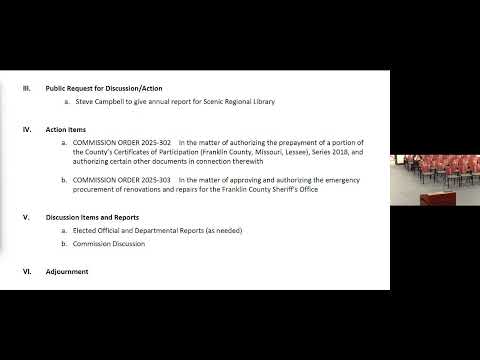
Scenic Regional Library tells Franklin County commission it served 129,000 residents, reported $7.4M budget
Summary
A representative of the Scenic Regional Library presented its annual report to the Franklin County Commission summarizing branch growth, circulation (including 289,000 digital checkouts), outreach programs and a roughly $7.4 million operating budget with $1.1 million in bonds outstanding.
Steve Campbell, a representative of the Scenic Regional Library, presented the library district’s annual report to the Franklin County Commission, outlining usage, programs and the library’s operating budget.
The report matters to county taxpayers because the district serves roughly 129,000 residents across Franklin, Warren and Gasconade counties (with one exception noted for Washington city library), operates nine branches and listed an operating budget of about $7.4 million for the most recent year, Campbell said.
Campbell told commissioners the district now has nine branches (up from seven when he began work in 2012), with buildings renovated or rebuilt between 2018 and 2022 after a voter-approved tax increase in 2014. The district issued more than 6,000 new library cards last year, recorded roughly 346,000 in-person visits and checked out 422,000 physical items systemwide.
Digital circulation was substantial: Campbell said patrons checked out about 289,000 e-books, e-audiobooks and digital music, representing roughly one-third of total circulation. He described statewide resource sharing through the Missouri Evergreen consortium and said Scenic Regional borrowed about 252,000 items from other libraries and loaned about 40,000 items to other systems last year.
Campbell also described several service lines beyond traditional lending: meeting-room use (about 1,700 uses last year), outreach to senior facilities (the library’s outreach staff visited more than 210 nursing homes, adult day centers and senior centers in 2024–25 and reached more than 2,600 seniors), and early-childhood programs such as the “Thousand Books Before Kindergarten” program (more than 845 parent–child participants, 61 completions so far). He noted the library’s teacher-assistance program fulfilled roughly 70 requests and delivered about 2,300 items to classrooms last year.
On revenue and budget, Campbell said the district’s approved budget was about $7.4 million and that the district still carries roughly $1.1 million in bonds from building projects. He also noted passport services as a growing revenue stream and convenience: the district processed more than 1,900 passport applications and took more than 1,700 passport photos last year; Campbell said the library collected about $96,000 in passport fees that were remitted per federal requirements.
Campbell cited a commonly used library value calculator to summarize taxpayer return, saying, “for every $1 in revenue in tax money a person in our district pays to our library, they get $3.69 back in services.” He emphasized partnerships that expand offerings, including check-out items such as fishing poles (Missouri Department of Conservation), blood-pressure cuffs (American Heart Association) and memory kits (Aging Ahead), and access to paid databases such as Value Line, Ancestry and Pronunciator for cardholders.
No formal action was requested or taken on the report; Campbell concluded his presentation and invited questions from commissioners.