
Board votes to prepare county systems as federal H.R.1 work requirements and Medi‑Cal asset test loom
Get AI-powered insights, summaries, and transcripts
Subscribe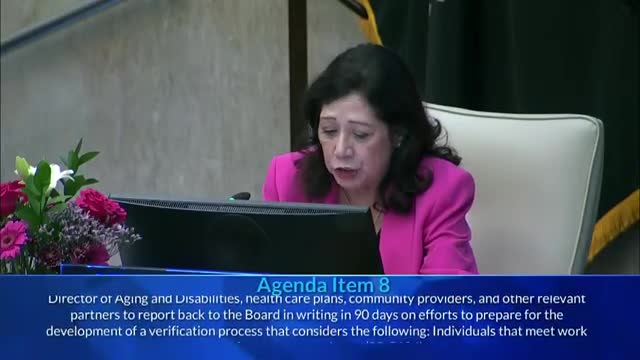
Summary
The Board of Supervisors approved a motion directing county departments to coordinate verification, expand qualifying activities and press the state for a minimally restrictive process after county staff warned H.R.1 will subject hundreds of thousands of residents to new work or asset rules.
The Los Angeles County Board of Supervisors voted 4–0 on Oct. 21 to direct county agencies to prepare for new federal requirements that will expand work rules for CalFresh and Medi‑Cal and reintroduce an asset test for some beneficiaries.
Supervisor Hilda Solis, the motion’s lead author, told the board H.R.1 includes “sweeping changes to public assistance programs,” and warned the new rules could jeopardize access to Medi‑Cal for as many as 1.5 million Angelenos and require about 202,000 CalFresh recipients to meet work requirements beginning early next year. "Work requirements will do nothing but hurt those that are most vulnerable," Solis said on the board floor.
The motion—coauthored by Supervisor Lindsey Horvath—directs the Department of Public Social Services (DPSS), the Department of Health Services, the Department of Mental Health and other county partners to build a coordinated verification system that tracks work or volunteer participation, exemptions and eligibility across both Medi‑Cal and CalFresh. It asked the CEO's legislative affairs and DPSS to press the state for a “flexible and minimally restrictive verification process” and to design technology solutions and data-sharing agreements with community partners to minimize coverage loss.
Supervisor Horvath emphasized outreach and broadening qualifying activities, including community service and workforce options, noting research shows work mandates often reduce caseloads but not poverty. "As many as 1,500,000 Angelenos are at risk of losing Medi‑Cal when new work requirements take effect on 01/01/2027," Horvath said, and urged immediate county action to preserve enrollment.
DPSS representatives told the board staff are examining technical options for verification, including self‑attestation for gig and self‑employment income and new geographic information tools to identify communities at higher risk of coverage loss. "Self attestation is key," Michael Zylvester, chief deputy administrator for DPSS, said in response to supervisors’ questions about tracking nontraditional work.
The motion also requires county departments to plan volunteer opportunities and other qualifying activities that could count toward work requirements, with special attention to populations facing barriers to access, such as people experiencing homelessness and those with limited English proficiency. A report back to the board was requested within 90 days with recommendations on verification technology, outreach, and potential fiscal implications.
The board approved the motion by roll call: Supervisors Solis, Mitchell, Horvath and Barker recorded aye votes; Supervisor Hahn was absent.