
Tennessee Revenue holds webinar explaining franchise and excise filing rules, deadlines and common errors
Get AI-powered insights, summaries, and transcripts
Sign Up Free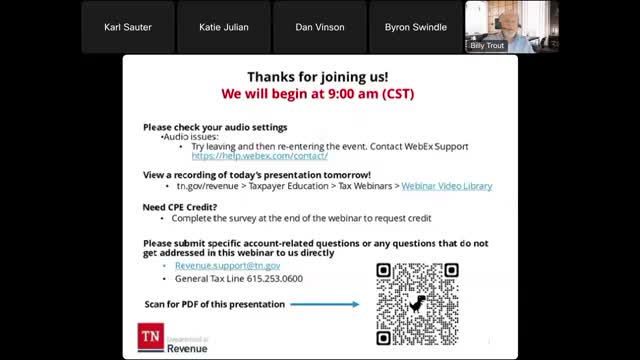
Summary
The Tennessee Department of Revenue walked taxpayers and tax professionals through franchise and excise (F&E) filing basics on Oct. 28, 2025, covering deadlines, a 7-month extension rule, estimated-payment rules, common schedule errors, apportionment changes tied to the Tennessee Works Tax Act and steps to close accounts.
Katie Julian, a presenter with the Tennessee Department of Revenue, led a 58-minute webinar on Oct. 28, 2025, detailing how corporations, LLCs and other registered entities must file Tennessee’s franchise and excise (F&E) tax returns and avoid common filing pitfalls.
Julian said F&E “is a combination of the franchise tax and the excise tax combined to make F and E. Franchise is basically a business's net worth.” She and other Revenue staff explained who must file, the timing for returns and estimated payments, renewal and exemption rules, how apportionment works under recent law changes, and the mechanics for obtaining tax clearance to dissolve a business.
The guidance matters because F&E affects most entities that register with the Tennessee Secretary of State and because several technical rules can trigger large adjustments if filled incorrectly. The Department emphasized that many errors stem from omitted schedules (which can default taxpayers to a full Tennessee apportionment), missed exemption renewals and confusion about extension and estimated-payment calculations.
Key filing dates and payment rules The F&E return is generally due on the 15th day of the fourth month after a fiscal-year end; for calendar-year filers that is April 15. Julian said the state allows a seven-month extension to file if certain payments are made on time; that extension moves the filing deadline to Nov. 15 for calendar-year taxpayers, but it is an extension to file, not to pay. To obtain the extension automatically, taxpayers must timely pay the lesser of: 90% of the current period liability, 100% of the prior period liability (annualized), or, if no prior period exists, $100.
Estimated payments are required when combined F&E liability is $5,000 or more (after credits) for the prior and current period. The four payment dates for calendar-year filers are April 15, June 15, Sept. 15 and Jan. 15. Carl Sauter, communications auditor in taxpayer services, advised a conservative approach: “The safest thing to do is to always just take your previous year and divide that by 4.”
Rates, minimums, and carryforwards The Department reiterated statutory rates and limits provided during the webinar: franchise tax is 25 cents per $100 of Tennessee net worth; excise tax is 6.5% of Tennessee taxable income; and an active entity generally owes a $100 minimum F&E tax each year. Net operating losses (NOLs) may be carried forward up to 15 years and cannot be carried back or transferred between entities.
Apportionment and recent law changes Speakers reviewed apportionment schedules and a recent statutory change. Julian noted that, starting with tax years ending on or after Dec. 31, 2025, Tennessee’s standard apportionment has phased in to a single sales factor under the Tennessee Works Tax Act. Audit staff warned about a common submission error: leaving the apportionment schedule blank causes the Department’s system to default to 100% apportionment to Tennessee. Auditor Byron Swindle said, “If you leave the schedule blank, the system will automatically go to 100.” He advised filers to supply even minimal apportionment figures where appropriate to avoid large automated adjustments.
Exemptions, renewals and penalties Some exemptions must be renewed annually in place of filing the return; the renewal due date matches the return due date (April 15 for calendar-year filers). A late exemption renewal generally triggers a $200 flat penalty. The Department explained one exception: if a timely F&E return is filed and the filer later submits the exemption application (FAE-183) showing the entity met exemption criteria for that tax period, Revenue can remove the $200 penalty upon request. Julian and Byron advised taxpayers to contact Revenue to correct that situation.
Late filing, interest and other penalties The Department clarified penalty rules: with a valid extension and timely filing, only interest will be due on any remaining balance; interest cannot be waived and the webinar cited the then-current interest rate (11.5 percent). For late returns without a valid extension, penalty and interest apply from the original due date. Delinquency penalty for a late return is 5% per month (or partial month) up to a 25% maximum, with a $15 minimum. Late estimated-payment penalties are calculated at 2% per month up to 24% plus interest.
Closing accounts and tax clearance Julian explained closing an F&E account requires closing all related tax accounts (sales, business tax, payroll as applicable) and obtaining a tax clearance letter before dissolving with the Secretary of State. The Department’s online clearance tool and procedural steps are on the Revenue website; staff reiterated that paying an assessment alone does not produce a clearance if returns for periods remain unfiled. The clearance letter is valid for 45 days once issued.
Technical resources and help Revenue staff pointed attendees to the Tennessee Taxpayer Access Point (TINTAP), certified MEF vendors and detailed guidance in the Department’s Franchise and Excise Tax Manual (the manual was identified as the primary line-by-line resource). Julian said webinar materials and a recording would be posted to Revenue’s webinar library and shared a PDF of the presentation. For individualized help, Revenue provided revenue.support@tn.gov and a phone number (615-253-0600).
What remained discussion and next steps Speakers did not adopt new policy or issue formal rulings during the webinar; the session was instructional. Staff encouraged attendees to review the tax manual, use the Department’s help channels for case-specific questions, and consider follow-up webinars (the Department plans monthly webinars on related topics).
Contact and resources The Tennessee Department of Revenue said the recording, the PDF presentation and Revenue help articles will be posted to tn.gov/revenue (search franchise and excise tax). For account actions, use TINTAP; for help requests submit a ticket via Revenue Help or email revenue.support@tn.gov; phone assistance is available at (615) 253-0600.