Get Full Government Meeting Transcripts, Videos, & Alerts Forever!
Tennessee Revenue holds webinar explaining franchise and excise filing rules, deadlines and common errors
Summary
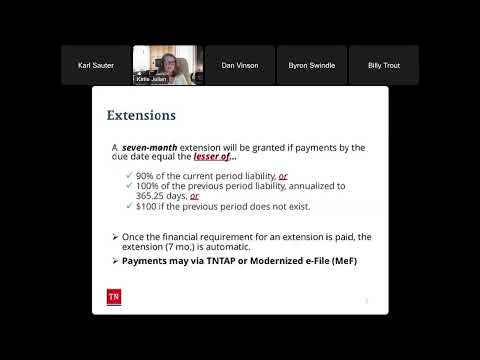
The Tennessee Department of Revenue walked taxpayers and tax professionals through franchise and excise (F&E) filing basics on Oct. 28, 2025, covering deadlines, a 7-month extension rule, estimated-payment rules, common schedule errors, apportionment changes tied to the Tennessee Works Tax Act and steps to close accounts.
Katie Julian, a presenter with the Tennessee Department of Revenue, led a 58-minute webinar on Oct. 28, 2025, detailing how corporations, LLCs and other registered entities must file Tennessee’s franchise and excise (F&E) tax returns and avoid common filing pitfalls.
Julian said F&E “is a combination of the franchise tax and the excise tax combined to make F and E. Franchise is basically a business's net worth.” She and other Revenue staff explained who must file, the timing for returns and estimated payments, renewal and exemption rules, how apportionment works under recent law changes, and the mechanics for obtaining tax clearance to dissolve a business.
The guidance matters because F&E affects most entities that register with the Tennessee Secretary of State and because several technical rules can trigger large adjustments if filled incorrectly. The Department emphasized that many errors stem from omitted schedules (which can default taxpayers to a full Tennessee apportionment), missed exemption renewals and confusion about extension and estimated-payment calculations.
Key filing dates and payment rules The F&E return is generally due on the 15th day of the fourth month after a fiscal-year end; for calendar-year filers that is April 15. Julian said the state allows a seven-month extension to file if certain payments are made on time; that extension moves the filing deadline to Nov. 15 for calendar-year taxpayers, but it is an extension to file, not to pay. To obtain the extension…
Already have an account? Log in
Subscribe to keep reading
Unlock the rest of this article — and every article on Citizen Portal.
- Unlimited articles
- AI-powered breakdowns of topics, speakers, decisions, and budgets
- Instant alerts when your location has a new meeting
- Follow topics and more locations
- 1,000 AI Insights / month, plus AI Chat