Get Full Government Meeting Transcripts, Videos, & Alerts Forever!
Get email alerts on the Transportation Impact Taxes Mou topic
No spam. Unsubscribe anytime.
County committee approves revised MOU with Gaithersburg to allocate $15.6 million in impact taxes to local transportation projects
Summary
Montgomery County’s Transportation and Environment Committee approved a revised memorandum of understanding with the City of Gaithersburg that updates a 2006 agreement and programs roughly $11.6 million for eight city shared-use path projects while reserving $4 million for county transit projects serving Gaithersburg.
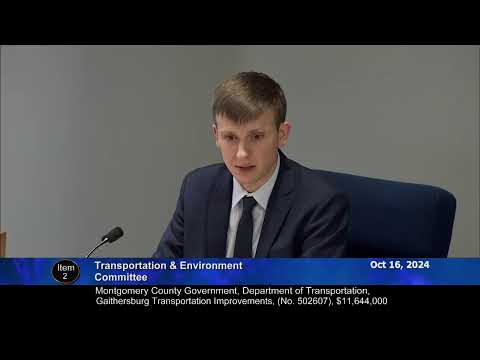
The Montgomery County Transportation and Environment Committee on Oct. 16 approved a revised memorandum of understanding between Montgomery County and the City of Gaithersburg that updates a 2006 agreement on the use of development impact taxes and programs funds for a set of city and county transportation projects. The committee also approved an associated amendment to the county’s FY25–30 Capital Improvements Program and a supplemental appropriation to program city-eligible funds.
The MOU update reflects a remaining balance of $15,600,000 in impact tax revenues collected within the city as of June 2025. Under the agreement the city’s new Gaithersburg Transportation Improvements CIP will program $11,600,000 (reported in staff materials variously as $11,600,000 and $11,644,000) for eight identified shared-use path projects in Gaithersburg; the remaining $4,000,000 is reserved for county transit projects that serve the city. The MOU also establishes a 65/35 split for how future impact tax revenues collected within the city will be allocated between city projects and county projects within Gaithersburg, with future project lists to be set through the usual CIP and budget amendment processes.
Why it matters: development impact taxes collected inside municipal boundaries can be used to pay for transportation improvements. County staff said the revised agreement removes the need to reopen detailed MOU negotiations each time the parties want to change which projects are eligible: the MOU defers the specific, amendable project list to the CIP so the city and county can amend project lists through the regular budget process.
Committee and staff presentations said the city portion will fund eight shared-use path projects identified in the supplemental appropriation: Old Town shared-use path; Quince Orchard Boulevard shared-use path; Industrial Drive shared-use path; Washingtonian Boulevard shared-use path; Conservation Lane shared-use path; West Deer Park Road shared-use path; Kentlands shared-use path; and the I-270/NIST East Side shared-use path. Council staff additionally recommended language in the fiscal note listing three county projects that could receive the $4,000,000 reserved for county uses: bus rapid transit system development (including the Maryland Route 355 Central bus rapid transit corridor), the proposed Lake Forest Transit Center (which may be broken out from a larger project in a future CIP amendment), and the Great Seneca Science Corridor Transit Improvements project for construction and fleet procurement.
County staff emphasized the MOU updates a 2006 agreement and implements a governance change: rather than a fixed, hard-coded list in the MOU, the parties will use the CIP process to identify and amend eligible projects. "This MOU ... defers the identification of the list of projects on which this revenue can be spent to the CIP," Council staff said. Director Chris Conklin, Department of Transportation, described the breakthrough as assigning transit investments to county funding and street/pedestrian investments to city funding, which "made sense" and helped parties reach agreement after a long period of negotiations.
Gaithersburg officials welcomed the agreement. "We are really happy to be at this moment," the city’s mayor said, calling the settlement the culmination of more than a decade of negotiation. City Manager Tanisha Bridal said the city and county had done "a lot of give and take" and that she believed the parties had "reached a fair agreement." Councilmember Sidney Katz, a former Gaithersburg mayor who helped convene negotiations, said, "Sometimes it takes a lifetime to become an overnight success" and thanked county and city negotiators.
On the budgeting timeline, Office of Management and Budget representative Gary Nalvin told the committee that the executive’s recommended CIP will include appropriations for the projects and that the $4,000,000 set aside for county projects could be appropriated either by supplemental or in the next CIP cycle (the committee heard January as the next regular CIP update). Council staff’s recommended fiscal-note language also notes that approval of the supplementation does not bind the council to specific future appropriations of the $4,000,000: future allocations remain subject to the council’s usual budget authority.
The committee approved the MOU (part A of the two-step process) and then approved the FY25–30 CIP amendment and the supplemental appropriation programming roughly $11.6 million for the Gaithersburg Transportation Improvements CIP. Committee members called the vote unanimous and moved the measures forward.
What’s next: the Gaithersburg CIP project will be reflected in the county’s budget documents and the executive’s recommended CIP; county staff said the Lake Forest Transit Center could be separated from a larger project in a future amendment. The council retains discretion over the eventual appropriation and project-level approvals for the county projects that may receive the reserved $4,000,000.