Get Full Government Meeting Transcripts, Videos, & Alerts Forever!
Get email alerts on the Lighting El Granada topic
No spam. Unsubscribe anytime.
Planning commission approves revised El Granada Elementary parking-lot lighting with conditions after public concern
Summary
San Mateo County planning commissioners approved an amendment to permits for parking-lot lighting at El Granada Elementary School after hearing technical changes from the district, input from lighting consultants and neighborhood concerns about night-sky impact and a late-night pole kept for custodial safety.
San Mateo County Planning Commission on a voice vote approved an amendment to project permits for El Granada Elementary School that authorizes five pole-mounted lights in the school’s parking lot, lower mounting heights and a programmable, zone-based lighting schedule aimed at reducing off-site light spill.
The action came after staff and the district presented a revised design developed with an outside dark-sky consultant, followed by public comment urging further limits on nighttime lighting. Camille Leung, the project planner, summarized the application as an amendment to the campus modernization project that separates parking-lot lighting for additional community review.
The project team, representing the Cabrillo Unified School District, described technical changes made after community meetings and consultant review. Drew Gammon, the district’s bond fiscal project director, said the district had reintroduced parking-lot lighting after earlier removal and then retained an outside consultant to reduce light levels, pole heights and quantity. Shannon Goolsby, the project lighting designer, said site visits and night observations confirmed the lot is “a fairly dark location” and that the design was revised to meet stricter dark‑sky goals, including a 2,200‑Kelvin color temperature.
Staff explained the key elements the commission considered: five 18‑foot pole‑mounted fixtures with full shielding aimed at minimizing back‑spill toward Santiago Avenue, timed zone controls for different fixture groups, and a 10‑minute “twist” timer inside the trash enclosure so that those lights are only on for short, staff‑activated periods. The staff report and planner noted relevant standards in the county General Plan and Local Coastal Program (including General Plan policy 8.13) and said the project would require amendments to a 1980 use permit, design review and a resource management permit.
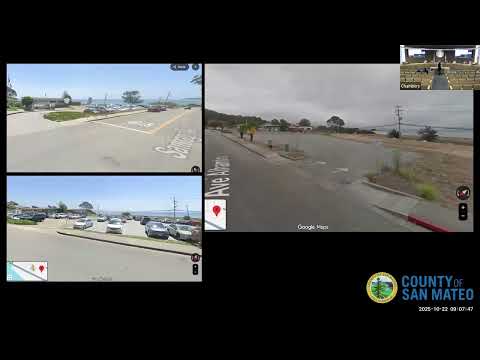
Neighborhood speakers welcomed the lower color temperature and other reductions but urged additional measures to ensure lights are on only when needed. Dan Haggerty, a long‑time El Granada resident and former Midcoast Community Council member, asked the commission to require either a convenient manual/time switch or a motion sensor so the late‑hour pole would not remain on by default: “I think it’s extremely reasonable … that there should be a either a a time switch somewhere that’s convenient ... or an appropriate motion sensor,” he said. Kimberly Hines, who lives across the street from the campus, asked for an inspection and on‑site testing before the district is allowed to put the poles into regular operation, citing a local precedent where fixtures did not meet expectations once installed.
District and design team members told commissioners the lighting control system is fully programmable and that manual overrides (switches in the electrical room of the new classroom building) would be available; the team said moving primary control to the school’s administration building is possible but would add cost and trenching to run conductors. Commissioners and staff discussed a compromise recommended by speakers and applicants: use an astronomical time clock to turn zones on and off on a set schedule while providing labeled manual switches for staff to override specific zones when custodial or maintenance staff must remain later than the scheduled off time. The project team said manual switching in the new classroom building would allow custodial staff to turn the pole on when necessary and that the district would train staff in use of the switches.
Commissioner Nugent moved approval of the amendment to the project permits — specifically a coastal development permit/use permit amendment, design review permit amendment and resource management permit amendment — with the conditions in Attachment A of the staff report; Commissioner Garcia seconded. Commissioner Garcia, Commissioner Nugent and Acting Chair Gupta voted aye. The motion carried.
The conditions incorporated in the approved permit package include requirements summarized in the staff report and planning commission attachments: use of lower‑temperature (yellow/amber, ~2,200 K) fixtures, full shielding on pole fixtures, the specified zone schedule (zones 1 and 3 timed off at 8:30 p.m., zone 2 remaining later for trash/cleaning up to 11 p.m. under the proposed schedule), a twist timer for the trash enclosure, significantly reduced pole heights compared with the originally permitted design and limitations on event night lighting (zone 4 and 5 to be used only for scheduled events, estimated at 25 events or fewer per year). The project remains subject to design‑review conditions and the county’s resource management standards.
The commission’s approval ended the item; staff said implementation details for wiring or relocating lighting control to the administration building could be pursued later if the district chose to fund those changes. No building permits or additional public hearings are required beyond the normal permit and inspection processes for the approved amendments.
Votes at a glance: the motion to approve the amendment to permits was moved by Commissioner Nugent, seconded by Commissioner Garcia; vote 3‑0 (Garcia – aye; Nugent – aye; Gupta/Acting Chair – aye).