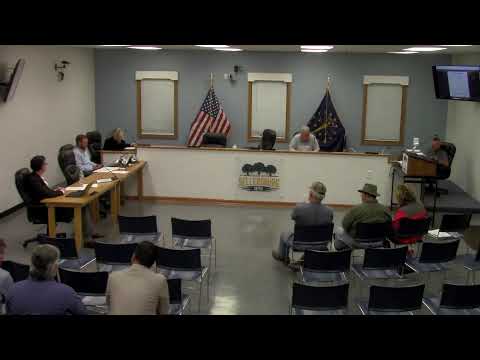
Sellersburg BZA approves variances to split seven duplex lots into 14 owner-occupied lots at Saint Joe Place
Loading...
Summary
The Town of Sellersburg Board of Zoning Appeals approved development-standard variances allowing Thompson Collective LLC to replat seven duplex lots in Saint Joe Place into 14 individually owned lots.
The Town of Sellersburg Board of Zoning Appeals on Thursday approved development-standard variances that will allow Thompson Collective LLC to replat an existing duplex development in the Saint Joe Place subdivision into 14 individually owned lots.
The board found that the three statutory criteria in Indiana Code 36-7-4-918.5 were met and approved variances for lot width and lot area to permit the split of seven existing two-family buildings into 14 attached single-family lots. The petition, filed under agenda item 2025-09-DV-07 by Jason Copperway on behalf of Thompson Collective LLC, covers property identified in the record at 6659 Atkins Road, Floyd Knobs.
Jake Vissing, an attorney with the law firm Frost Brown Todd representing the petitioner, described the plan as a replat that draws property lines down the party wall so each attached unit can be sold to owner-occupants rather than held in common ownership. Vissing said the use and character of the property would not change — the same number of dwelling units would remain on-site — but legal ownership and tax parcels would be separate. He described plans to record a “comprehensive declaration of covenants, conditions and restrictions” covering exterior maintenance, party-wall responsibilities and an HOA enforcement mechanism. Vissing told the board his draft declaration would require an 85% owner vote to amend the document.
Residents who live nearby told the board they were concerned about density, property values and notice. Jeff Barton of 1130 Crone Road asked how easily an HOA could be removed in the future, and Sandy (Sandra) Carver, who said she represents a property owner across the street, said the proposed individual-sale prices (she cited a projected sale price near $230,000) could undermine surrounding home values that she described as generally in the $300,000–$400,000 range. Carver also said she believed about 11 separate variances would be needed for the proposal; that count was presented as her observation during public comment.
Town staff and the board discussed technical standards. Staff identified minimums for the R-2 zone cited in the record: a minimum lot width of 40 feet when measured at the street frontage and a minimum lot area requirement of 4,000 square feet per unit for single-family and two-family dwellings. Staff noted the site totals about 2.188 acres and that the buildings are already constructed, which staff said creates practical difficulties for subdividing under strict application of the ordinance given the cul-de-sac geometry and irregular lot shapes.
After taking separate findings-of-fact votes addressing the statutory criteria for the lot-width and lot-area requests, the board voted to approve the development standard variances. The board’s approval included direction that a recorded declaration of covenants and restrictions be filed with the county clerk; the board noted that the declaration will set maintenance and exterior-material expectations and provides a private enforcement mechanism among owners. The transcript does not list a roll-call tally by name; the action was recorded as approved on the record following motions and seconds.
Board and staff members discussed next steps. The board was told on the record that, administratively, the rezoning/variance approval will be followed by a plat submittal to the planning commission. Depending on the item and required approvals, plats may return to the town council for final action as required by the town’s subdivision procedures; the transcript contains discussion and some clarifying comments from staff about which approvals are ministerial and which will require further hearings.
No new construction was proposed as part of the application, and staff said the requested variances are an exception rather than a change to town policy. The board noted it could set conditions related to siding, roof materials and road/drive maintenance as part of its approval.
The board’s action allows the applicant to proceed with the replat process under the approved variances and to record HOA/declaration documents as a mechanism for addressing shared elements such as party walls and roofs. The transcript records substantive public concern about neighborhood character and property values as part of the public-comment portion of the hearing.