Lifetime Citizen Portal Access — AI Briefings, Alerts & Unlimited Follows
Senate hearing spotlights allegations of government pressure on social platforms and debate over FCC threats to broadcasters
Loading...
Summary
Witnesses told the Commerce Committee that government contacts with social media companies led to unlawful or coercive censorship in some cases, while senators and witnesses also warned that recent threats by the Federal Communications Commission chair to revoke broadcast licenses raise separate First Amendment risks.
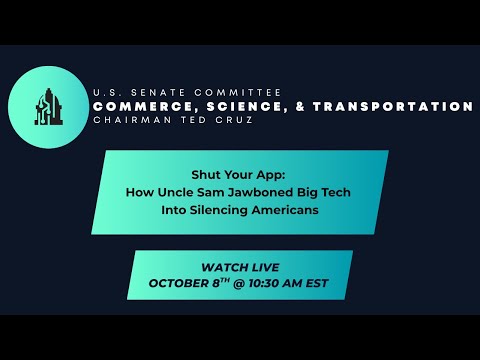
Alex Berenson, a journalist who testified that Twitter permanently suspended him in 2021, and Sean Davis, CEO and cofounder of The Federalist, told the Senate Commerce Committee that government contacts with social media companies contributed to deplatforming and other restrictions on their speech.
Berenson said his suspension “deprived me of my largest and most vital platform for my journalism” and testified the ban followed, in his view, pressure from the Biden White House and “at least 1 senior Pfizer board member.” He told senators he sued Twitter in December 2021, that Twitter later admitted his posts “should not have led to my suspension,” and that he was reinstated in July 2022. Berenson told the committee a federal district judge had “laid out” facts in rulings in a 2023 lawsuit he brought against the federal government and others; he also said a recent ruling recognized that, “on the merits, the federal government has now conceded my claim that the Biden administration violated my First Amendment rights in 2021,” while the court nevertheless dismissed his case on other legal grounds.
Sean Davis, who identified himself as the CEO and cofounder of The Federalist, described his outlet’s experience with demonetization and alleged platform actions. “We were also targeted for bankruptcy and destruction by the US State Department and its Global Engagement Center,” Davis said, testifying that the outlet faced advertiser and platform pressure during 2020. He said tech companies and outside groups sometimes coordinated in ways that throttled his site’s reach.
Witnesses and senators debated where the line should be drawn between lawful, noncoercive government information-sharing about foreign disinformation and impermissible coercion of private platforms. Gene Kimmelman, a public-interest advocate and former CEO of Public Knowledge, told the committee he does not believe “government should coerce social media companies.” Several senators echoed that transparency can reduce harms, while others said the government has a legitimate role in flagging foreign disinformation and threats to public safety.
Committee members also separated this line of inquiry from a parallel set of concerns about the Federal Communications Commission. Multiple senators and witnesses criticized recent public comments by FCC Chair Brendan Carr, who at times publicly suggested regulatory scrutiny of broadcasters over programming he deemed objectionable. “If ABC acted to remove Jimmy Kimmel because of FCC chairman Carr’s threats, would Carr’s actions violate the First Amendment?” asked one member; a witness replied, “Yes. I think so.” Several senators described those public threats as unprecedented and asked the committee to examine the FCC’s public-interest enforcement posture.
Witnesses and senators also discussed the limits of current law. Berenson and others noted Section 230’s role in social platforms’ content decisions and described legal obstacles to obtaining damages from federal officials for First Amendment claims. Committee members and witnesses requested more transparency from both platforms and government agencies about reports or requests to remove or label content, and some urged statutory or procedural changes—for example, mandatory disclosure of government requests to platforms or a private right of action against government coercion.
The hearing ranged across related topics including media consolidation, antitrust enforcement, and the technical limits of automated detection of AI-manipulated media. Several witnesses recommended improving competition among platforms and guardrails for algorithmic power but warned of an “arms race” between manipulation and detection technologies.
The committee accepted testimony and placed submitted letters and documents into the hearing record; senators will be able to submit additional questions for the record and witnesses were given deadlines in the hearing to respond.
Provenance: testimony and exchanges summarized above appear in witness statements and question-and-answer segments beginning with Alex Berenson’s opening testimony and continuing through questioning by Senators Cruz, Cantwell, Klobuchar, and others.