Get Full Government Meeting Transcripts, Videos, & Alerts Forever!
Get email alerts on the Cdbg Funding topic
No spam. Unsubscribe anytime.
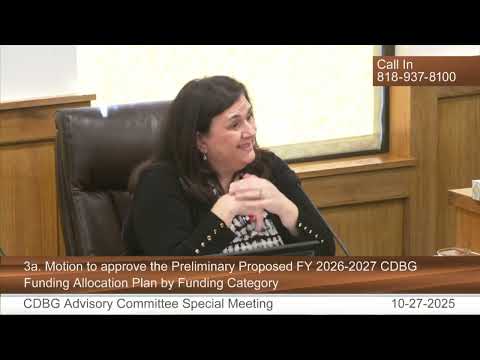
Glendale CDBG advisory committee approves preliminary FY 2026–27 allocation plan and RFP packets
Summary
The City of Glendale’s Community Development Block Grant Advisory Committee on Oct. 27 approved a preliminary $1.7 million FY 2026–27 CDBG allocation plan and authorized RFP packets for public social services and capital projects, while noting final federal appropriations could change local entitlement amounts.
GLENDALE, Calif. — The City of Glendale’s Community Development Block Grant (CDBG) Advisory Committee on Oct. 27 approved a preliminary funding-allocation plan for fiscal year 2026–27 and voted to release request-for-proposal (RFP) packets for public social services and capital improvement projects.
The committee approved staff’s preliminary estimate of a $1,700,000 annual entitlement for Glendale’s CDBG program for 2026–27, and directed staff to use the allocation breakdown presented: $340,000 (20%) for program administration, $255,000 (15%) for public social services (the federal cap), and about $1,100,000 (65%) for capital improvement projects to be available to community agencies. Staff noted there is no undesignated balance or return funds at this time.
The recommendation is preliminary because staff said the federal appropriations process remains unsettled. City staff reported that during congressional appropriations discussions the U.S. House proposed holding national CDBG funding near $3.3 billion while a Senate draft contemplated roughly $3.0 billion; the committee’s local estimate uses the city’s current allocation projection. Staff said final local entitlement could change after Congress and federal agencies complete appropriations and that the committee will revisit the plan if the actual grant amount differs.
Committee members discussed whether reserving the full capital share could affect nonprofits’ decisions to apply for social-services funding. One member said organizations tracking potential city-funded planning work might alter or shrink proposals if they expect some CDBG funds to be redirected to city capital projects later in the year. Staff replied that any city capital projects would be proposed only if returned/undesigned funds or other adjustments become available in a later update to the committee.
The committee also approved the program priorities for FY 2026–27, which staff said remain the same as those developed for Glendale’s five-year consolidated plan adopted last year. Staff reviewed outreach and data used to set priorities: community meetings (one Oct. 1 meeting had no in-person attendees), an email/telephone comment period that yielded six submissions, and American Community Survey (ACS) data (2023 estimates used because 2024 ACS data were not available at the time of the meeting). Staff cited selected 2023 ACS figures used in the formula: a city population of about 187,008 (noted as an increase of roughly 773 persons), a 13.4% family poverty rate in Glendale, children making up about 18% of the population, seniors about 18.4%, and a median rent of $2,002.
On the public social services RFP packet, staff said the city will estimate $255,000 for social-services awards and will publish the program priorities into ZoomGrants, the online application system. The committee approved updated application questions intended to improve evaluation when agencies are partially funded: question 3 will ask applicants to state the number of unduplicated people they expect to serve at the full requested funding level; newly added question 28 will ask the number of unduplicated people the program could serve at a stated minimum funding amount. Staff said the unduplicated-person count is a longstanding metric and that quarterly roster checks are used to verify unduplicated service counts.
Staff briefed the committee on ZoomGrants, which the city uses for online submissions and for which the city’s IT department pays licensing costs through October 2026. Staff and committee members said the system has reduced paper handling and has been positively received by agencies, who appreciate later deadlines and online submission. The Housing Rights Center was mentioned as an example of an agency already familiar with ZoomGrants from work with other municipalities.
For the capital improvement project (CIP) RFP packet, staff said roughly $1.1 million is being proposed for community-agency capital awards, and that RFP materials will include HUD’s Build America, Buy America (BABA) requirements and NEPA considerations (including radon testing guidance previously adopted). Staff reviewed five existing policies that will be enforced in CIP awards: (1) disqualify incomplete proposals that fail to correct material weaknesses; (2) agencies may not be funded for more than two CIP projects at once and may apply for a second CIP only if the first funded project is in construction and expected to be completed within a year of application; (3) proposals must include at least one general‑contractor cost estimate that reflects prevailing wage rates (two estimates are strongly recommended); (4) proposals must demonstrate project readiness, including completed planning and preconstruction tasks where applicable; and (5) attendance at a mandatory technical-support meeting is required to submit an RFP.
Staff and committee members discussed the HUD conflict-of-interest/competition concern that a contractor who helped prepare an estimate for a nonprofit’s proposal would be ineligible to bid if that nonprofit wins funding. Staff said agencies and contractors sometimes coordinate on proposals with the understanding that contractors will swap work among agencies if necessary.
The RFP technical-support meeting for both social-services and CIP applicants will be held Dec. 8; staff said the day will be split so social-services applicants attend the morning session and capital applicants may attend a later session that same day. Staff also described a CIP checklist that will be provided in the RFP materials to help the committee and applicants assess project readiness.
Votes at a glance
- Item 3(a): Approve preliminary proposed FY 2026–27 CDBG funding allocation plan by funding category — Motion approved (roll call: committee members present voted yes). - Item 3(b): Approve FY 2026–27 CDBG program priorities — Motion approved (roll call: committee members present voted yes). - Item 3(c): Approve FY 2026–27 CDBG public social services RFP packet (including updated application questions) — Motion approved (roll call: committee members present voted yes). - Item 3(d): Approve FY 2026–27 CDBG capital improvement project RFP packet (including BABA, NEPA/radon guidance, and CIP policies) — Motion approved (roll call: committee members present voted yes).
Meeting context and next steps
Staff told the committee it may return in February or March with a revised allocation if Congress and federal agencies issue a different national appropriation number. The committee set the RFP publishing timeline and a mandatory technical support meeting on Dec. 8 for prospective applicants. Staff also emphasized the need to monitor HUD’s timeliness rule and entitlement balance (staff cited HUD guidance that a locality must maintain CDBG expenditure timeliness and avoid having more than 1.5 times its annual entitlement in undisbursed funds), which the committee’s 2023 policies were designed to address.
The committee adjourned after approving the four items; staff thanked members and noted continued outreach to nonprofits and schools about the RFP cycle, and that returned or canceled funds later in the program year could be used for city CIP projects if and when available.