Get Full Government Meeting Transcripts, Videos, & Alerts Forever!
Skagit County work session advances third draft of critical areas ordinance; public comment period set Oct. 30–Nov. 14
Summary
County planning staff summarized substantive changes to the draft Critical Areas Ordinance — including wider riparian buffers, a streamlined reasonable-use path for residential development, and an overhaul of aquifer recharge rules — and opened a third, 15‑day written comment period before the Board may act on Nov. 25.
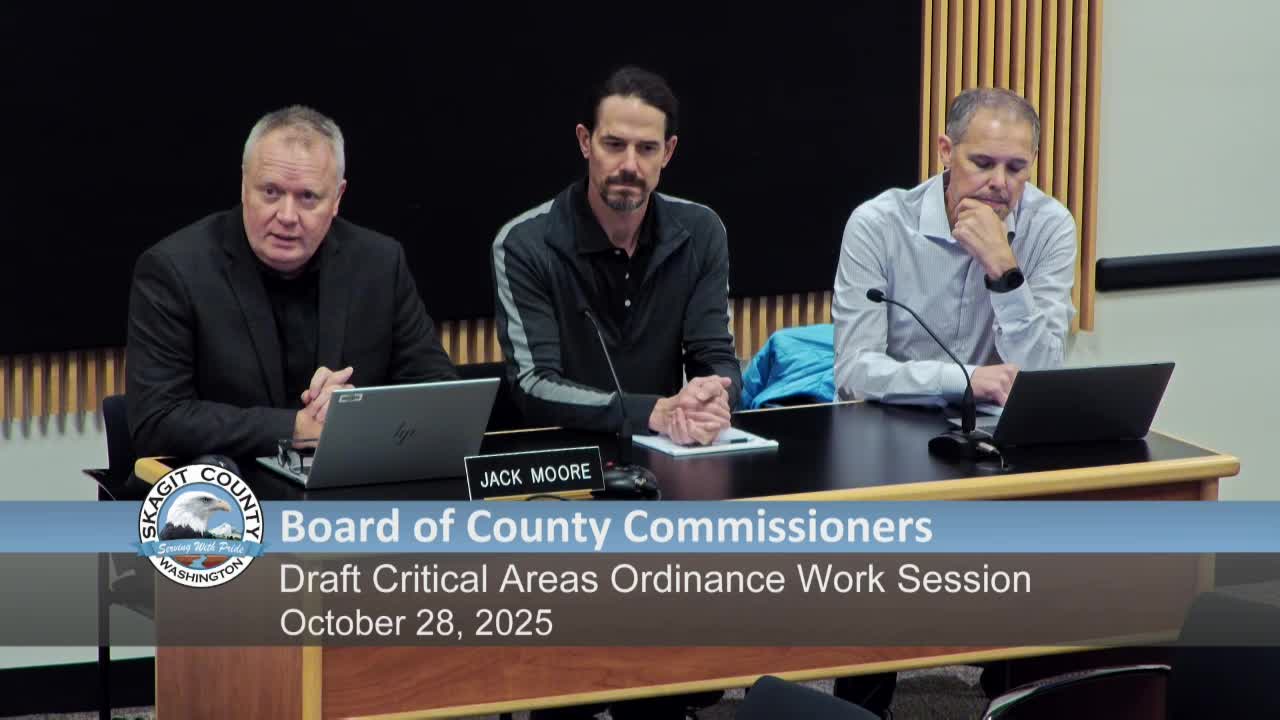
Skagit County planning staff on Oct. 28 presented the Board of County Commissioners with a third draft of the county’s Critical Areas Ordinance update, outlining changes intended to align local code with best available science and to make permitting more predictable for property owners. Senior planner Robbie Eckcroft told the board the county received 25 comments on the prior draft and that the county delayed adoption for a 60‑day mediation after the Swinomish Indian Tribal Community requested mediation with the Washington State Department of Commerce.
The new draft would widen standard riparian buffers, change the county’s reasonable‑use review process and overhaul critical aquifer recharge protections. “As required by the Washington State Growth Management Act, Skagit County is required to update its critical areas ordinance,” Robbie Eckcroft, Senior Planner, said during the work session, and staff are proposing a number of amendments in response to public and tribal comments.
Why it matters: the critical areas ordinance governs protections for wetlands, fish and wildlife habitat, frequently flooded areas, geologically hazardous areas and aquifer recharge zones. Changes to buffer widths, the permitting pathway for development, and aquifer protections affect where and how development and agricultural operations proceed across the county’s lowland and delta areas.
Major changes summarized by staff
- Riparian buffers: staff proposed increasing standard buffer widths from 50 feet to 100 feet for non‑fish‑bearing streams and from 100 feet to 150 feet for fish‑bearing streams less than 5 feet wide. Planning staff said the change is intended to preserve predictability for landowners rather than adopting Washington Department of Fish and Wildlife’s site potential tree…
Already have an account? Log in
Subscribe to keep reading
Unlock the rest of this article — and every article on Citizen Portal.
- Unlimited articles
- AI-powered breakdowns of topics, speakers, decisions, and budgets
- Instant alerts when your location has a new meeting
- Follow topics and more locations
- 1,000 AI Insights / month, plus AI Chat