Get Full Government Meeting Transcripts, Videos, & Alerts Forever!
Get email alerts on the Health.ems Nrp topic
No spam. Unsubscribe anytime.
Tennessee officials report expansion of neonatal resuscitation training for EMS
Summary
State EMS training coordinator Mary Lee Lemley updated a Tennessee Department of Health committee on statewide rollout of the Neonatal Resuscitation Program (NRP), reporting new state funding, exam counts, equipment changes and a July 1, 2026 equipment requirement for uncuffed tubes.
Mary Lee Lemley, an EMS trainer, told a Tennessee Department of Health committee that the statewide rollout of the Neonatal Resuscitation Program (NRP) for emergency medical services has expanded markedly over the past year and is supported by new state funding and equipment updates. "I'm just gonna give you a little bit of an update from where we were to where we are with our EMS training," Lemley said at the meeting.
The update matters because the training targets neonatal care delivered by prehospital providers; Lemley said the program has helped rescue and stabilize neonates in the field and that more counties are offering NRP classes. "This is our Tennessee. 95 counties. My big thing was 95 counties in 95 days. Well, I'm at 101 days," she said, summarizing the program's outreach.
Lemley told the committee that state funding for fiscal year 2025 included $135,000 that was procured at a bulk exam rate; she said the program later received an additional $135,000. According to her presentation, those funds translated to roughly 6,942 NRP exam seats distributed across the state. Lemley also reported that the per-exam pretest fee rose from $55 to $75 "as of yesterday." She said the program has assigned and used just under 2,000 exams in a little over a year and that about 5,223 exam seats remained available.
The presentation broke out regional usage: Lemley reported that Middle Tennessee received 2,372 exams; Erlanger 672; East/Knoxville 1,382; Northeast 672; and West Tennessee 1,844. She said the program is working with RQI (which houses NRP exams) to reconcile historical participation so the state can better measure initial baseline coverage.
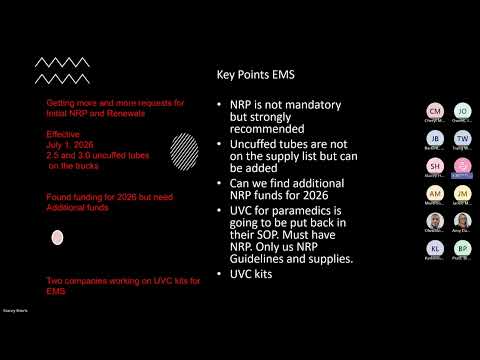
Lemley described changes to equipment and protocol support for EMS teams. She said that after several years of a mandate removing uncuffed endotracheal tubes from ambulances, uncuffed tubes are being returned to trucks. "When we first started this journey, about 6 years ago, we had no uncuffed tubes on our truck. And a mandate came down several years ago that said all pediatric patients needed to be intubated with cuffed tubes... last month, the uncuffed tubes are going back on the truck," Lemley said. She also said Tennessee has about 1,600 EMS trucks in service.
She outlined a state requirement and timeline related to airway equipment: "Uncuffed tooth, that's 07/01/2026. They will have to have a 2.5 and a 3 uncuffed tooth, and they'll have to at least have 1 supraglottic airway on their trucks that will at least cover that 2 kilo baby," Lemley said. (Transcript wording used "uncuffed tooth" and the sizes as stated above; the committee discussion treated those as the required airway sizes and related equipment.)
Lemley also discussed visual aids and materials for ambulances: she said the NRP algorithm cards (previously about $10 each) were negotiated down in price to about $4.46 apiece and that equipping the fleet with laminated cards, including shipping, would cost about $17,293. She presented a per-truck wish list of neonatal items that she estimated at about $84 per truck, while noting she was still seeking lower pricing from vendors.
Several training partners and educators were named as participants in the rollout; Lemley listed Vanderbilt EMS, Volunteer State, Montlow, Columbia and Rome State as programs that currently require students to complete NRP before leaving school, and said five additional programs were considering the same requirement.
Committee members and commenters thanked the trainers and noted complementary funding opportunities. A commenter identified during the meeting as representing a children's hospital alliance said the Rural Health Transformation Fund had included pediatric concepts related to the EMS work Lemley described. Jim Edmonson of Hardin County spoke briefly during questions.
The committee was told the program is tracking county-level participation with a map and that the presenter will return with an update showing counties that have reached 80 percent coverage (which she said will be indicated as "gold" on the map). The presenter said scheduled NRP classes will target counties that have not yet begun the program.
Lizzie, a meeting facilitator, closed the session by noting the committee meets three times a year and that the next meeting is scheduled for April 16. "We ask that all of our official committee members attend in person," she said.
Lemley emphasized continuing needs: more instructor capacity, ongoing funding for exams and materials, and county-by-county outreach. "We've got a lot of work to do and we've got staff that are now coming up for renewal. And we'll get there," she said.
The meeting record contains no formal motions or votes on the items Lemley discussed; the presentation was informational and followed by questions and comments.