Get Full Government Meeting Transcripts, Videos, & Alerts Forever!
Get email alerts on the Transportation Demand Management topic
No spam. Unsubscribe anytime.
Committee weighs repeal of county Transportation Demand Management law; no vote taken
Summary
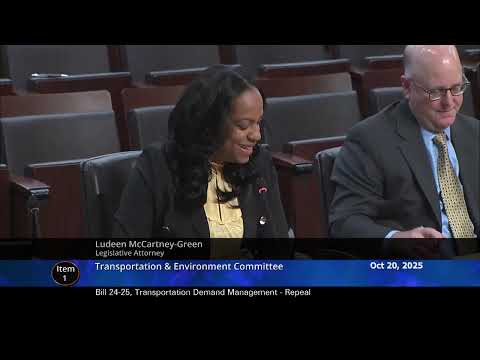
The Montgomery County Transportation and Environment Committee on Oct. 20 took up Bill 2-425, which would repeal Article 2 of Chapter 42A of the Montgomery County Code and remove the county’s current Transportation Demand Management employer requirements and fee structure.
The Montgomery County Transportation and Environment Committee on Oct. 20 took up Bill 2-425, which would repeal Article 2 of Chapter 42A of the Montgomery County Code and remove the county’s current Transportation Demand Management (TDM) employer requirements and fee structure. The committee held an extended work session on the measure but did not vote; members directed staff to continue negotiations on transition language, enforcement and how to treat existing development agreements.
The bill was introduced to address what sponsors and staff described as an overly complex program that has become misaligned with post-pandemic commuting patterns and duplicative of other transportation impact tools. “The repeal of the law does not diminish the purpose, the underlying purpose, of transportation demand management,” Councilmember Balcom said, adding that the county should continue pursuing non-auto driver mode share goals through other policies and partnerships.
Committee staff and department officials outlined three core concerns if the bill moves forward: the budget impact on current outreach and employer-assistance programs, how to handle enforcement and possible fines for noncompliant employers while repeal is pending, and what to do with existing Transportation Mitigation Agreements (TMAGs) and TDM plans recorded in land records.
County Department of Transportation officials said the fees targeted for repeal account for roughly 25% of the TDM program’s current budget and that removing the fees could reduce outreach contractor activity by an estimated 25%–50%, depending on fixed costs. “That’s about a 25% impact to our ability to meet the programming demands in those districts,” the DOT director said. Deputy Director Hailey Peckett said outreach contractors support marketing, employer and property-manager contacts, workshops and individualized employer assistance; staff reported roughly 250,000 outreach contacts and about 85,000 business contacts in FY25.
Planning staff highlighted an additional fiscal estimate: the Planning Board’s impact statement said the county could see a total net loss of about $6,000,000 over six years if the law is repealed, and recommended more analysis of racial equity, climate and economic impacts. Committee staff also noted that an Inspector General report found inadequate oversight of employer compliance, and that the County Executive has asked DOT to establish a schedule to begin levying fines in December for noncompliance under current law unless the matter is otherwise resolved.
Committee members generally endorsed the goal of reducing single-occupant vehicle trips but differed on whether the county should rely on mandates or on incentives, infrastructure investments and outreach. “The best way to ensure that residents and employees have an ease of travel is by making travel easier,” Chair Glass said, referencing investments such as bus rapid transit, Vision Zero street improvements and other capital projects.
On the status of development-related agreements, planning staff and legal advisors said TMAGs and some TDM plans are recorded instruments and three-party agreements that may have been used in lieu of built improvements at the time of development approval. Planning Division chief David Anspacher said modifying or terminating those agreements could trigger amendments to preliminary plans and updates to transportation impact studies, with associated costs to applicants. Committee members and staff proposed a process in which the department would notify known responsible parties and permit property owners to file termination requests; the Planning Board would retain discretion to deny termination where the agreement remains a condition of prior approvals.
Committee members asked DOT to coordinate with the County Executive on enforcement timing and recommended that the department defer issuing fines while the Council considers Bill 2-425. Several members expressed a preference for replacement, simplified legislation that would preserve the county’s ability to require TDM measures as part of development approval while removing or streamlining employer survey and fine-based compliance requirements; staff said the executive branch has a draft of a simpler bill but had not formally transmitted it to the Council.
The committee did not take a formal vote and instructed staff to continue interagency work, refine transition language for recorded agreements, and return with details on contract scopes, contractor reporting and the likely programmatic impacts of revenue loss. The item will return for further consideration; no committee recommendation or formal committee action was recorded at the session’s close.
Less critical details: committee staff noted about 140 TMAGs exist in records and roughly 13 newer development TDM plans; the code section cited on fines is section 42A-32 and the class C fine listed in the existing law is $50. The committee recessed its discussion to allow further review by planning, DOT and the Office of the County Attorney.