Get Full Government Meeting Transcripts, Videos, & Alerts Forever!
Get email alerts on the Jail Health topic
No spam. Unsubscribe anytime.
Jail health services outline CalAIM rollout, early billing returns and care strategies
Summary
Chief of Jail Health Services described CalAIM implementation, new billing for Medi‑Cal services, staffing and capacity, and care models that link people leaving custody to community treatment.
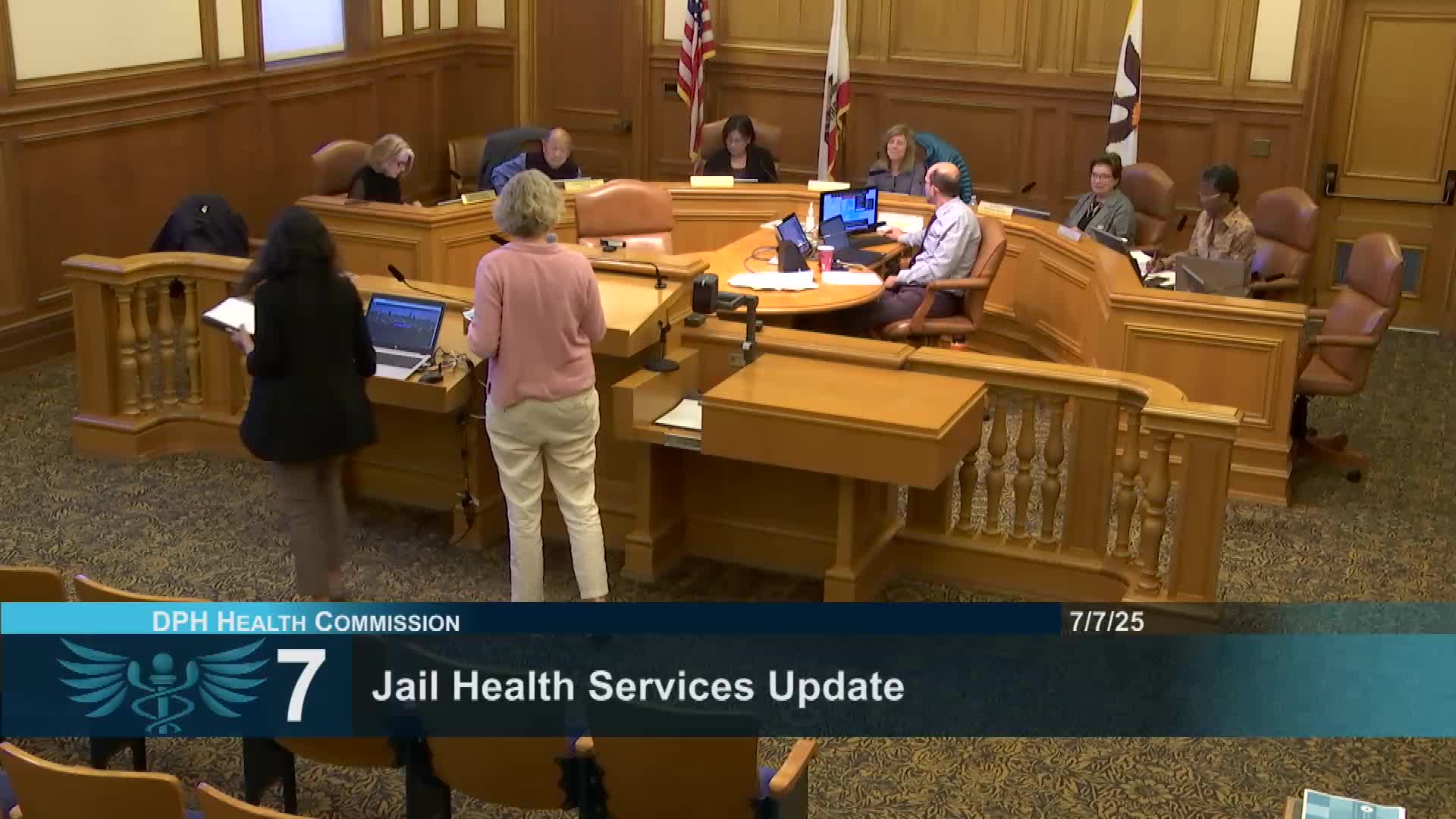
Dr. Michelle Pratt, chief of Jail Health Services, presented a detailed update to the San Francisco Health Commission on the section's work, the CalAIM justice‑involved implementation and early billing results since launch.
Pratt explained why DPH provides jail health care and cited legal precedent: "The only people who have a constitutional right to health care are people who are incarcerated," referencing Estelle v. Gamble and California Title 15 requirements that regulate jail health care. She described the department's mission to mitigate structural inequities and provide integrated clinical services in partnership with the Sheriff's Office.
Pratt said the jail population has risen since mid‑2023, with roughly 15,000 bookings last year representing about 10,000 unique patients and a current daily census near 1,300. She said the jail's median length of stay is about 2.71 days, stressing that many people are in custody only briefly, which complicates linkage to community care.
Jail Health Services provides primary and urgent care, dentistry, substance use disorder (SUD) treatment including medication for opioid use disorder (MOUD), psychiatric services, infection control (TB, mpox, STIs), and discharge planning. Pratt described the Stabilization, Treatment and Recovery (STAR) model and new care coordination under CalAIM that emphasize screening on intake, medication initiation when appropriate, and warm handoffs to community supports such as BEAM, Juno navigators, Ward 93 and Team Lilly at Zuckerberg San Francisco General Hospital.
Pratt said DPH received approximately $4.5 million in state startup funds to build an Epic redesign, eligibility and billing processes necessary for CalAIM billing and care coordination. The CalAIM justice‑involved program launched April 1; Pratt reported that initial claims activity suggests the department may realize more revenue than earlier projections. "We thought we would probably bring in about $7.6 million through our billing, but based on the first three months, it'll be closer to $11 million," she said, while noting claims were submitted and payments were still pending.
Pratt described budget and staffing figures shown in the presentation: a reported allocation of 165 positions with approximately 13.4 vacancies and, for the 2025–26 budget, a proposed 181 full‑time equivalents focused on jail health operations. She cautioned that because correctional health historically could not bill Medicaid, design and training for registration, claims and care transitions required extensive work.
Commissioners asked questions about quality oversight, external review options, accreditation, the impact of federal and state Medicaid changes on jail programs (including CalAIM waivers), and how the jail links short‑stay patients to community treatment. Pratt and DPH staff emphasized the importance of pipeline hiring (students, residents, social work trainees) and partnerships across DPH and community organizations to sustain care and staffing.
No formal commission action was taken on the report; commissioners praised the program and requested future updates on CalAIM billing performance and quality measures.