Get Full Government Meeting Transcripts, Videos, & Alerts Forever!
Get email alerts on the Continuing Education Cooperating Teachers topic
No spam. Unsubscribe anytime.
Minnesota Department of Education asks PELSB to waive CEU cap for mentor teachers in apprenticeships and residencies
Summary
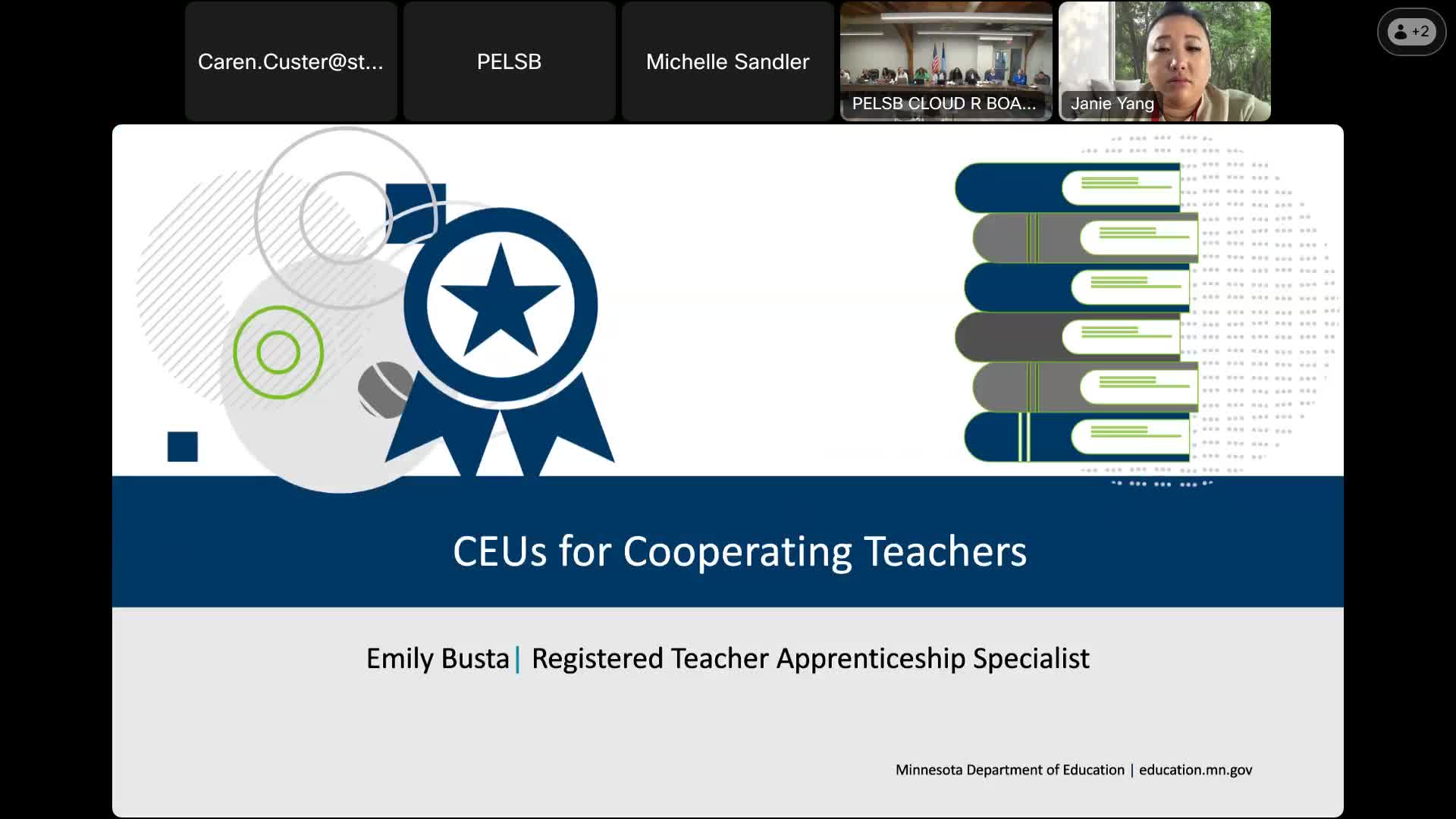
Emily Busta, Registered Teacher Apprenticeship Specialist at the Minnesota Department of Education, asked the Professional Educator Licensing and Standards Board on Oct. 10 to waive a rule that caps cooperating teachers at 30 clock hours per five‑year relicensure period so mentor teachers in apprenticeships and residencies can earn 24 CE hours per semester.
Emily Busta of the Minnesota Department of Education asked the Professional Educator Licensing and Standards Board on Oct. 10 to approve a resolution waiving a rule that limits cooperating teachers to 30 clock hours for supervising student teachers in a five‑year relicensure period. Busta asked that mentor teachers and "journey workers" who supervise residents or apprentices be allowed to collect 24 continuing education hours for each semester they host a resident or apprentice.
Busta said supervising an apprenticeship or year‑long residency involves substantially more mentoring, coaching, documentation and assessment than a traditional semester student‑teaching placement, and that the waiver would acknowledge and help recruit cooperating teachers. "When you are taking on an apprentice in an apprenticeship program or a resident in a residency program, you are actually taking on a lot more responsibility than when you're hosting a traditional student teacher," Busta said.
Board members asked how the change would be monitored and whether it would allow excessive or inappropriate clock‑hour claims. Ms. Shoemaker and others noted local relicensure committees will continue to review and approve the clock hours that teachers submit for relicensure. Dr. Bailey said relicensure committees serve as the local check to ensure balance and to confirm that proposed renewal activities meet licensure requirements.
Board members also raised whether a waiver would apply only to apprenticeships/residencies or more broadly. Dr. Bailey said a short‑term waiver of the cap would be the fastest way to accommodate apprenticeships and residencies while staff undertakes full rulemaking for renewal requirements; a waiver would remove the cap for all cooperating teachers in practice, and detailed distinctions (traditional student teachers vs. apprenticeships vs. residencies) could be developed in a later rulemaking process.
Board members expressed general support for the concept and asked staff to prepare formal resolution language for consideration at the next meeting. Staff also agreed to provide guidance materials to help local relicensure committees evaluate clock hours submitted under any waiver.