Get Full Government Meeting Transcripts, Videos, & Alerts Forever!
Get email alerts on the Workforce Development topic
No spam. Unsubscribe anytime.
Senate committee hears broad support for SB 143 'ban the box' extension to private employers
Summary
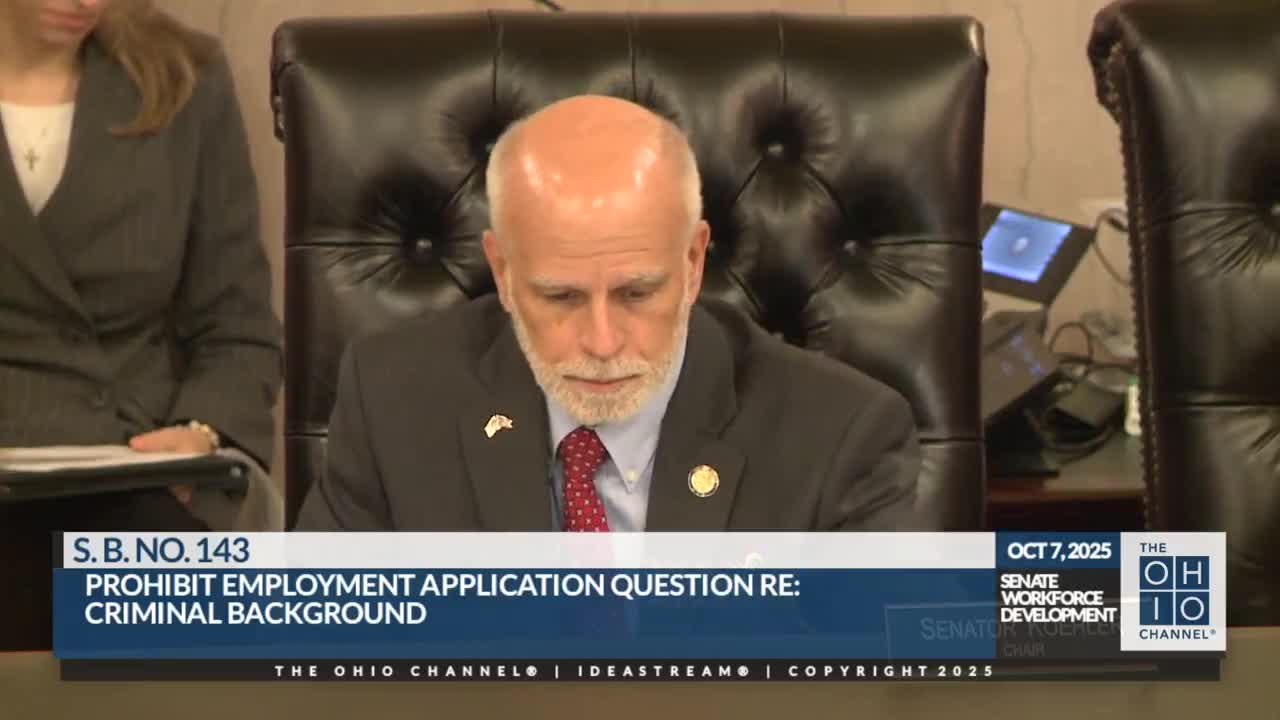
Ohio Senate committee members heard proponent testimony at a second hearing on SB 143, which would limit when private employers can ask about applicants' criminal histories.
Ohio Senate Workforce Development Committee members heard proponent testimony and asked clarifying questions at a second hearing on Senate Bill 143, legislation that would limit when private employers may ask about an applicant's criminal history.
Seth Van Horn, director of the Center for Employment Opportunities in Columbus, described CEO's reentry employment work and told the committee SB 143 "would allow people with a criminal history to apply to jobs in the private sector with the confidence that they will be evaluated based on the skills, experience and the person they are today." Van Horn said CEO serves "350 plus" job seekers with criminal records across Cincinnati, Cleveland and Columbus and reported an average wage at placement in Columbus of $17.74 per hour.
Glenn A. Harris, Director of Prevention at the Ohio Domestic Violence Network, described how survivors can carry criminal records tied to abuse and said SB 143 "ensures survivors could be considered on their skills first by removing criminal history questions from the initial job application." Harris told the committee the network's 76 member programs provided 127,000 survivors services in 2024 and framed stable employment as a protective factor against intimate partner violence.
Gary Daniels, legislative director for the ACLU of Ohio, and Michelle LaBrosse of the Ohio Justice and Policy Center both urged the committee to extend fair‑chance hiring to private employers, citing statewide data and cost outcomes. Daniels summarized the problem as twofold: "lots of Ohioans have a criminal record" and those people "often have a much more difficult time finding a job or even being considered for employment." LaBrosse said Ohio's prison spending exceeds $44,000 per person annually, that the average state prison stay is 2.73 years, and argued expanding hiring pathways would reduce collateral sanctions and benefit the economy.
Wendy Tarr, executive director of ARCH (Accompanying Returning Citizens with Hope), described employer use of automated screening tools that automatically exclude applicants and said removing the application question gives people an "opportunity to present themselves in person to share who they are today, not who they were years ago." Several witnesses noted the bill includes exemptions where background checks are legally required, such as childcare and law enforcement roles, and does not prevent employers from conducting background checks later in the hiring process.
Committee members asked multiple questions about how the bill would operate in practice. Senators asked about empirical data linking employment to recidivism; Van Horn offered to provide his organization's recidivism data. Members also raised concerns about modern screening tools, including internet searches and AI, and whether employers could effectively work around the application prohibition; witnesses said community engagement, employer convenings, and education are part of implementation efforts. Committee members also pressed for clarification on whether arrests not followed by conviction or participation in diversion programs could be considered; witnesses and counsel responded that the bill is intended to target the initial application stage and that later‑stage background checks and employer inquiries remain possible under the bill's framework, though some specifics remain fact‑dependent and were not resolved in the hearing.
Senators asked about appeals and enforcement; witnesses supported having an appeal process to protect applicants' rights. Seth Van Horn told the committee SB 143 would "prohibit employers with 5 or more employees from including questions about criminal background on initial employment applications" (as described in his testimony). The hearing record shows robust proponent testimony, several clarifying exchanges with committee members, and written testimony from David Stillwagen, Derek Clay, Reginald Battle and Ryan Burgess. The committee did not take a vote; the bill was listed as having a second hearing and the meeting was adjourned.
The record does not include committee amendments, a formal vote, or a staff report resolving the outstanding implementation questions discussed at the hearing.