Get Full Government Meeting Transcripts, Videos, & Alerts Forever!
Get email alerts on the Workforce Development topic
No spam. Unsubscribe anytime.
Proponent urges E‑Verify mandate for nonresidential construction in House Bill 246
Summary
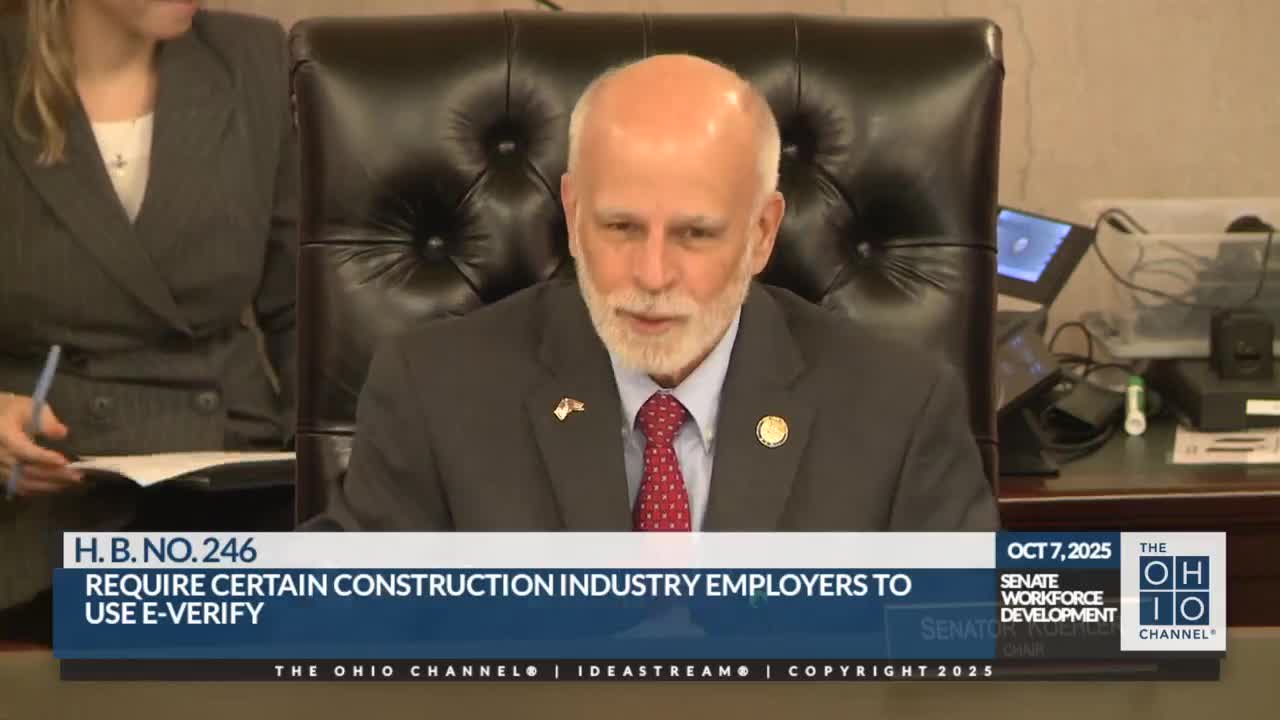
At a second hearing, a proponent for House Bill 246 told the Ohio Senate Workforce Development Committee the measure would require nonresidential construction employers to use E‑Verify to ensure workers are authorized to work in the U.S.; written testimony from several groups was submitted. The committee took no vote.
Chair Kaler and members of the Ohio Senate Workforce Development Committee heard proponent testimony on House Bill 246 at a second hearing.
Gabe Guiterini, chairman of the Ohio College Republican Federation, told the committee that HB 246 "helps guarantee that fairness by requiring non residential construction employers to use E Verify," and said the federal program "helps employers confirm work eligibility quickly and accurately." He framed the bill as intended to protect wages and opportunities for recent graduates and apprentices by ensuring jobs go to people legally authorized to work in the United States.
Guiterini said requiring E‑Verify would prevent contractors who "ignore" federal employment requirements from undercutting those who follow the law and would keep "wages fair" and safety standards higher. He asked the committee to consider the bill to ensure that apprenticeships and internships are not devalued by employers who hire off‑the‑books labor.
The clerk recorded written testimony submitted in support of HB 246 from Ralph King, Sherry Bridal with FAIR, and Emily Marino with the America First Policy Institute. No committee vote was taken during the hearing; the committee listed the item as a second hearing before moving to other business.
The hearing record does not include a motion, vote, or committee direction on implementation, compliance, penalties, certification requirements, or which specific employers would be covered beyond Guiterini's description of "non residential construction employers." Those details were not specified in the oral testimony included in the record.