Get Full Government Meeting Transcripts, Videos, & Alerts Forever!
Get email alerts on the School Levies 20 Mil Floor topic
No spam. Unsubscribe anytime.
Committee backs bill to limit school levy spikes, adds one-time glide path for some emergency levies
Summary
The House Ways and Means Committee advanced House Bill 129 after adopting an amendment that creates a temporary glide path allowing certain existing emergency levies to convert once to a "fixed sum" renewal and to receive rollback credits; another amendment seeking to permanently grandfather rollbacks was laid on the table.
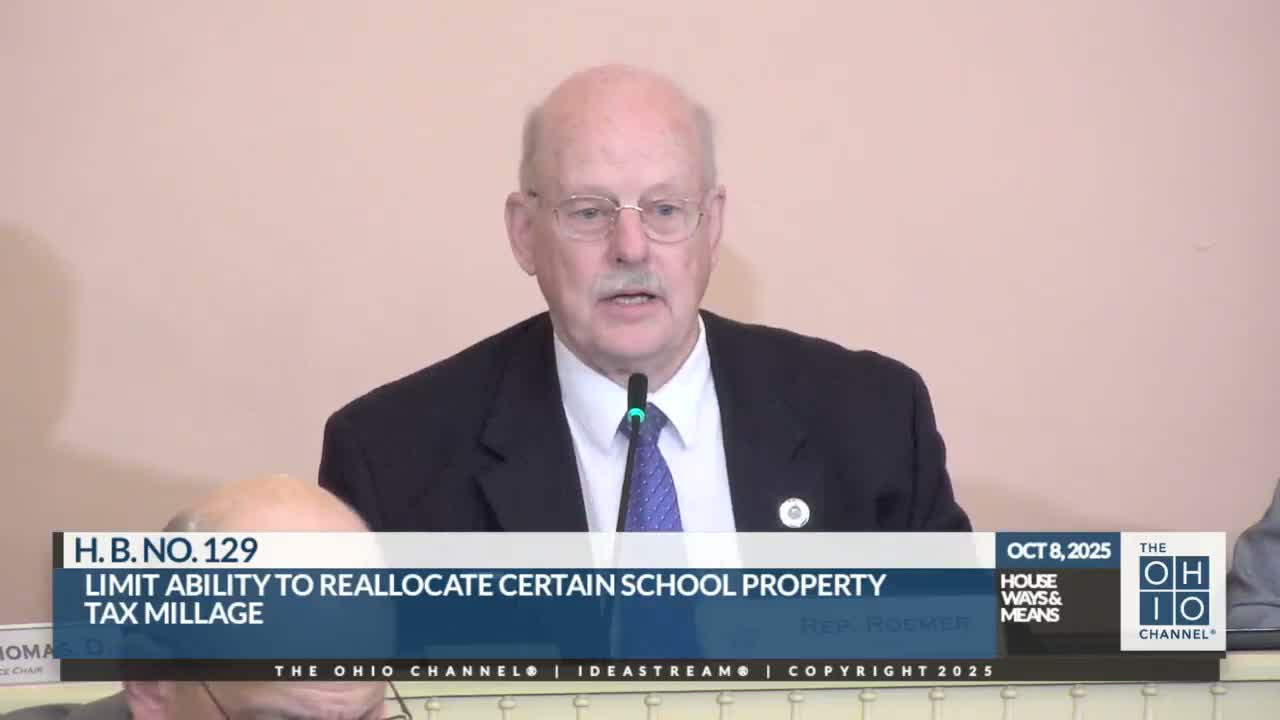
The House Ways and Means Committee on Oct. 30 advanced House Bill 129, a measure aimed at limiting sudden increases in school property-tax millage and clarifying how emergency, substitute and replacement levies are treated for the 20-mill floor and state rollback credits.
Why it matters: Supporters said the bill increases clarity and transparency for taxpayers and prevents repeated spikes in millage rates; opponents and some members urged additional time to vet how the changes affect joint vocational school districts and other local entities.
What the amendment does: Vice Chair Representative David Thomas explained an amendment (AM 136_0894) that creates a one-time option for districts that currently levy emergency levies to convert the existing revenue stream to a fixed-sum levy when their emergency levy is next renewed. That fixed-sum renewal would be eligible for the state rollbacks (the 10% and 2.5% owner-occupied credit) so taxpayers would not pay more than they currently do. The amendment also specifies that moved levies are not included in the 20-mill floor calculation until the district’s next revaluation cycle. Thomas said substitute levies were not eligible to be converted to fixed-sum renewals because their revenue varies year to year.
Testimony and concerns: Auditor Matt Nolan testified in support, saying clarity and consistency around levy types is needed and praising the bill’s transparency measures. Representative Jared Rogers raised concerns by note of joint vocational school districts that said the bill could negatively affect them over time and asked the committee to provide opportunities for affected districts to testify in future hearings.
Votes and amendments: The committee accepted the sponsor’s amendment AM 136_0894 without recorded objection. Representative Glassburn moved a separate amendment (01/193069181) that aimed to continue grandfathered rollback credits; Representative Thomas moved to lay that amendment on the table and the motion carried 9-4. The committee then voted to favorably report HB 129; the clerk recorded unanimous support and the bill was reported out for further action.
Next steps: Committee staff were asked to harmonize and engross accepted amendments and substitutes. Members said they expect further work as the bill proceeds to the full House; some members asked for follow-up hearings to allow joint vocational school districts and other affected entities to testify.
Ending: Proponents said HB 129 will clean up confusing levy law and make tax bills more transparent; some members and stakeholders asked for additional review to avoid unintended impacts on specialized school districts.