Get Full Government Meeting Transcripts, Videos, & Alerts Forever!
Get email alerts on the Property Tax Budget Commissions topic
No spam. Unsubscribe anytime.
House panel advances bill letting county budget commissions reduce levies; disabilities advocates warn of Medicaid risk
Summary
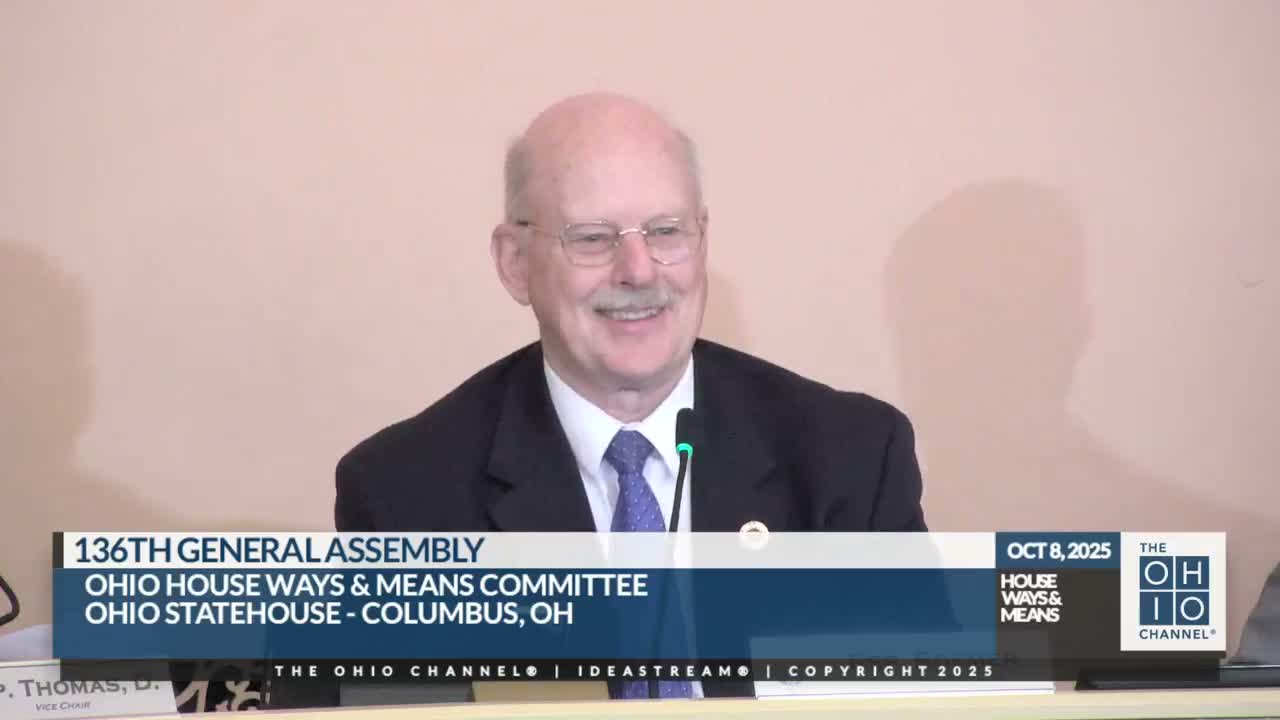
Chairman Jared Romer and members of the House Ways and Means Committee advanced House Bill 309 on Oct. 30 after accepting an amendment that lengthens the period during which a county budget commission cannot reduce a voter-approved levy.
Chairman Jared Romer and members of the House Ways and Means Committee advanced House Bill 309 on Oct. 30 after accepting an amendment that lengthens the period during which a county budget commission cannot reduce a voter-approved levy.
The bill, as amended, prevents county budget commissions from lowering a levy within five years of the levy’s first vote and adds definitions the sponsor said were recommended by the governor’s property tax study committee for "unnecessary collections" and "excessive collections." The committee accepted the sponsor’s amendment by unanimous consent before hearing testimony and later voted 13-0 to favorably report the bill to the full House.
Why it matters: County boards of developmental disabilities (DD) rely heavily on local property tax levies and also provide a significant portion of the state’s Medicaid match for DD waiver services. Witnesses told the committee that reductions in locally collected property tax revenue could destabilize services for people with intellectual and developmental disabilities and their families.
Adam Hermann, chief executive officer of the Ohio Association of County Boards of Developmental Disabilities, testified in opposition to HB 309 "as introduced" and said the amended substitute was an improvement because it adds definitions that could provide "a clear objective standard." Hermann told the committee county boards of DD "support more than 118,000 people with intellectual and developmental disabilities and their families" and that their services are "primarily funded through local property tax levies, which have been approved by voters and communities across the state." He said county boards provide roughly half of Ohio’s Medicaid match for DD services and gave state fiscal-year estimates: about $567,000,000 in FY 2025, $628,000,000 in FY 2026, and $691,000,000 in FY 2027.
Matt Nolan, Warren County auditor and president of the County Auditors Association, testified in support of the bill and said Warren County has for two decades reduced levies when local circumstances justified it. Nolan said giving three elected county officials (auditor, treasurer, prosecutor) explicit authority clarifies practices that counties like Warren already follow and would "cement going forward" the ability to ensure "only the tax revenue that is needed is brought in." He told the committee that budget commissions are elected officials and that, in his experience, the possibility of electoral accountability keeps commissioners from making decisions that would unduly harm popular local programs.
Committee debate and votes: Representative Thomas (vice chair) moved the primary amendment (AM 136_0885), explaining it implements the governor's study committee recommendations and extends the no-reduction period from one year to five and inserts definitions. That amendment was accepted by the committee without recorded objection. Representative Troy offered a separate compromise amendment to provide a one-year safe harbor for renewal levies; Representative Thomas moved to lay that amendment on the table. The motion to lay on the table carried on a roll call vote, 8 affirmative and 4 negative. The committee later voted 13-0 to favorably report the substitute bill.
Discussion vs. decision: The record shows legislative choices (accepted amendment; tabled a competing amendment) and testimony expressing both support and concern. Witnesses repeatedly asked that any commission decisions take into account county boards' statutory obligations, reserve balances and five-year cost projections; staff and members noted the availability of an appeal to the Board of Tax Appeals if parties disagree with budget-commission outcomes.
What’s next: The committee directed legislative-service staff to harmonize and engross accepted amendments and substitute language; the bill was reported favorably to the full House for further consideration.
Ending: Supporters said the bill clarifies inconsistent interpretations of budget-commission authority across counties; opponents asked for additional statutory guardrails so commission action would not jeopardize Medicaid-funded services. The committee record shows members expect future legislative or administrative refinements if the law is enacted and implementation produces disputes.