Get Full Government Meeting Transcripts, Videos, & Alerts Forever!
Get email alerts on the Emergency Communications topic
No spam. Unsubscribe anytime.
Douglas County 9-1-1 center outlines staffing, funding and radio-system upgrades
Summary
The Emergency Communications Center briefed commissioners on staffing, funding splits with partner cities, call volumes and upcoming technology and contract issues, including a Motorola service-contract renewal and new transcription/Spanish-translation tools.
Tony Foster, director of the Douglas County Emergency Communications Center, told the Board of County Commissioners at a Jan. 29 work session that the center is near full staffing and preparing for several major technology upgrades and contract renewals.
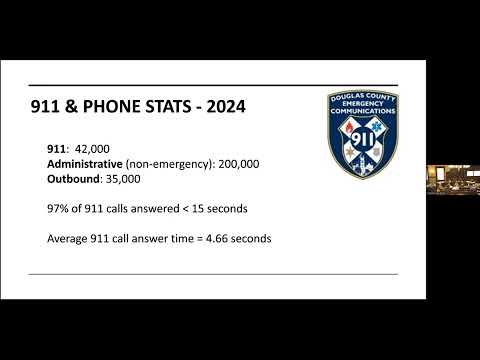
Foster said the center has budget authority for 35 positions and currently has 31 filled. "We currently have a budget authority for 35 positions," he said. He told commissioners the center operates on two 12-hour shifts and has four supervisors per shift, a quality-assurance supervisor and four training leads. Foster said the center’s average 9-1-1 call answer time in 2024 was 4.66 seconds and that 97% of calls were answered within 15 seconds.
The center is funded by a mix of local contributions and state 9-1-1 fees. "Currently 33.33% of the operating budget is provided by Douglas County, and then the City of Lawrence is at 60%. And then the City of Eudora is at 3.67 and Baldwin City at 3%," Foster said. He also noted the state 9-1-1 SAVES program provides about $620,000 a year that, by statute, can only be spent on 9-1-1 delivery technology and not personnel.
Why this matters: Commissioners were briefed on near-term cost pressures and technology needs that could affect county budgets and public-safety interoperability, including an approaching Motorola service-contract renewal for the county’s K6 P25 radio system.
Foster described the county’s radio infrastructure as a five-site P25 system provided through a statewide core. "We don't own our core. We are connected to the K6 system, which provides us this great radio system," he said, adding that the core is operated by KDOT and administered through the Kansas Highway Patrol. The ECC maintains about 1,600 radio subscribers, roughly 400 of which are Douglas County entities including sheriff and public works.
Staffing and retention: Foster said the center’s turnover is lower than typical for 9-1-1 centers. He estimated overall turnover around 15%, with most turnover occurring during training; he said trainee turnover can approach 50% but tenured staff are stable. In response to a question about starting pay, Foster said the new starting rate after a pay study is $24.23 per hour, which he said has helped hiring and retention.
Operations and service levels: Foster said the center handled about 42,009 9-1-1 calls in 2024, roughly 200,000 administrative/nonemergency calls and about 35,000 outbound calls. He referenced the National Emergency Number Association (NENA) standard that 95% of 9-1-1 calls be answered within 15 seconds and said the center exceeded that metric in 2024.
Planned tech and contract issues: Foster outlined near-term projects for 2025 and beyond: implementation of Motorola StorSmart transcription (including Spanish translation), planned emergency-fire-dispatch protocols, and a pending Motorola service-contract renewal in the coming years. "We anticipate that Motorola service contract going up substantially," Sarah (county staff) said during the exchange, noting the county has reallocated some funding and is coordinating with city partners on advisory-board discussions. Foster said some future system upgrades between now and 2031 are expected and that staff will seek state funding where possible.
Interagency dispatching and CAD integration: Foster described existing arrangements with neighboring Osage County, which currently requires telephone notification and separate dispatching. He said CAD-to-CAD integration and web services from the CAD vendor (Motorola) could eventually give better visibility into units in neighboring systems.
Alternate responses and partnerships: The ECC has recently added call transfers to the 988 crisis line and began dispatching a mobile response team this year, Foster said. He described 988 as the source of many mobile-response referrals but said some come directly or via law enforcement. "Most of them are coming from 988," he said.
Public-safety building move and staffing outreach: Foster said the ECC is planning a move to a new public-safety building and invited commissioners to tour the facility. He also thanked commissioners for support of pay adjustments that he said helped make telecommunicator work a career rather than a short-term job.
Ending: Foster and Deputy Director Sonia Bayaza offered to return for more detailed discussions and to provide additional staffing and turnover data to staff memos. No formal decisions or votes were taken during the work session; the presentation was for informational and planning purposes only.