Get Full Government Meeting Transcripts, Videos, & Alerts Forever!
Get email alerts on the Housing Manufactured Homes topic
No spam. Unsubscribe anytime.
Sumner council adopts manufactured-home park overlay to protect three mobile-home communities
Summary
The Sumner City Council on Oct. 20 adopted Ordinance 2936 creating a manufactured-home park overlay zone that limits redevelopment of three mobile-home parks and requires relocation planning and a compliance certificate; the measure passed 6-1.
Sumner City Council on Oct. 20 adopted Ordinance 2936, a zoning code amendment creating a manufactured-home park overlay zone covering three mobile-home parks in the city’s northeast quadrant. The council approved the ordinance by a 6-1 vote after staff described requirements for relocation planning and administrative compliance reviews.
The overlay is meant to preserve roughly 260 mobile-home sites in Sumner by making the sites eligible to remain as mobile-home parks and by adding procedures owners must follow if they seek to redevelop or close a park. "The ordinance before you tonight would amend our zoning code to adopt a mobile home park overlay zone," said Ryan Windisch, community economic development director, during the presentation to council.
The ordinance applies to three parks identified in staff materials: Crystal Springs, AA (referred to in staff materials as "AA"), and Somerville Estates. Rainier Manor, where individual lots are already owned by residents, is not included. Under the new rules, an owner who seeks to redevelop a designated park must either demonstrate the property’s continued viability as a park or convince a hearing examiner that it has "lost all beneficial use" and thus requires another use. If a park closure or sale would displace tenants, owners must prepare a relocation report and plan; the director must review compliance and grant a certificate of compliance before certain future permits or rezones can proceed. Owners may appeal the director’s compliance decision to the hearing examiner.
Windisch told council the overlay is intended to implement local policy work tied to the Washington State Growth Management Act and the city’s 2024 comprehensive-plan update, both of which call for measures to reduce displacement of vulnerable households as redevelopment occurs. He described required components of relocation plans as including notice to tenants, information about state resources and other available mobile-home sites, and steps to assist tenants who seek to organize to purchase a park.
Tenants and residents who testified at the meeting urged council to adopt protections and to consider the practical impacts of any sale or closure. Amanda Henderson, a Sumner resident who said she watched a lengthy planning-commission hearing on related matters, asked council members to view that three-hour record before future hearings: "I just ask that between now and the next public hearing ... please watch that 3 hour meeting," she said. Spencer Thomas, a resident of one park, said moving would be disruptive for many neighbors: "I hope they take the zoning and consider us there," he said.
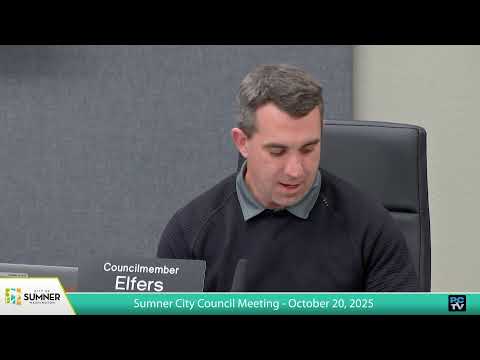
Council members questioned how the overlay would interact with existing state protections and with property owners’ responsibilities. Several members asked how a claim of "loss of beneficial use" would be evaluated and whether the ordinance could inadvertently encourage owners to defer maintenance to make redevelopment easier. "If a landlord just didn't... fix pipes or whatever, there's code," said Council member Elfers, noting that building- and health-code enforcement could provide resident recourse if conditions deteriorated.
Council member Kenna moved adoption of the ordinance; the motion was seconded and passed 6-1. Deputy Mayor Bowman moved adoption of the consent agenda earlier in the meeting; the consent agenda, which included several contracts and a resolution, passed unanimously.
Votes at a glance: - Ordinance 2936, Manufactured Home Park Overlay Zoning Code Text Amendment — Adopted (motion to adopt by Council member Kenna; seconded; vote tally: yes 6, no 1). Key provisions: applies to three mobile-home parks (Crystal Springs, AA, Somerville Estates); requires relocation report and certificate of compliance; allows owner to appeal to hearing examiner; tenants have state-level notice and right-of-refusal protections described by staff. - Consent agenda — Adopted unanimously (items read into record: Department of Ecology Subordination Agreement; Heritage Park Consulting Contract Amendment; Resolution No. 1733, Pierce Conservation District interlocal agreement; Titus Will utility easement; approval of minutes from Oct. 6 and Oct. 13, 2025). Motion to adopt consent agenda by Deputy Mayor Bowman; seconded and passed unanimously.
What the ordinance does and does not do: - It does not eliminate owners’ ability to seek redevelopment; owners may petition the hearing examiner to show that a park has lost beneficial use and that other uses are required. - It adds a local administrative step: the director must issue a certificate of compliance showing the required relocation work was completed before certain permits or rezones proceed. - It builds on state law protections staff described: Washington state law requires at least two years’ notice before certain park closures and provides tenants a right of first refusal to organize and make an offer when a park is sold, and it provides avenues for relocation assistance.
Next steps and context: City staff followed a multi-step schedule before the Oct. 20 vote: review by the planning commission, a public hearing in July, a study session with council, and community-development committee review. Windisch said the community-development committee recommended approval with edits to enforcement and zone applicability. Several council members thanked staff for working through concerns and changes before final action.
The ordinance is expected to affect the three named parks and to be one tool among state and local measures intended to limit displacement of lower-income residents as redevelopment occurs. The council did not specify further local funding changes tied to the overlay at the Oct. 20 meeting.