Get Full Government Meeting Transcripts, Videos, & Alerts Forever!
Get email alerts on the Election Law topic
No spam. Unsubscribe anytime.
Subcommittee hears bill to let Georgia Ethics Commission seek records from nonresidents in election probes; hearing-only, substitute to be filed
Summary
House Bill 414 would give the Georgia Ethics Commission expanded authority to pursue records and testimony from persons domiciled outside Georgia when those individuals participate in state elections; the subcommittee held a hearing and allowed a committee substitute to be introduced the next day.
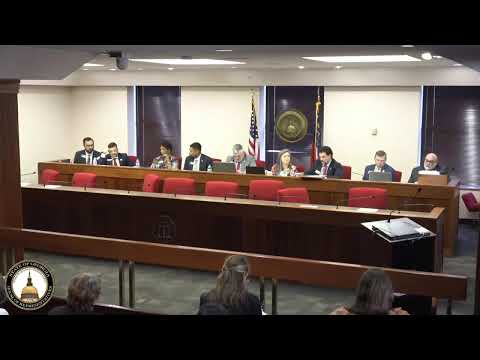
House Governmental Affairs Subcommittee members heard House Bill 414, a measure the sponsor described as extending the Georgia Ethics Commission’s enforcement reach to nonresidents who participate in Georgia elections, during a hearing that the panel designated as "hearing only."
Sponsor Chairman Jones said the bill is not intended to expand the commission’s authority inside Georgia but to provide “equal application of such authority” to persons domiciled outside the state who participate in Georgia election activity. Executive Director David Amati of the Georgia Ethics Commission told the panel that the change would let the commission seek records located out of state through superior-court orders when those records are “pertinent or necessary to further the investigation or enforcement action.”
The bill text, the sponsor said, defines nonresidence by reference to existing code section 9-10-90 and inserts language authorizing the ethics commission to request information from nonresidents (lines cited in the bill packet). The sponsor pointed the committee to provisions that (a) allow the commission to request records from nonresidents, (b) require a superior court to review the commission’s showing if the person refuses, and (c) designate venue in Fulton County for enforcement of out-of-state compliance in the statute’s draft (sponsor’s presentation, lines cited in the packet).
David Amati, executive director of the Georgia Ethics Commission, explained the enforcement gap the bill intends to close: “What we’ve seen … is groups that wanna run dark money ads attacking someone might step out of state to hire a vendor … our subpoenas currently don't have authority outside of the state. … This would give us the ability through superior court judge’s order to go out and get that … documents from the group in South Carolina or Florida, wherever they may be.”
Representative Bernal asked for an example of the targeted conduct; Amati described out-of-state vendors running unregistered electioneering and said the change would let the commission obtain evidence located out of state. Representative Oliver asked whether the bill incorporates existing long-arm statutory case law; the commission and the sponsor said the bill relies on the long-arm statute and existing subpoena authorities rather than creating an entirely new enforcement regime.
Chairman Jones said he would offer a technical amendment to correct a misspelling before the substitute is introduced. The committee agreed to treat the presentation as a hearing only for the subcommittee; the sponsor said he planned to introduce a committee substitute in full committee the following day and the subcommittee did not take a final vote on the measure.
The subcommittee preserved the opportunity for members to question the substitute at the full committee. No formal motion to pass or vote on final language was taken at the hearing.