Get Full Government Meeting Transcripts, Videos, & Alerts Forever!
Get email alerts on the Roads Infrastructure topic
No spam. Unsubscribe anytime.
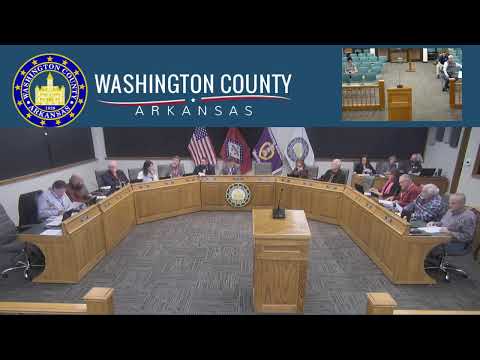
Quorum Court advances $395,000 road-fund fix after year of emergency maintenance
Summary
Washington County justices voted to send an ordinance to the full quorum court that would appropriate additional money from the road fund’s unappropriated reserves to cover cost overruns tied to an expanded pavement maintenance program this year.
Washington County Quorum Court members voted to forward an ordinance to the full court that would appropriate additional funds from the road fund’s unappropriated reserves to cover cost escalations in the county’s road maintenance program.
The ordinance was moved to the full court with a "due pass" recommendation after County Road Director Jeff Crowder and multiple justices described an unusually large, seasonal effort this year to stabilize pavement in the face of long-term deferred maintenance and rising material costs.
The vote matters because county staff said the road fund itself—not the county general fund—bears the shortfall. Comptroller Sherman told justices the department had budgeted for a reserve but that claims and costs rose, and the proposed transfer would draw down unappropriated reserves in the road fund to cover year-end expenses.
"We use what we call a PCI, which is a pavement condition index. That tells us how our roads are countywide," Director Jeff Crowder told the court. "The PCI is 0 to 100%. 0 being we're in trouble. A 100 being perfect. We've seen that a lot of our roads... were in the forties and fifties. Bringing these forties and fifties back up to 60, 70, 80... if we didn't, we were going to lose these roads."
Crowder explained the county carried out a large chip-seal program this year to stabilize pavement rather than allow it to degrade to the point of full replacement. He described both the operational constraints of a seasonal schedule and the impact of market conditions for fuel and materials.
"We did everything that was in our power to... stay within the money that was allotted. But unfortunately, in our department it's seasonal, so we only have a certain window that we can perform this work in," Crowder said.
Questions from justices focused on the largest contributors to the shortfall. Crowder said about $395,854 represented overspending in a variety of line items, including outsourcing slurry work for subdivision roads that lack curbs and gutters (a contract bid he cited at roughly $349,000) and costs tied to leased equipment. He said on-site production of rock using a leased crusher saved the county more than $1 million compared with buying rock off site, but breakdowns and additional leased equipment drove the lease line negative for the year.
Justice Koger asked whether the county had already spent the $395,854; Crowder responded, "Yes. We have." Comptroller Sherman and other justices clarified the funds proposed for the ordinance would come from the road fund’s unappropriated reserves, not the county general fund.
Crowder also described work on bridges, saying a bridge project at Cincinnati is scheduled to begin Jan. 6 and that the county’s bridge crew is performing in-house repairs where possible to save money. He said state inspection standards have grown stricter and the county is responding to a rising number of state write-ups.
Several justices praised road department staff for a large, historic effort this year. "We had an absolutely historical year in our road department," Judge Deakins said, adding that stabilizing roads this year will reduce long-term replacement costs.
The ordinance was moved to the full quorum court with a due-pass recommendation; county staff said the appropriation would be drawn from the road fund’s unappropriated reserves. The full-court vote is scheduled at the next quorum-court meeting.
Votes at this meeting: a motion to send the ordinance to full court passed on a voice roll with a second and no public opposition recorded.
Looking ahead, Crowder and justices said next year’s plans focus on continuing maintenance (about 65 miles targeted), edge repairs, shoulder work, and adding fog lines where feasible to improve safety and reduce future deterioration.