
Planning commission approves zoning change to allow micro distilleries in downtown business zones
Get AI-powered insights, summaries, and transcripts
Sign Up Free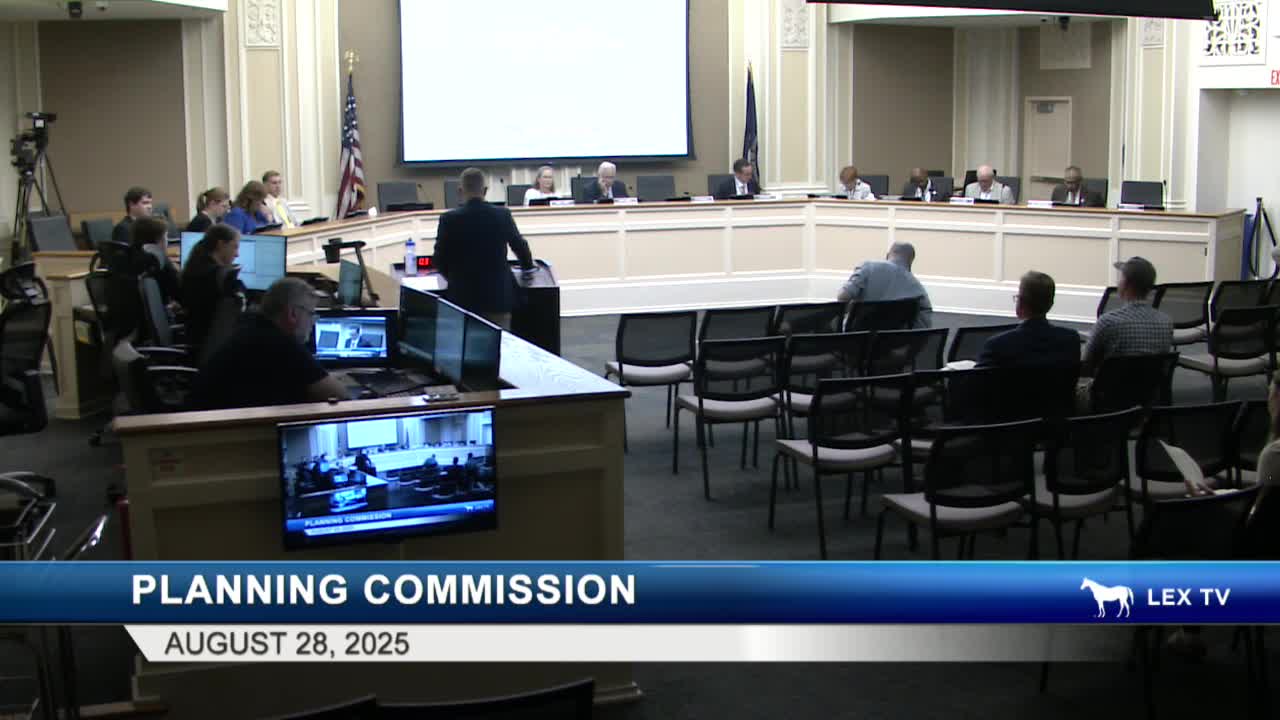
Summary
The Lexington-Fayette Planning Commission voted unanimously Aug. 28 to adopt staff'recommended text for ZOTA 25.6, allowing micro distilleries in downtown B2 zones with production limits and a conditional-use path for larger operations.
The Lexington-Fayette Urban County Government Planning Commission voted unanimously Aug. 28 to approve Zoning Ordinance Text Amendment (ZOTA) 25.6, adding micro distilleries to the downtown B2 zoning designation under conditions recommended by planning staff.
The amendment allows a micro distillery as a principal use in the downtown B2 zone limited to 10,000 gallons of production annually by right, and provides a conditional-use path for operations up to the micro distillery definition adopted by the city in June (50,000 gallons or less). Planning staff and applicant representatives told commissioners that state licensing would still be required for any distillery operation.
Planning staff senior planner Jeremy Young presented the amendment to the commission and described the change. Young said the city's ordinance defines a micro distillery as "a distillery that produces less than 50,000 gallons of distilled spirits," and explained staff's proposal to allow a 10,000-gallon principal use while reserving a conditional-use review for larger micro distilleries so businesses could expand without relocating.
John Woodall, counsel for applicant New Era Whiskey and Spirits, told the commission the applicant requested a 10,000-gallon allowance at the proposed downtown site. Woodall said the staff alternative would allow 10,000 gallons by right in B2 and provide a mechanism to seek approval if a business sought to expand toward the 50,000-gallon micro distillery threshold.
Public speakers and representatives of potential operators urged approval as a tool for downtown tourism and economic development. Brian Luffman, co-founder of Never Say Die Spirits, said including the B2B (downtown center business) designation in the change would support tourism and attract investment. Nick Nicholson, speaking from the private sector, compared downtown distillery projects in Louisville and said such facilities can generate significant visitor activity.
Several residents raised operational concerns. Casey Mather, representing the Northside Neighborhood Association, asked whether barrel storage or fermentation would pose fire, mold, or odor risks for historic downtown buildings; applicant representatives and staff responded that the typical downtown facilities would not conduct mashing/fermentation on-site and that only limited barrel storage was expected.
Commissioner Forrester moved to approve ZOTA 25.6 based on the staff alternative text; the motion was seconded and carried unanimously.
What the amendment changes: it formally adds micro distilleries to the downtown B2 classifications (B2, B2A and B2B) with a 10,000-gallon principal-use cap and a conditional-use path for operations up to the city's micro distillery definition (50,000 gallons). It leaves state licensing and alcohol-control requirements under Kentucky law in place.
The commission did not set additional conditions beyond the staff text; the item will proceed per the council/administrative steps required for text amendments and to applicants' subsequent state permitting processes.
Speakers who testified or were quoted during the discussion included planning staff, applicant representatives and members of the public; commissioners emphasized the amendment's potential for tourism and the need to balance that with protections for historic downtown structures.