
Planning Commission approves zoning change to allow small distilleries downtown with limits
Get AI-powered insights, summaries, and transcripts
Sign Up Free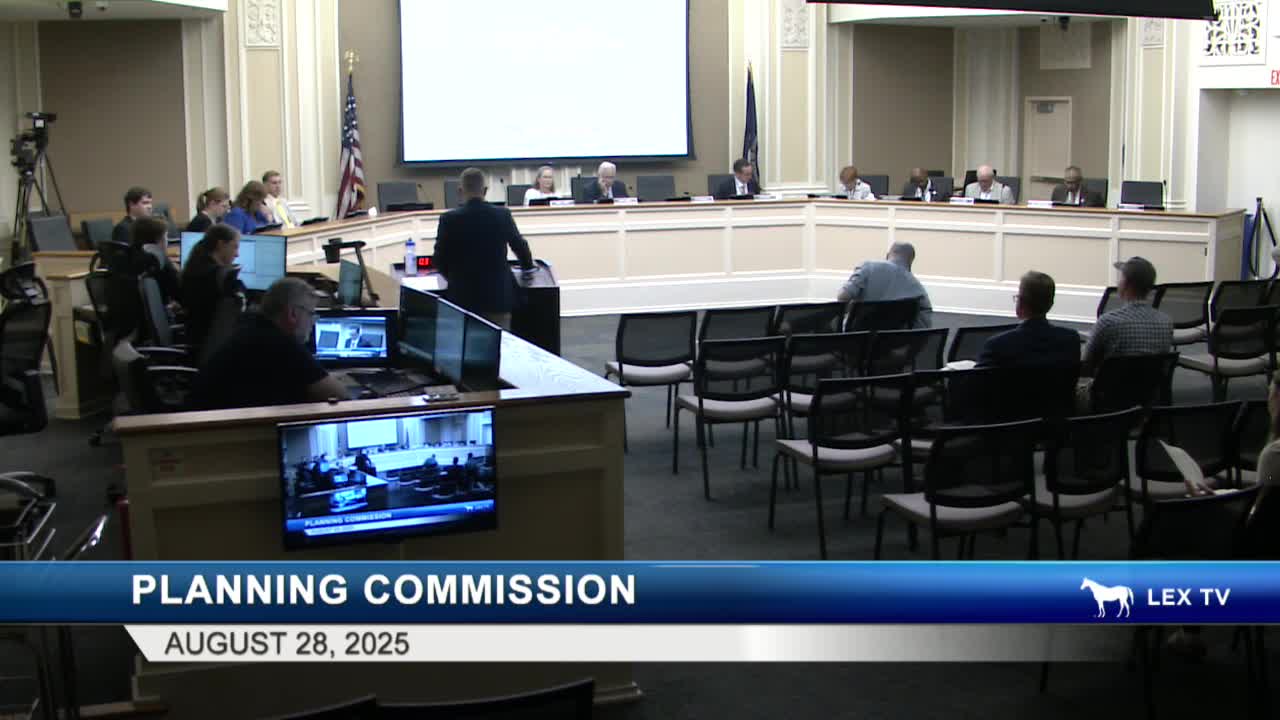
Summary
The Lexington-Fayette Urban County Planning Commission on Aug. 28 approved ZOTA 25.6, adding micro distilleries as a principal use in the B-2 downtown business zone with a 10,000-gallon-by-right cap and a conditional-use path up to the 50,000-gallon micro-distillery definition adopted by the city in June.
LEXINGTON, Ky. — The Lexington-Fayette Urban County Planning Commission on Wednesday approved a zoning text amendment to allow micro distilleries in the downtown B-2 business zone, adopting staff’s alternative text that sets a 10,000-gallon annual production cap by right and preserves a conditional-use pathway for larger micro distilleries up to the 50,000-gallon definition the city adopted in June.
The vote followed a staff presentation, remarks from applicant representatives and several members of the public who said downtown distilleries can support tourism. Commissioners moved the measure after a brief discussion and approved it unanimously.
Jeremy Young, planning staff, told the commission the proposed ZOTA 25.6 would add micro distilleries to Article 8.17 (the downtown business zone) and described the staff recommendation as a compromise: allow 10,000 gallons as a permitted principal use in the B-2 zone, but provide a conditional-use route for operations seeking production between 10,001 and 50,000 gallons. Young said staff’s alternative text was chosen after reviewing other cities’ ordinances and consulting industry advocates to balance downtown compatibility and business growth.
John Woodall, counsel for applicant New Era Whiskey and Spirits, said the applicant originally requested a 10,000-gallon allowance. Woodall noted the city’s June definition of “micro distillery” as 50,000 gallons or less and described the approved language as allowing a 10,000-gallon operation by right while enabling an applicant to seek Board of Adjustment approval if it later wanted to expand within the micro-distillery cap. “The state still has sway here in terms of what gets licensed,” Woodall said, adding that the applicant would need state licensing for any production.
Charlie Kirks, representing New Era Whiskey and Spirits, clarified operational plans: the applicant expects to bring in distilled spirits for on-site redistillation and tasting rather than fermenting or mashing grain on-site. “We won't be fermenting and mashing grain on-site… the distillation process brings no smell whatsoever,” Kirks said in response to commissioner questions.
Members of the public who spoke included Brian Luffman, co-founder of Never Say Die Spirits, who said similar downtown distilleries have strengthened tourism in Louisville and encouraged Lexington to build its own visitor-focused whiskey experiences. Casey Mather, speaking for the Northside Neighborhood Association, asked about barrel storage, fire safety and mold risk in historic buildings; applicant representatives and staff said only minimal on-site storage is expected and that many downtown operations focus on tasting-room experiences rather than large-scale production.
The commission’s staff report described the B-2 zone as downtown’s core (with sub-designations B-2A and B-2B for frame and center business districts) and noted the amendment’s goals are consistent with the comprehensive plan objectives to support mixed downtown uses, job creation and tourism. Staff recommended adopting the alternative text to standardize allowances across the B-2 subzones while preserving a path for expansion under conditional use review.
The Planning Commission also handled routine and procedural items at the meeting. The commission approved the July 10 meeting minutes unanimously; two applicants requested postponements: an economic development zone text amendment (PLN ZODA 24-6) was postponed to Nov. 20 at the applicant’s request, and a plan for Warratt/War Admiral Place (PLN MAR 2510) was postponed to Sept. 25 to allow coordination with staff. Commissioners set a work session for Sept. 18 with affordable-housing providers and related stakeholders to discuss impediments and next steps on housing affordability.
Actions at a glance: - Approval: ZOTA 25.6 (micro distilleries in B-2) adopted based on staff alternative text; motion passed unanimously. - Postponement: PLN ZODA 24-6 (economic development zone revisions) postponed to Nov. 20 at applicant request. - Postponement: PLN MAR 2510 (Warratt/War Admiral Place) postponed to Sept. 25 at applicant request. - Approval: July 10 meeting minutes approved unanimously.
Why it matters: The amendment opens downtown to small-scale distillery tasting rooms and visitor-oriented operations while including production limits and a conditional-use mechanism for larger micro-distilleries. Supporters said the change could help Lexington build a downtown tourism draw similar to distillery-led initiatives in other Kentucky cities; neighbors asked for clarity about storage and impacts in historic buildings.
The commission did not adopt special odor or fermentation restrictions beyond the production limits and the conditional-use review pathway; state licensing requirements for spirit production remain in effect and will govern separate regulatory approvals. Commissioners and staff said the change standardizes zoning across downtown subzones and preserves a route for businesses to seek expansion without relocating.
The Planning Commission will include the approved text as an amendment to the Lexington zoning ordinance; implementation steps and any required state approvals were not specified at the meeting.
Ending: The commission adjourned after setting the affordable-housing work session for Sept. 18 and confirming the next planning meetings and hearing dates for postponed items.