
Leon County adopts 2026 state and federal lobbying priorities, opposes major property tax rollbacks
Get AI-powered insights, summaries, and transcripts
Subscribe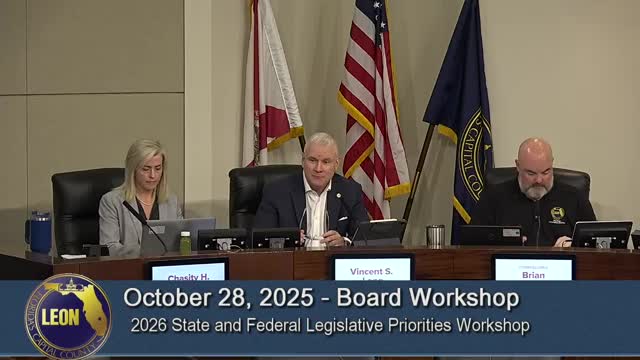
Summary
The Leon County Board of County Commissioners on Oct. 1 approved its 2026 state and federal legislative priorities, voting to oppose major property-tax reductions and to add items ranging from passenger-rail restoration to protections for election workers and a set of gun-safety measures.
The Leon County Board of County Commissioners on Oct. 1 approved its 2026 state and federal legislative priorities, voting to oppose proposed statewide property-tax rollbacks, back restoration of passenger rail in North Florida, seek protections for election workers' personal information and add a set of gun-safety measures to the county's lobby agenda.
The action followed presentations from county staff and the county's state and federal lobbying teams, which briefed commissioners on the range of ballot and statutory changes under consideration in Tallahassee and in Washington, D.C., and on the county's approach to seeking line-item state and federal funding for infrastructure and capital projects.
Why it matters: Commissioners and county staff said the proposals circulating at the state level — several drafted as constitutional amendments or statutory changes — could sharply reduce local ad valorem revenue and force deep cuts to county programs unless offset by alternative revenue sources or state compensation.
County staff and outside lobbyists outlined likely legislative timelines for the coming months and identified priorities the board asked them to pursue, including targeted appropriation requests. The board approved the full list of priorities individually after discussion and amendments.
Supervisor of Elections concerns and records exemption
The board began the meeting with a brief presentation by the Leon County Supervisor of Elections, who asked commissioners for help at the state level in limiting public access to poll-worker personal information. The supervisor said changes to state driver's-license numbering and greater use of driver's-license information in election processes have created public confusion and increased calls to the office. He urged “any help we could get” to push for exemptions that would prevent release of poll workers’ names and phone numbers under public-records requests, saying release of that data had led in at least one case to disruptive calls at polling places.
Ken Morris, who provided the board's property tax update, said the suite of proposals under consideration in the Florida House would not affect school funding but could include language protecting law-enforcement budgets from reductions tied to property-tax changes. Morris warned that language could be broad and raise definitional questions — for example whether jails operated under a sheriff's contract are included in “law enforcement” — and said the county's early fiscal modeling shows large revenue impacts from several proposals.
Projected fiscal impacts cited to the board by staff included: an immediate elimination of homestead property tax that county staff estimated could reduce county ad valorem revenue by about $85 million (roughly 40% of current collections); a phased 10-year elimination producing steeper reductions in the first three years (estimated drops of about $40 million, $23 million and $11 million in years one through three in staff modeling); and proposals that would create new targeted exemptions (for example, a 25% additional homestead exemption estimated at about $20 million to $25 million in county impact for fiscal year 2028). Morris said those figures are estimates produced with the property appraiser and described some values as “high-end” because of incomplete title data.
Board debate and final posture
Commissioners split on strategy. Several members — including Commissioner Maddox and Commissioner Cummings — urged a firm, oppositional posture to any proposal that would remove local ad-valorem authority or sharply cut county revenue, saying the changes would undermine local services such as parks, libraries, planning, road maintenance and human services. Commissioner Minor and others emphasized the need to provide detailed, real-world examples of what revenue losses would mean for county services so the county’s delegation and legislative leaders can understand the local impact.
Commissioner O'Keefe argued for a pragmatic approach: acknowledging the political reality in Tallahassee and trying to secure a seat at the table to shape any reforms so the county can limit harm. The board ultimately approved the county’s recommended state legislative priorities, including a policy position opposing property-tax changes that would substantially diminish county revenues.
Other priorities and line-item funding
The board also approved a slate of recurring and new priorities, including:
- Support for restoration of passenger rail service in North Florida and legislation to allow Florida to join the Southern Rail Commission (board members noted HB 53 has been filed in the House). - Continued advocacy for flexible use of state housing funds for local affordable-housing needs and support for proposed changes to SHIP and other state programs. - Support for the Florida Association of Counties platform and opposition to unfunded state mandates and preemption of local authority. - A request that the state exempt poll workers’ personal data from public-records release (the supervisors' request noted concerns about threats and targeted misinformation at polling sites; the board added the item to its priorities).
The board also adopted the county's list of state and federal appropriation requests; staff said they prioritized projects that are shovel-ready, have local matching funds and align with anticipated legislative funding buckets such as water quality, transportation and economic development. Lobbyists on the call said they will coordinate closely with the county's delegation to find champions to sponsor line items.
Gun-safety measures added to agenda
During a later discussion, Commissioner O'Keefe moved to add four specific gun-safety measures to the county's state and federal lobbying priorities: universal background checks, closing private-sale “gun show” loopholes, safe-storage requirements, an extreme-risk protection order (red-flag) policy, and a requirement to report lost or stolen firearms. The motion was seconded and passed on a 5–2 vote; Commissioners Caban and Chairman Welch voted no. Commissioners who supported the addition said they see the measures as public-safety proposals that merit advocacy; opponents warned such national issues are politically divisive and questioned whether adding them to the county’s lobbying agenda will help the county obtain other priorities.
Manufactured-home park protections and mobile-home resident option
The board approved a state legislative priority to support resident opportunity to purchase manufactured/mobile-home parks when ownership changes, after clarifying the item would not promote purchase of new mobile homes but would create a narrow right-of-first-refusal mechanism to preserve existing residents’ housing where corporate buyers raise lot rents. The priority passed 6–1.
Votes at a glance
- Adopt state legislative priorities (individual items taken separately): adopted (voice votes/roll calls recorded during the meeting). Key outcomes: opposition to property-tax reform position approved; affordable housing priority approved; protection of poll-worker records approved. - Adopt federal legislative priorities and appropriations list: adopted unanimously. - Add four gun-safety measures to county lobbying priorities (universal background checks; close private-sale loopholes; safe-storage; extreme-risk orders; report lost/stolen guns): adopted 5–2 (Nay: Commissioner Caban; Chairman Welch). - Support manufactured/mobile-home resident purchase-right measures: adopted 6–1 (Nay: Commissioner Caban).
What county staff and lobbyists said next
Nikki Hatch, county legislative staff, told commissioners the county will continue coordinating with its delegation and the Southern Group lobbying team to refine projects for line-item requests and to monitor committee work in Tallahassee and Congress. Chase Kroll, who leads the county's federal lobbying team, rehearsed likely federal appropriations timing given the then-ongoing federal funding disputes and encouraged a coordinated push in January when Congress returns to appropriations work.
Where this goes from here
County staff and the lobbying teams will carry the board's directions into the upcoming legislative session, seek champions for earmarks and state line items, and return with progress updates. Commissioners asked staff to develop concrete, local impact analyses showing what loss scenarios (for example, an $85 million ad-valorem reduction) would mean for county services and staffing so those figures can be presented to the county delegation and in public communications.
Ending
The board closed the workshop after agreeing to the priorities and to ongoing coordination with staff and the county's state and federal lobbying teams. "We are recommending the board's approval of the proposed 2026 state and federal legislative priorities," county staff told commissioners during the meeting. "We are here to help you in any way we can," a supervisor of elections told the board when asking for support on the public-records exemption.
Votes and formal motions recorded at the meeting are summarized above; staff will return with follow-up materials and formal draft appropriation requests as the session approaches.