
Superintendent presents academic update showing mixed gains, persistent city–county gaps
Get AI-powered insights, summaries, and transcripts
Subscribe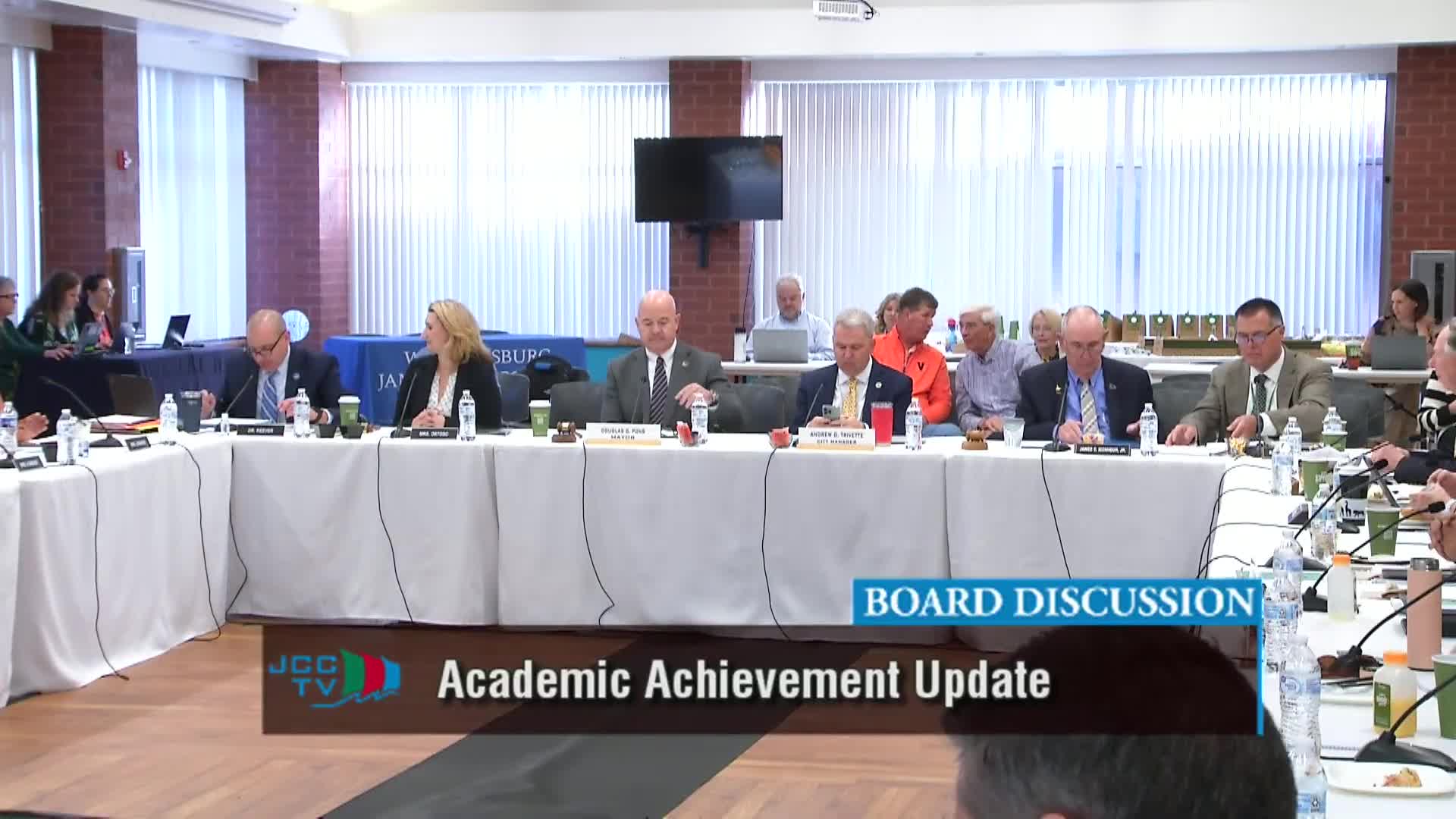
Summary
WJCC leaders presented 2024–25 academic performance data showing overall pass rates above the state average in tested subjects but persistent enrollment- and locality-based disparities. District leaders outlined curriculum adoptions, targeted supports and family engagement events to accelerate progress.
Superintendent Dr. Keever and WJCC staff presented an academic achievement update during the joint meeting, reporting combined 2024–25 pass rates and outlining strategies to accelerate student learning.
The division reported these combined pass rates for the 2024–25 school year: 78% English reading, 80% English writing (grade 10), 77% math, 77% science and 74% history/social sciences. Presenters said those divisionwide figures place the district above the state average in all five tested subjects.
Division leaders described growth measures under the new Virginia accountability model and said 88% of students in grades 4–8 demonstrated growth in reading; similar growth measures in math and other indicators contributed to internal projections that, while unofficial, showed approximately one distinguished school, 14 “on track” schools and one “off track” school pending official state designations.
Officials discussed changes to testing and graduation pathways. The division noted the state moved from the PALS assessment to VALS for early literacy screenings, and explained a state alternative pathway (LAVC2) that allowed about 1,200 high‑school students to earn verified credit in social studies without taking the SOL; those students were awarded verified credit at a reported 91.2% rate. Presenters cautioned that social‑studies SOL pass-rate comparisons exclude students who earned verified credit through alternative pathways.
WJCC leaders said they believe all schools will receive full accreditation under the Virginia Standards of Accreditation, based on an internal review; they noted the division has not yet received official designations from the Virginia Department of Education.
The presentation stressed targeted instructional investments and tools: Benchmark Advance (elementary literacy, entering its second year of implementation), HMH Into Literature for grades 6–12, Kiddom for elementary math, and adaptive tools IXL and Lexia for progress monitoring. The division said it has reading and math specialists, interventionists, trained tutors and regular common assessments to track progress.
Division officials highlighted equity concerns and a continuing gap between city and county student performance. On several subjects, James City County students outperformed students who reside in the City of Williamsburg. Presenters supplied locality-level figures: the division cited a total enrollment snapshot of 11,233 students; about 10,200 students reside in James City County and about 1,150 in the City of Williamsburg. The transient (mobility) rate differed substantially: presenters reported a city transient rate of 21.5% (233 students) and a county rate of 11% (1,117 students). Presenters said homelessness and housing instability had large associated declines in reading pass rates, citing McKinney‑Vento definitions and research shared by William & Mary and Project HOPE.
Officials also identified differences in student groups: the city had a higher share of economically disadvantaged students (54.4% in the city versus 35.8% in the county) and a higher share of English learners (22.2% in the city versus 8% in the county). Presenters said one-third of English learners are at levels 1 or 2 and require the most direct academic support; the district named specific schools with higher numbers of level‑1/2 English learners.
Board members and supervisors asked questions about staff development, teacher workload and the financial implications of curriculum changes. Supervisor Miss Larson asked whether staff development burdens and frequent administrative changes might be affecting classroom instruction; division leaders acknowledged teacher fatigue and said the division is evaluating additional personnel supports, administrative feedback cycles and strategies for behavior supports that can free teachers to instruct.
Larson also asked about the financial impact of changing assessment and curriculum tools. WJCC staff said they would supply further budget information; they said some purchases had been covered with year‑end funds and that the division is seeking to build a textbook reserve to manage future curriculum changes.
The presentation included family engagement steps: two family academies (a literacy night scheduled for Oct. 22 at the Williamsburg Regional Library at 5:30 p.m., and a math night later in the school year), LEAP parent nights for multilingual families, SEAC events for families of students with disabilities, and a planned “reading revolution” event at elementary schools next week.
Officials concluded by saying data will drive targeted interventions — high‑quality tier‑1 instruction, progress monitoring with interventions and ongoing professional learning — and promised additional detail in a forthcoming “portrait of a graduate” presentation in early November.
No formal board action was taken on the presentation; several elected officials praised staff work and the newly adopted contract, saying the contract should reduce uncertainty and allow the division to focus on instruction.